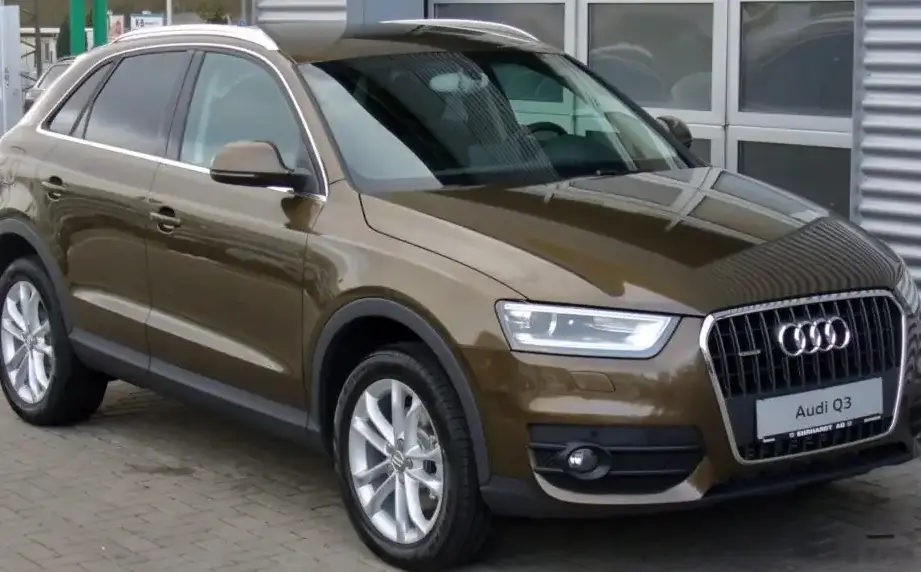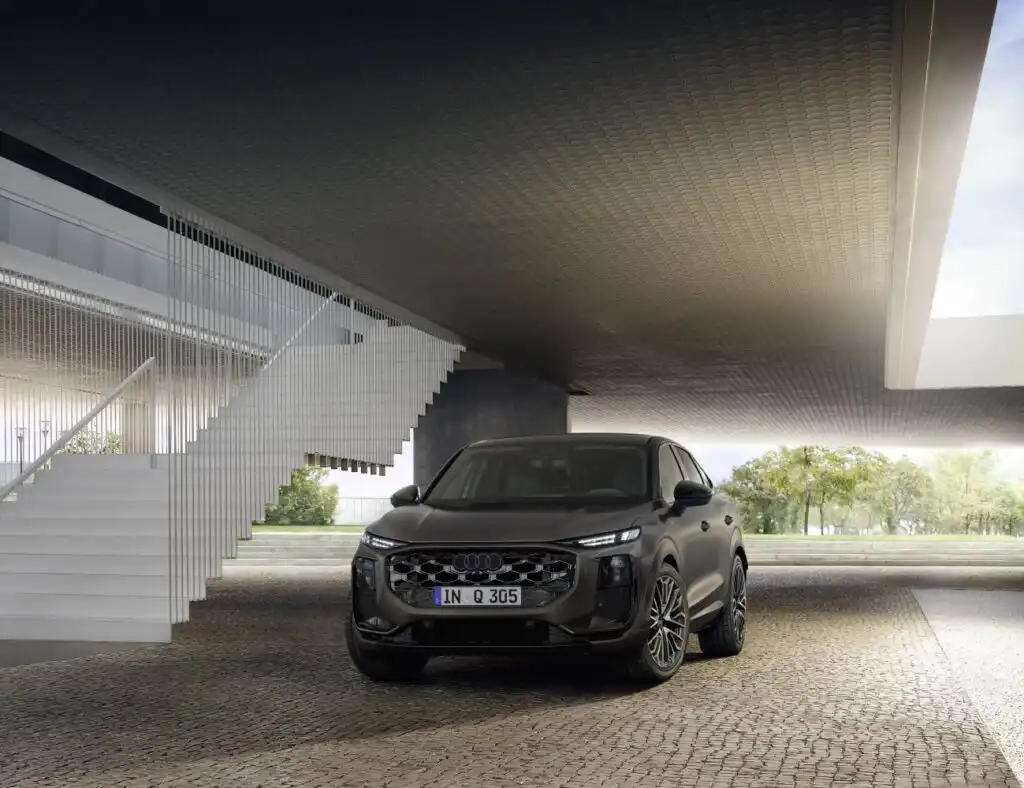
The Audi Q3 III Sportback 1.5 TFSI, launched in August 2025, represents a key entry point into the third generation of Audi’s compact SUV coupe range (FJ chassis). Positioned as a mid-range offering within the Sportback lineup, it combines a turbocharged gasoline engine with mild hybrid technology and Audi’s S tronic dual-clutch transmission. This variant aims to balance fuel efficiency, performance, and affordability, appealing to buyers seeking a stylish and technologically advanced compact SUV. The Sportback body style distinguishes itself from the standard Q3 with a sloping roofline, enhancing its sporty aesthetic.
Technical Specifications
| Brand | Audi |
| Model | Q3 |
| Generation | Q3 III Sportback (FJ) |
| Type (Engine) | 1.5 TFSI (150 Hp) Mild Hybrid S tronic |
| Start of production | August, 2025 |
| Powertrain Architecture | MHEV (Mild Hybrid Electric Vehicle) |
| Body type | Coupe, SUV |
| Seats | 5 |
| Doors | 5 |
| Combined fuel consumption (WLTP) | 6.1-6.7 l/100 km (38.6 – 35.1 US mpg, 46.3 – 42.2 UK mpg, 16.4 – 14.9 km/l) |
| CO2 emissions (WLTP) | 138-153 g/km |
| Fuel Type | Petrol (Gasoline) |
| Acceleration 0 – 100 km/h | 9.1 sec |
| Acceleration 0 – 62 mph | 9.1 sec |
| Acceleration 0 – 60 mph | 8.6 sec |
| Maximum speed | 207 km/h (128.62 mph) |
| Emission standard | Euro 6e |
| Weight-to-power ratio | 10.4 kg/Hp, 96.2 Hp/tonne |
| Weight-to-torque ratio | 6.2 kg/Nm, 160.3 Nm/tonne |
| Battery voltage | 48 V |
| Battery technology | Lithium-ion (Li-Ion) |
| Power | 150 Hp @ 5000-6000 rpm |
| Power per litre | 100.1 Hp/l |
| Torque | 250 Nm @ 1500-3500 rpm (184.39 lb.-ft. @ 1500-3500 rpm) |
| Engine layout | Front, Transverse |
| Engine displacement | 1498 cm3 (91.41 cu. in.) |
| Number of cylinders | 4 |
| Engine configuration | Inline |
| Cylinder Bore | 74.5 mm (2.93 in.) |
| Piston Stroke | 85.9 mm (3.38 in.) |
| Compression ratio | 12:1 |
| Number of valves per cylinder | 4 |
| Fuel injection system | Direct injection |
| Engine aspiration | Turbocharger, Intercooler |
| Valvetrain | DOHC |
| Engine oil capacity | 4.3 l (4.54 US qt | 3.78 UK qt) |
| Coolant | 10.5 l (11.1 US qt | 9.24 UK qt) |
| Kerb Weight | 1560 kg (3439.21 lbs.) |
| Max. weight | 2050-2170 kg (4519.48 – 4784.03 lbs.) |
| Max load | 490-610 kg (1080.27 – 1344.82 lbs.) |
| Trunk (boot) space – minimum | 488 l (17.23 cu. ft.) |
| Trunk (boot) space – maximum | 1289 l (45.52 cu. ft.) |
| Fuel tank capacity | 55 l (14.53 US gal | 12.1 UK gal) |
| Max. roof load | 75 kg (165.35 lbs.) |
| Permitted trailer load with brakes (8%) | 2000 kg (4409.25 lbs.) |
| Permitted trailer load with brakes (12%) | 1800 kg (3968.32 lbs.) |
| Permitted trailer load without brakes | 750 kg (1653.47 lbs.) |
| Permitted towbar download | 90 kg (198.42 lbs.) |
| Length | 4531 mm (178.39 in.) |
| Width | 1859 mm (73.19 in.) |
| Width including mirrors | 2087 mm (82.17 in.) |
| Height | 1559 mm (61.38 in.) |
| Wheelbase | 2681 mm (105.55 in.) |
| Front track | 1588 mm (62.52 in.) |
| Rear (Back) track | 1581 mm (62.24 in.) |
| Front overhang | 940 mm (37.01 in.) |
| Rear overhang | 910 mm (35.83 in.) |
| Drag coefficient (Cd) | 0.32 |
| Minimum turning circle (turning diameter) | 11.8 m (38.71 ft.) |
| Approach angle | 17° |
| Departure angle | 25° |
| Drivetrain Architecture | ICE and electric motor drive the front wheels in mixed mode. |
| Drive wheel | Front wheel drive |
| Number of gears and type of gearbox | 7 gears, automatic transmission S tronic |
| Front suspension | Independent, type McPherson with coil spring and anti-roll bar |
| Rear suspension | Independent multi-link spring suspension with stabilizer |
| Front brakes | Ventilated discs |
| Assisting systems | ABS (Anti-lock braking system) |
| Steering type | Steering rack and pinion |
| Power steering | Electric Steering |
| Tires size | 235/55 R8 |
| Wheel rims size | 8J x 18 |
Powertrain & Engine Architecture
The Q3 Sportback 1.5 TFSI utilizes the Volkswagen Group’s EA211 family of engines, specifically the 1.5-liter turbocharged inline-four cylinder unit. This engine, designated as a mild hybrid, incorporates a 48V electrical system and a belt starter generator (BSG). The BSG allows for extended start-stop functionality, regenerative braking, and a limited amount of electric assistance during acceleration. The engine produces 150 horsepower at 5000-6000 rpm and 250 Nm (184 lb-ft) of torque between 1500-3500 rpm. It features direct fuel injection and a variable valve timing system (DOHC) to optimize efficiency and performance. The engine’s turbocharger, coupled with an intercooler, helps to mitigate turbo lag and maintain consistent power delivery. The S tronic 7-speed dual-clutch transmission provides quick and smooth gear changes, contributing to a more engaging driving experience.
Driving Characteristics
The 1.5 TFSI engine, paired with the S tronic transmission, delivers adequate performance for everyday driving. Acceleration from 0 to 60 mph takes approximately 8.6 seconds, and the car reaches a top speed of 128.62 mph. While not a particularly sporty configuration, the engine provides sufficient power for highway merging and overtaking. The S tronic transmission’s quick shifts help to maximize the available power. Compared to higher-output Q3 variants, such as the 45 TFSI with its 2.0-liter engine, the 1.5 TFSI feels less responsive. However, it offers a more fuel-efficient and refined driving experience. The gear ratios are tuned for a balance between acceleration and fuel economy, prioritizing comfort over outright performance.
Equipment & Trim Levels
The Q3 Sportback 1.5 TFSI typically comes standard with features such as Audi’s MMI infotainment system with a touchscreen display, automatic climate control, LED headlights, and a suite of driver-assistance systems including lane departure warning and forward collision warning. Interior upholstery is generally cloth, with leather options available as upgrades. Common optional extras include a panoramic sunroof, upgraded sound system, and adaptive cruise control. Trim levels often build upon the standard equipment, adding features like heated seats, power-adjustable seats, and more premium interior materials.
Chassis & Braking
The Q3 Sportback utilizes a MacPherson strut front suspension and a multi-link rear suspension, providing a comfortable and controlled ride. The suspension is tuned to prioritize comfort, but still offers decent handling characteristics. The front brakes are ventilated discs, while the rear brakes are typically solid discs. ABS (Anti-lock Braking System) is standard, along with electronic stability control. The chassis is designed to provide a balance between agility and stability, making it suitable for both city driving and highway cruising.
Market Reception & Comparison
The Audi Q3 Sportback 1.5 TFSI has been generally well-received by automotive critics, praised for its stylish design, comfortable interior, and fuel efficiency. However, some reviewers have noted that the 1.5-liter engine can feel underpowered in certain situations, particularly when fully loaded or driving uphill. Compared to other trims in the Q3 lineup, the 1.5 TFSI offers a more affordable entry point, but sacrifices some performance. Its fuel economy is competitive within its class, typically achieving between 35.1 and 38.6 US mpg on the combined cycle. Reliability has been generally good, with few reported issues specific to the 1.5 TFSI engine and S tronic transmission.
Legacy
The 1.5 TFSI engine, combined with the S tronic transmission, has proven to be a reliable and efficient powertrain in various Volkswagen Group vehicles. While it’s still relatively early in its lifecycle, the engine has demonstrated good long-term durability. In the used car market, the Q3 Sportback 1.5 TFSI is expected to hold its value reasonably well, appealing to buyers seeking a stylish and well-equipped compact SUV with a good balance of performance and fuel economy. The mild hybrid technology adds a layer of future-proofing, as regulations regarding emissions become increasingly stringent.