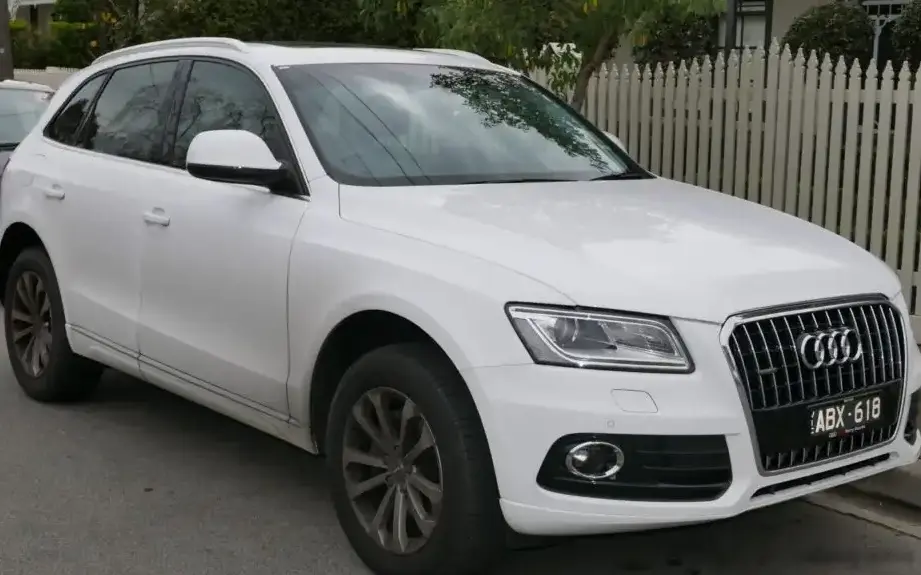
The Audi Q5 I (8R) facelift, produced from 2012 to 2016, represented a significant update to Audi’s popular compact luxury SUV. The 2.0 TFSI quattro tiptronic variant, introduced in August 2015, occupied a key position in the Q5 lineup, offering a balance between performance, efficiency, and all-weather capability. This model combined a turbocharged four-cylinder engine with Audi’s renowned quattro all-wheel-drive system and an eight-speed automatic transmission, appealing to buyers seeking a premium SUV experience without the higher price tag of the larger engine options. It was positioned as a mid-range offering, slotting between the base 2.0 TFSI front-wheel-drive model and the more powerful 3.0 TFSI variants.
Technical Specifications
| Brand | Audi |
| Model | Q5 |
| Generation | Q5 I (8R, facelift 2012) |
| Type (Engine) | 2.0 TFSI (230 Hp) quattro tiptronic |
| Start of production | August, 2015 |
| End of production | 2016 |
| Powertrain Architecture | Internal Combustion engine |
| Body type | SUV |
| Seats | 5 |
| Doors | 5 |
| Fuel consumption (urban) | 8.6-8.7 l/100 km (27.4 – 27 US mpg, 32.8 – 32.5 UK mpg, 11.6 – 11.5 km/l) |
| Fuel consumption (extra urban) | 6.6-6.8 l/100 km (35.6 – 34.6 US mpg, 42.8 – 41.5 UK mpg, 15.2 – 14.7 km/l) |
| Fuel consumption (combined) | 7.3-7.5 l/100 km (32.2 – 31.4 US mpg, 38.7 – 37.7 UK mpg, 13.7 – 13.3 km/l) |
| CO2 emissions | 169-174 g/km |
| Fuel Type | Petrol (Gasoline) |
| Acceleration 0 – 100 km/h | 6.9 sec |
| Acceleration 0 – 62 mph | 6.9 sec |
| Acceleration 0 – 60 mph | 6.6 sec |
| Maximum speed | 228 km/h (141.67 mph) |
| Emission standard | Euro 6 |
| Weight-to-power ratio | 7.7 kg/Hp, 129.9 Hp/tonne |
| Weight-to-torque ratio | 5.1 kg/Nm, 197.7 Nm/tonne |
| Power | 230 Hp @ 4700-6200 rpm |
| Power per litre | 115.9 Hp/l |
| Torque | 350 Nm @ 1500-4600 rpm (258.15 lb.-ft. @ 1500-4600 rpm) |
| Engine layout | Front, Longitudinal |
| Engine Model/Code | EA888 / CNCE |
| Engine displacement | 1984 cm3 (121.07 cu. in.) |
| Number of cylinders | 4 |
| Engine configuration | Inline |
| Cylinder Bore | 82.5 mm (3.25 in.) |
| Piston Stroke | 92.8 mm (3.65 in.) |
| Compression ratio | 9.6:1 |
| Number of valves per cylinder | 4 |
| Fuel injection system | Direct injection and Multi-port manifold injection |
| Engine aspiration | Turbocharger, Intercooler |
| Valvetrain | DOHC |
| Engine oil capacity | 4.6 l (4.86 US qt | 4.05 UK qt) |
| Kerb Weight | 1770 kg (3902.18 lbs.) |
| Max. weight | 2380 kg (5247 lbs.) |
| Max load | 610 kg (1344.82 lbs.) |
| Trunk (boot) space – minimum | 540 l (19.07 cu. ft.) |
| Trunk (boot) space – maximum | 1560 l (55.09 cu. ft.) |
| Fuel tank capacity | 75 l (19.81 US gal | 16.5 UK gal) |
| Max. roof load | 75 kg (165.35 lbs.) |
| Permitted trailer load with brakes (8%) | 2400 kg (5291.09 lbs.) |
| Permitted trailer load with brakes (12%) | 2000 kg (4409.25 lbs.) |
| Permitted trailer load without brakes | 750 kg (1653.47 lbs.) |
| Permitted towbar download | 100 kg (220.46 lbs.) |
| Length | 4629 mm (182.24 in.) |
| Width | 1898 mm (74.72 in.) |
| Width including mirrors | 2089 mm (82.24 in.) |
| Height | 1655 mm (65.16 in.) |
| Wheelbase | 2807 mm (110.51 in.) |
| Front track | 1617 mm (63.66 in.) |
| Rear (Back) track | 1614 mm (63.54 in.) |
| Front overhang | 895 mm (35.24 in.) |
| Rear overhang | 927 mm (36.5 in.) |
| Ride height (ground clearance) | 200 mm (7.87 in.) |
| Drag coefficient (Cd) | 0.34 |
| Minimum turning circle (turning diameter) | 11.6 m (38.06 ft.) |
| Approach angle | 25° |
| Ramp-over (brakeover) angle | 17.6° |
| Climb angle | 31° |
| Wading depth | 500 mm (19.69 in.) |
| Drivetrain Architecture | The Internal combustion engine (ICE) drives permanently the four wheels of the vehicle. |
| Drive wheel | All wheel drive (4×4) |
| Number of gears and type of gearbox | 8 gears, automatic transmission tiptronic |
| Front suspension | Independent multi-link suspension, Transverse stabilizer |
| Rear suspension | Independent on trapezoidal lever, Transverse stabilizer |
| Front brakes | Ventilated discs |
| Rear brakes | Disc |
| Assisting systems | ABS (Anti-lock braking system) |
| Steering type | Steering rack and pinion |
| Power steering | Electric Steering |
| Tires size | 235/65 R17; 235/55 R19; 255/45 R20; 255/40 R21 |
| Wheel rims size | 8J x 17; 8J x 19; 8.5J x 20; 8.5J x 21 |
INTRODUCTION
The Audi Q5 I (8R) facelift, launched in 2012, built upon the success of the original Q5, offering refined styling, updated technology, and improved efficiency. The 2.0 TFSI quattro tiptronic model, introduced in 2015, was a key component of this update. It catered to a broad audience seeking a premium compact SUV with all-wheel drive and the convenience of an automatic transmission. This variant was built on the Volkswagen Group’s 8R platform, also underpinning models like the Volkswagen Tiguan and the SEAT Ateca. The Q5 aimed to compete with established players like the BMW X3, Mercedes-Benz GLK (later GLC), and Acura RDX in the luxury crossover segment.
Powertrain & Engine Architecture
At the heart of the Q5 2.0 TFSI quattro tiptronic lies the EA888 engine, specifically the CNCE code variant. This 1.984-liter inline-four cylinder engine utilizes direct fuel injection combined with multi-point injection, optimizing both power delivery and fuel efficiency. A single twin-scroll turbocharger with an intercooler provides forced induction, boosting output to 230 horsepower at 4700-6200 rpm and 350 Nm (258 lb-ft) of torque between 1500 and 4600 rpm. The engine features a dual overhead camshaft (DOHC) valvetrain with four valves per cylinder. The eight-speed tiptronic automatic transmission, a staple of Audi’s lineup, provides smooth and responsive gear changes. This transmission allows for both fully automatic operation and manual gear selection via steering wheel-mounted paddles or the gear selector. The quattro all-wheel-drive system employs a multi-plate clutch to distribute torque between the front and rear axles, providing enhanced traction and stability in various driving conditions.
Driving Characteristics
The 2.0 TFSI quattro tiptronic Q5 delivers a comfortable and composed driving experience. While not as overtly sporty as the higher-powered variants, the 230 hp engine provides adequate acceleration for everyday driving and highway merging. The 0-60 mph sprint takes approximately 6.6 seconds. The eight-speed transmission is well-tuned, offering seamless shifts and keeping the engine in its optimal power band. The quattro all-wheel-drive system inspires confidence in inclement weather, providing excellent grip and stability. Compared to the manual transmission versions of the 2.0 TFSI, the tiptronic offers greater convenience, particularly in urban environments. However, some enthusiasts may find the automatic transmission slightly less engaging than the manual. The gear ratios are optimized for a balance of acceleration and fuel economy, with a relatively tall final drive contributing to improved highway cruising efficiency.
Equipment & Trim Levels
The 2.0 TFSI quattro tiptronic Q5 typically came well-equipped as standard. Features included leather upholstery, tri-zone automatic climate control, a power liftgate, and Audi’s MMI infotainment system with a 6.5-inch display screen. Standard safety features included ABS, stability control, and a suite of airbags. Optional extras included a panoramic sunroof, navigation system, premium sound system (Bang & Olufsen), and advanced driver-assistance systems such as adaptive cruise control and blind-spot monitoring. Interior trim options varied, with choices in wood, aluminum, and carbon fiber accents. The exterior styling was relatively understated, with chrome accents and available LED headlights adding a touch of sophistication.
Chassis & Braking
The Q5 2.0 TFSI quattro tiptronic features a fully independent suspension system, with a multi-link setup at the front and a trapezoidal link setup at the rear. This configuration provides a comfortable ride and good handling characteristics. Stabilizer bars are fitted to both axles to reduce body roll during cornering. Braking duties are handled by ventilated discs at the front and solid discs at the rear, providing ample stopping power. ABS (Anti-lock Braking System) is standard, enhancing braking performance and stability. The steering is electrically assisted, offering a precise and responsive feel.
Market Reception & Comparison
The Audi Q5 2.0 TFSI quattro tiptronic was generally well-received by automotive critics. It was praised for its comfortable ride, refined interior, and capable all-wheel-drive system. Fuel economy was considered competitive for its class, averaging around 32 mpg combined. Compared to the 3.0 TFSI variants, the 2.0 TFSI offered a more affordable entry point into the Q5 lineup, albeit with slightly less performance. The 2.0 TDI diesel models, popular in Europe, offered even better fuel economy but were not widely available in the US market. Reliability was generally good, although some owners reported minor issues with the infotainment system and electrical components.
Legacy
The Audi Q5 I (8R) established itself as a benchmark in the compact luxury SUV segment. The 2.0 TFSI quattro tiptronic variant remains a popular choice in the used car market, offering a compelling combination of luxury, performance, and practicality. The EA888 engine, in its various iterations, has proven to be a durable and reliable powerplant. While maintenance costs can be higher than those of non-luxury brands, the Q5’s build quality and long-term reliability generally justify the expense for many buyers. The Q5’s success paved the way for the second-generation Q5, which further refined the formula and cemented Audi’s position as a leader in the luxury crossover market.