Technical Specifications
| Brand | Audi |
| Model | Q5 |
| Generation | Q5 II (FY) |
| Type (Engine) | 2.0 TDI (150 Hp) |
| Start of production | 2016 |
| End of production | 2018 |
| Powertrain Architecture | Internal Combustion engine |
| Body type | SUV |
| Seats | 5 |
| Doors | 5 |
| Fuel consumption (urban) | 5.2-5.6 l/100 km (45.2 – 42 US mpg, 54.3 – 50.4 UK mpg, 19.2 – 17.9 km/l) |
| Fuel consumption (extra urban) | 4.0-4.6 l/100 km (58.8 – 51.1 US mpg, 70.6 – 61.4 UK mpg, 25 – 21.7 km/l) |
| Fuel consumption (combined) | 4.5-4.9 l/100 km (52.3 – 48 US mpg, 62.8 – 57.6 UK mpg, 22.2 – 20.4 km/l) |
| CO2 emissions | 117-129 g/km |
| Fuel Type | Diesel |
| Acceleration 0 – 100 km/h | 9.7 sec |
| Acceleration 0 – 62 mph | 9.7 sec |
| Acceleration 0 – 60 mph | 9.2 sec |
| Maximum speed | 206 km/h (128 mph) |
| Emission standard | Euro 6 |
| Weight-to-power ratio | 11.1 kg/Hp, 90.4 Hp/tonne |
| Weight-to-torque ratio | 5.2 kg/Nm, 192.8 Nm/tonne |
| Power | 150 Hp @ 3250-4200 rpm |
| Power per litre | 76.2 Hp/l |
| Torque | 320 Nm @ 1500-3250 rpm (236.02 lb.-ft. @ 1500-3250 rpm) |
| Engine layout | Front, Longitudinal |
| Engine Model/Code | DEUA |
| Engine displacement | 1968 cm3 (120.09 cu. in.) |
| Number of cylinders | 4 |
| Engine configuration | Inline |
| Cylinder Bore | 81 mm (3.19 in.) |
| Piston Stroke | 95.5 mm (3.76 in.) |
| Compression ratio | 16.2:1 |
| Number of valves per cylinder | 4 |
| Fuel injection system | Diesel Commonrail |
| Engine aspiration | Turbocharger, Intercooler |
| Valvetrain | DOHC |
| Engine oil capacity | 4.7 l (4.97 US qt | 4.14 UK qt) |
| Coolant | 12.1 l (12.79 US qt | 10.65 UK qt) |
| Kerb Weight | 1660 kg (3659.67 lbs.) |
| Max. weight | 2320 kg (5114.72 lbs.) |
| Max load | 660 kg (1455.05 lbs.) |
| Trunk (boot) space – minimum | 550 l (19.42 cu. ft.) |
| Trunk (boot) space – maximum | 1550 l (54.74 cu. ft.) |
| Fuel tank capacity | 65 l (17.17 US gal | 14.3 UK gal) |
| AdBlue tank | 12 l (3.17 US gal | 2.64 UK gal) |
| Max. roof load | 75 kg (165.35 lbs.) |
| Permitted trailer load with brakes (8%) | 2000 kg (4409.25 lbs.) |
| Permitted trailer load with brakes (12%) | 2000 kg (4409.25 lbs.) |
| Permitted trailer load without brakes | 750 kg (1653.47 lbs.) |
| Permitted towbar download | 100 kg (220.46 lbs.) |
| Length | 4663 mm (183.58 in.) |
| Width | 1889 mm (74.37 in.) |
| Height | 1656 mm (65.2 in.) |
| Wheelbase | 2820 mm (111.02 in.) |
| Front track | 1617 mm (63.66 in.) |
| Rear (Back) track | 1609 mm (63.35 in.) |
| Drag coefficient (Cd) | 0.30 |
| Minimum turning circle (turning diameter) | 11.7 m (38.39 ft.) |
| Drivetrain Architecture | The Internal combustion engine (ICE) drives the front wheels of the vehicle. |
| Drive wheel | Front wheel drive |
| Number of gears and type of gearbox | 6 gears, manual transmission |
| Front suspension | Independent multi-link suspension |
| Rear suspension | Independent multi-link suspension |
| Front brakes | Ventilated discs |
| Rear brakes | Ventilated discs |
| Assisting systems | ABS (Anti-lock braking system) |
| Steering type | Steering rack and pinion |
| Power steering | Electric Steering |
| Tires size | 235/65 R17; 235/60 R18; 235/55 R19; 255/45 R20; 255/40 R21 |
| Wheel rims size | 8.0J x 17; 18; 19; 20; 21 |
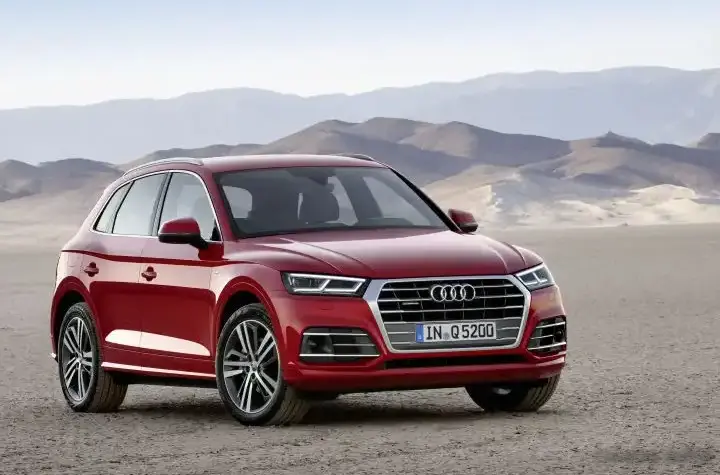
The Audi Q5 II (FY) 2.0 TDI 150 hp, launched in 2016, represented a key offering in Audi’s popular Q5 range. This second-generation Q5, built on the MLB Evo platform, aimed to improve upon the original Q5 in terms of refinement, technology, and efficiency. The 2.0 TDI 150 hp variant was specifically targeted at buyers prioritizing fuel economy and lower running costs without sacrificing the Q5’s core attributes of comfort and practicality. It served as an entry point into the Q5 lineup in many European markets, offering a more accessible price point than the higher-powered engine options.
Powertrain & Engine Architecture
At the heart of the Q5 2.0 TDI 150 hp lies the Volkswagen Group’s EA288 series diesel engine, specifically the DEUA code. This is a four-cylinder, inline engine displacing 1968cc. It utilizes a common rail direct injection system, delivering fuel at pressures up to 2,000 bar for optimized combustion. The engine features a single turbocharger with an intercooler to enhance power and efficiency. The valvetrain employs a dual overhead camshaft (DOHC) configuration with four valves per cylinder. The 150 hp output is achieved through careful calibration of the engine management system, balancing performance with fuel consumption. The engine is longitudinally mounted, driving the front wheels through a six-speed manual transmission. While an S tronic dual-clutch transmission was available on other Q5 variants, the 150 hp model was primarily offered with the manual gearbox, further emphasizing its focus on efficiency.
Driving Characteristics
The 2.0 TDI 150 hp Q5 offered a comfortable and composed driving experience, though not particularly sporty. With 150 horsepower and 320 Nm (236 lb-ft) of torque, acceleration from 0-60 mph took around 9.2 seconds. The manual transmission, while engaging, required frequent shifting to maintain momentum, especially when overtaking. The gear ratios were tuned for fuel efficiency rather than outright performance. Compared to the more powerful 2.0 TDI variants (190 hp) or the 3.0 TDI, the 150 hp model felt noticeably less responsive. However, the readily available torque at low engine speeds made it well-suited for everyday driving and cruising on highways. The front-wheel-drive configuration provided adequate traction in most conditions, but lacked the all-weather capability of the quattro all-wheel-drive system available on other Q5 models.
Equipment & Trim Levels
The Q5 2.0 TDI 150 hp typically came with a respectable level of standard equipment. This included Audi’s MMI infotainment system with a 7-inch display, automatic climate control, and a leather-wrapped steering wheel. Safety features such as ABS, electronic stability control, and multiple airbags were standard. Interior upholstery was typically cloth, though leather options were available as upgrades. Common optional extras included larger alloy wheels, a panoramic sunroof, parking sensors, and advanced driver-assistance systems like adaptive cruise control. Trim levels varied by market, but generally followed a progression from ‘SE’ or ‘Sport’ to ‘S line’, with each step adding more luxurious features and styling enhancements.
Chassis & Braking
The Q5 II (FY) featured a sophisticated chassis design. Both front and rear suspension utilized independent multi-link setups, providing a comfortable ride and good handling characteristics. The front suspension incorporated aluminum components to reduce weight. Braking duties were handled by ventilated discs on all four wheels. The braking system was generally effective, providing ample stopping power for everyday driving. Stabilizer bars were fitted to both the front and rear axles to minimize body roll during cornering. The steering system was an electric power steering setup, offering a light and precise feel.
Market Reception & Comparison
The Audi Q5 2.0 TDI 150 hp was generally well-received by automotive critics. It was praised for its fuel efficiency, comfortable ride, and refined interior. However, some reviewers noted that the engine lacked the punch of its more powerful counterparts. Compared to the 2.0 TDI 190 hp, the 150 hp version offered significantly better fuel economy but at the expense of performance. The 3.0 TDI, while more expensive, provided a substantial increase in power and a more luxurious driving experience. In terms of reliability, the EA288 diesel engine proved to be generally robust, although some early models were affected by issues related to the diesel emissions system.
Legacy
The Audi Q5 II (FY) 2.0 TDI 150 hp remains a popular choice in the used car market. Its combination of fuel efficiency, practicality, and Audi’s reputation for quality makes it an attractive option for buyers seeking a reliable and affordable compact luxury SUV. The EA288 engine, while subject to scrutiny regarding emissions, has proven to be durable when properly maintained. Regular servicing, including oil changes and filter replacements, is crucial for ensuring long-term reliability. The availability of parts and qualified mechanics is generally good, making maintenance relatively straightforward. Today, these Q5s represent a good value proposition, offering a taste of Audi luxury at a reasonable price point.