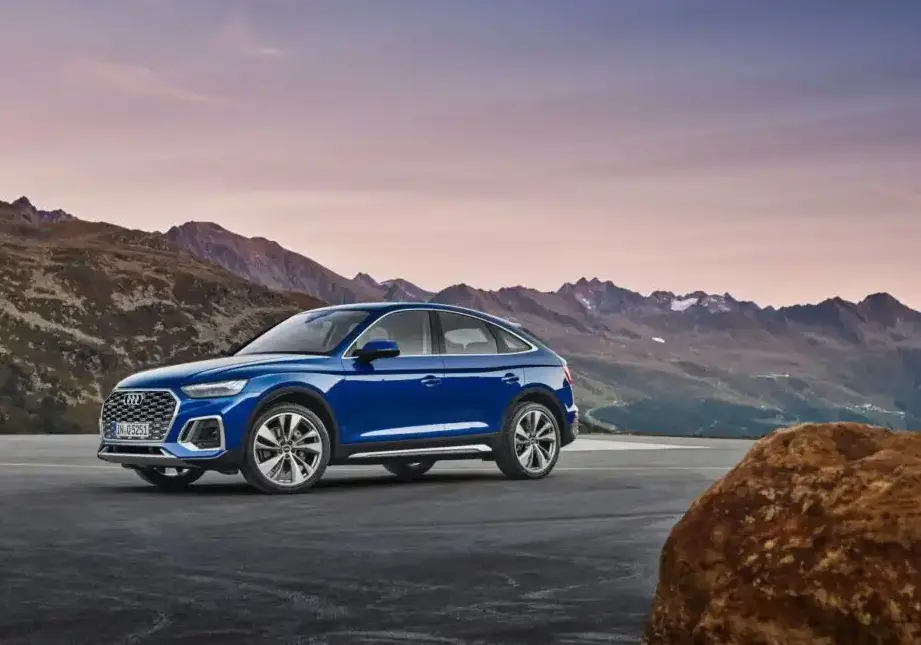
The Audi Q5 II Sportback 40 TDI, produced from 2020 to November 2024, represents a key variant within the second-generation Q5 (FY) series. This model, characterized by its sleek Sportback body style and a 2.0-liter turbocharged diesel engine, occupied a central position in Audi’s Q5 lineup, offering a balance between performance, efficiency, and practicality. It was primarily marketed in Europe and other regions where diesel engines remained popular, appealing to buyers seeking a premium SUV with lower running costs. The “40 TDI” designation signifies a specific power output level, while the “Mild Hybrid” and “quattro ultra” technologies highlight Audi’s commitment to fuel efficiency and all-wheel-drive capability. The S tronic transmission, a seven-speed dual-clutch unit, further refined the driving experience.
Technical Specifications
| Brand | Audi |
| Model | Q5 |
| Generation | Q5 II Sportback (FY, facelift 2020) |
| Type (Engine) | 40 TDI (204 Hp) Mild Hybrid quattro ultra S tronic |
| Start of production | 2020 |
| End of production | November, 2024 |
| Powertrain Architecture | MHEV (Mild Hybrid Electric Vehicle) |
| Body type | SUV |
| Seats | 5 |
| Doors | 5 |
| Combined fuel consumption (WLTP) | 6.2-6.9 l/100 km (37.9 – 34.1 US mpg) |
| CO2 emissions (WLTP) | 163-180 g/km |
| Fuel consumption (urban – NEDC) | 6.1 l/100 km (38.6 US mpg) |
| Fuel consumption (extra urban – NEDC) | 4.8-5.1 l/100 km (49 – 46.1 US mpg) |
| Fuel consumption (combined – NEDC) | 5.3-5.5 l/100 km (44.4 – 42.8 US mpg) |
| CO2 emissions (NEDC) | 140-144 g/km |
| Fuel Type | Diesel |
| Acceleration 0 – 100 km/h | 7.6 sec |
| Acceleration 0 – 62 mph | 7.6 sec |
| Acceleration 0 – 60 mph | 7.2 sec (Calculated) |
| Maximum speed | 222 km/h (137.94 mph) |
| Emission standard | Euro 6d-ISC-FCM |
| Weight-to-power ratio | 8.9 kg/Hp |
| Weight-to-torque ratio | 4.6 kg/Nm |
| Power | 204 Hp @ 3800-4200 rpm |
| Torque | 400 Nm @ 1750-3250 rpm (295.02 lb.-ft.) |
| Engine layout | Front, Longitudinal |
| Engine Model/Code | DTPA |
| Engine displacement | 1968 cm3 (120.09 cu. in.) |
| Number of cylinders | 4 |
| Engine configuration | Inline |
| Number of valves per cylinder | 4 |
| Fuel injection system | Diesel Commonrail |
| Engine aspiration | Turbocharger, Intercooler |
| Engine oil capacity | 5.5 l (5.81 US qt | 4.84 UK qt) |
| Coolant capacity | 12.3 l (13 US qt | 10.82 UK qt) |
| Kerb Weight | 1825 kg (4023.44 lbs.) |
| Trunk (boot) space – minimum | 510 l (18.01 cu. ft.) |
| Trunk (boot) space – maximum | 1480 l (52.27 cu. ft.) |
| Fuel tank capacity | 65 l (17.17 US gal | 14.3 UK gal) |
| Max. roof load | 75 kg (165.35 lbs.) |
| Permitted trailer load (braked) | 2400 kg (5291.09 lbs.) |
| Permitted trailer load (unbraked) | 750 kg (1653.47 lbs.) |
| Permitted towbar download | 100 kg (220.46 lbs.) |
| Length | 4689 mm (184.61 in.) |
| Width | 1893 mm (74.53 in.) |
| Width (including mirrors) | 2140 mm (84.25 in.) |
| Height | 1660 mm (65.35 in.) |
| Wheelbase | 2819 mm (110.98 in.) |
| Front track | 1616 mm (63.62 in.) |
| Rear track | 1609 mm (63.35 in.) |
| Front overhang | 910 mm (35.83 in.) |
| Rear overhang | 960 mm (37.8 in.) |
| Drivetrain Architecture | ICE and electric motor drive front wheels, rear drive via clutch |
| Drive wheel | All wheel drive (4×4) |
| Number of gears | 7 |
| Gearbox type | Automatic transmission S tronic |
| Front brakes | Ventilated discs |
| Rear brakes | Disc |
| Tire size | 235/60 R18 |
| Wheel rims size | 8J x 18 |
Powertrain & Engine Architecture
The heart of the Q5 40 TDI Sportback is the DTPA engine, a 2.0-liter inline-four cylinder diesel engine. This engine utilizes a sophisticated common-rail direct injection system, delivering fuel at extremely high pressures for optimized combustion. A turbocharger with an intercooler further enhances performance by forcing more air into the cylinders. The engine produces 204 horsepower at 3800-4200 rpm and a substantial 400 Nm (295 lb-ft) of torque between 1750 and 3250 rpm. The “40 TDI” designation doesn’t directly correlate to engine displacement, but rather to a power bracket within Audi’s naming convention.
Crucially, this variant incorporates a 48-volt mild hybrid system (MHEV). This system features a belt starter generator (BSG) that recovers energy during deceleration and stores it in a small battery. This stored energy can then assist the engine during acceleration, reducing load and improving fuel economy. The seven-speed S tronic dual-clutch transmission provides rapid and smooth gear changes, contributing to both performance and efficiency. The quattro ultra all-wheel-drive system intelligently distributes torque between the front and rear axles as needed, enhancing traction and stability.
Driving Characteristics
The Q5 40 TDI Sportback with the S tronic transmission offers a refined and capable driving experience. While not overtly sporty, the engine delivers ample power for everyday driving and confident overtaking. The S tronic transmission’s quick shifts contribute to a responsive feel. Compared to the more powerful Q5 45 TDI or the performance-oriented SQ5, the 40 TDI prioritizes fuel efficiency and comfort. The quattro ultra system provides secure handling in various weather conditions, although it’s less focused on off-road capability than the full-time quattro system found in some other Audi models. The gear ratios are tuned for a balance between acceleration and fuel economy, with a relatively tall final drive to maximize efficiency on the highway.
Equipment & Trim Levels
The Q5 40 TDI Sportback typically came well-equipped as standard. Features included Audi’s MMI infotainment system with a touchscreen display, automatic climate control, leather upholstery, and a suite of driver-assistance systems such as lane departure warning and automatic emergency braking. Optional extras included a virtual cockpit digital instrument cluster, a premium sound system, adaptive cruise control, and a panoramic sunroof. Trim levels varied by market, but generally offered increasing levels of luxury and technology. The Sportback body style itself added a touch of coupe-like elegance compared to the standard Q5 SUV.
Chassis & Braking
The Q5 Sportback utilizes a MacPherson strut front suspension and a multi-link rear suspension, providing a comfortable and controlled ride. The suspension tuning is geared towards balancing comfort and handling. Braking duties are handled by ventilated discs at the front and solid discs at the rear. The anti-lock braking system (ABS) and electronic stability control (ESC) are standard features, enhancing safety and stability. The steering is an electric power-assisted rack and pinion system, offering precise and responsive control.
Market Reception & Comparison
The Audi Q5 40 TDI Sportback was generally well-received by automotive critics. It was praised for its refined interior, comfortable ride, and efficient engine. The Sportback body style was also a popular choice, offering a more stylish alternative to the traditional SUV shape. Compared to other trims in the Q5 lineup, the 40 TDI offered a compelling value proposition for buyers who prioritized fuel economy and practicality over outright performance. Its fuel economy figures, ranging from 6.2 to 6.9 l/100km, were competitive within its segment. Reliability reports generally indicated good long-term dependability, although diesel particulate filter (DPF) maintenance was a consideration for owners.
Legacy
The Audi Q5 II Sportback 40 TDI has established itself as a popular choice in the used car market. Its combination of practicality, efficiency, and premium features continues to appeal to buyers. The 2.0-liter TDI engine, while subject to scrutiny regarding diesel emissions in the past, has proven to be a durable and reliable unit when properly maintained. The S tronic transmission, while requiring occasional servicing, is generally considered robust. As a result, well-maintained examples of the Q5 40 TDI Sportback hold their value relatively well, making them a sensible and desirable option for those seeking a premium compact SUV.