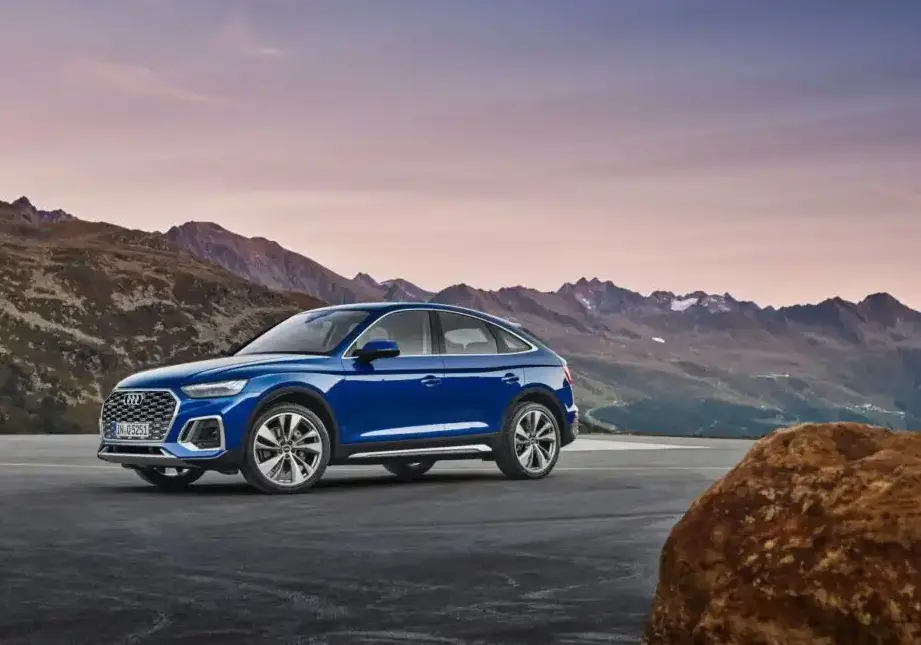
The Audi Q5 II Sportback 45 TFSI, produced from 2020 to November 2024, represents a significant iteration of Audi’s popular compact luxury SUV. This variant, part of the FY facelift generation, combines a 2.0-liter turbocharged four-cylinder engine with a mild hybrid system and Audi’s renowned quattro ultra all-wheel-drive system, paired with a seven-speed S tronic dual-clutch transmission. Positioned as a mid-range offering within the Q5 Sportback lineup, it aimed to balance performance, efficiency, and technology for a broad customer base. The Sportback body style, distinguished by its sloping roofline, offered a more dynamic aesthetic compared to the standard Q5 SUV.
Technical Specifications
| Brand | Audi |
| Model | Q5 |
| Generation | Q5 II Sportback (FY, facelift 2020) |
| Type (Engine) | 45 TFSI (265 Hp) Mild Hybrid quattro ultra S tronic |
| Start of production | 2020 |
| End of production | November, 2024 |
| Powertrain Architecture | MHEV (Mild Hybrid Electric Vehicle) |
| Body type | SUV |
| Seats | 5 |
| Doors | 5 |
| Combined fuel consumption (WLTP) | 8.3-9.1 l/100 km (28.3 – 25.8 US mpg) |
| CO2 emissions (WLTP) | 189-208 g/km |
| Fuel consumption (economy) – urban (NEDC) | 9.1-9.2 l/100 km (25.8 – 25.6 US mpg) |
| Fuel consumption (economy) – extra urban (NEDC) | 6.3-6.6 l/100 km (37.3 – 35.6 US mpg) |
| Fuel consumption (economy) – combined (NEDC) | 7.4-7.6 l/100 km (31.8 – 30.9 US mpg) |
| CO2 emissions (NEDC) | 169-174 g/km |
| Fuel Type | Petrol (Gasoline) |
| Acceleration 0 – 100 km/h | 6.1 sec |
| Acceleration 0 – 62 mph | 6.1 sec |
| Acceleration 0 – 60 mph | 5.8 sec |
| Maximum speed | 240 km/h (149.13 mph) |
| Emission standard | Euro 6d-ISC-FCM |
| Weight-to-power ratio | 6.7 kg/Hp |
| Weight-to-torque ratio | 4.8 kg/Nm |
| Power | 265 Hp @ 5250-6500 rpm |
| Torque | 370 Nm @ 1600-4500 rpm (272.9 lb.-ft. @ 1600-4500 rpm) |
| Engine layout | Front, Longitudinal |
| Engine Model/Code | DPUA, DPVA |
| Engine displacement | 1984 cm3 (121.07 cu. in.) |
| Number of cylinders | 4 |
| Engine configuration | Inline |
| Number of valves per cylinder | 4 |
| Fuel injection system | Direct injection |
| Engine aspiration | Turbocharger, Intercooler |
| Engine oil capacity | 5.2 l (5.49 US qt | 4.58 UK qt) |
| Kerb Weight | 1775 kg (3913.21 lbs.) |
| Trunk (boot) space – minimum | 510 l (18.01 cu. ft.) |
| Trunk (boot) space – maximum | 1480 l (52.27 cu. ft.) |
| Fuel tank capacity | 70 l (18.49 US gal | 15.4 UK gal) |
| Max. roof load | 75 kg (165.35 lbs.) |
| Permitted trailer load with brakes (12%) | 2400 kg (5291.09 lbs.) |
| Permitted trailer load without brakes | 750 kg (1653.47 lbs.) |
| Permitted towbar download | 100 kg (220.46 lbs.) |
| Length | 4689 mm (184.61 in.) |
| Width | 1893 mm (74.53 in.) |
| Width including mirrors | 2140 mm (84.25 in.) |
| Height | 1660 mm (65.35 in.) |
| Wheelbase | 2819 mm (110.98 in.) |
| Front track | 1616 mm (63.62 in.) |
| Rear (Back) track | 1609 mm (63.35 in.) |
| Front overhang | 910 mm (35.83 in.) |
| Rear overhang | 960 mm (37.8 in.) |
| Drivetrain Architecture | ICE and electric motor drive front wheels, rear drive via clutch |
| Drive wheel | All wheel drive (4×4) |
| Number of gears and type of gearbox | 7 gears, automatic transmission S tronic |
| Front brakes | Ventilated discs |
| Rear brakes | Disc |
| Tires size | 235/60 R18 |
| Wheel rims size | 8J x 18 |
INTRODUCTION
The Audi Q5 II Sportback 45 TFSI (2020-2024) builds upon the success of the second-generation Q5 (FY) introduced in 2017. The Sportback variant, launched as part of the facelift in 2020, distinguishes itself with a coupe-like roofline that extends to the rear, enhancing its sporty appearance. This model year saw the integration of a 48-volt mild hybrid system across the Q5 range, improving fuel efficiency and responsiveness. The “45 TFSI” designation indicates the engine’s power output relative to Audi’s internal naming convention, signifying a step up from the base 40 TFSI model but positioned below the more potent 50 TFSI.
Powertrain & Engine Architecture
At the heart of the Q5 45 TFSI lies the EA888 2.0-liter turbocharged inline-four cylinder engine, specifically coded DPUA or DPVA depending on the market and specific calibration. This engine utilizes direct fuel injection and an aluminum block with an iron sleeve. The turbocharger, an integral part of the engine’s performance, provides significant boost across a wide RPM range. The mild hybrid system incorporates a belt-driven starter-generator (BSG) and a small lithium-ion battery. This system allows for extended start-stop functionality, coasting with the engine off, and a small power boost during acceleration. The seven-speed S tronic dual-clutch transmission delivers rapid and smooth gear changes. This transmission features a wet clutch design for enhanced durability and heat dissipation. The quattro ultra all-wheel-drive system intelligently distributes torque between the front and rear axles as needed, prioritizing front-wheel drive for efficiency and engaging the rear axle when traction demands it.
Driving Characteristics
The 265 horsepower and 370 lb-ft of torque produced by the 2.0-liter engine, combined with the quick-shifting S tronic transmission, provide brisk acceleration. The 0-60 mph sprint takes approximately 5.8 seconds. While not as overtly sporty as some competitors, the Q5 45 TFSI offers a comfortable and refined driving experience. The S tronic transmission’s gear ratios are tuned for a balance of acceleration and fuel economy. Compared to the base 40 TFSI model, the 45 TFSI delivers noticeably more power and responsiveness, particularly during overtaking maneuvers. The quattro ultra system provides confident handling in various weather conditions, although it’s less focused on off-road capability than some traditional all-wheel-drive systems. The mild hybrid system is largely transparent to the driver, contributing to improved fuel economy without significantly altering the driving experience.
Equipment & Trim Levels
The Q5 Sportback 45 TFSI typically came standard with features such as Audi’s virtual cockpit digital instrument cluster, a 10.1-inch touchscreen infotainment system with Apple CarPlay and Android Auto integration, leather upholstery, heated front seats, and a panoramic sunroof. Available options included adaptive cruise control, a premium Bang & Olufsen sound system, navigation, and various driver-assistance features. Trim levels often included “Premium” and “Prestige” variants, with the Prestige trim adding more luxury features and technology. Interior upholstery options ranged from standard leather to premium Nappa leather. Dashboard trim could be customized with wood, aluminum, or carbon fiber accents.
Chassis & Braking
The Q5 Sportback utilizes a MacPherson strut front suspension and a multi-link rear suspension, providing a comfortable ride and predictable handling. The suspension is tuned to prioritize comfort over outright sportiness. Braking duties are handled by ventilated discs at the front and solid discs at the rear. The electronic stability control (ESC) system integrates with the quattro ultra system to enhance stability and control. Steering is provided by an electromechanical power steering system, offering precise and responsive feel. The Sportback’s chassis is reinforced to compensate for the loss of structural rigidity due to the sloping roofline.
Market Reception & Comparison
The Audi Q5 Sportback 45 TFSI was generally well-received by automotive critics, praised for its stylish design, comfortable interior, and refined driving experience. Compared to rivals like the BMW X3 and Mercedes-Benz GLC Coupe, the Q5 Sportback offered a compelling blend of luxury, technology, and practicality. Fuel economy was competitive for its class, with the mild hybrid system contributing to improved efficiency. Reliability reports have been generally positive, although some owners have reported minor issues with the infotainment system. The 45 TFSI trim offered a sweet spot in the Q5 lineup, providing a significant performance upgrade over the 40 TFSI without the higher price tag of the 50 TFSI.
Legacy
The Audi Q5 II Sportback 45 TFSI represents a key step in Audi’s electrification strategy, showcasing the benefits of mild hybrid technology. The EA888 engine, in its various iterations, has proven to be a durable and reliable powerplant. On the used car market, these models hold their value relatively well, reflecting their reputation for quality and refinement. The combination of a stylish design, comfortable interior, and efficient powertrain continues to make the Q5 Sportback 45 TFSI a desirable option for buyers seeking a compact luxury SUV.