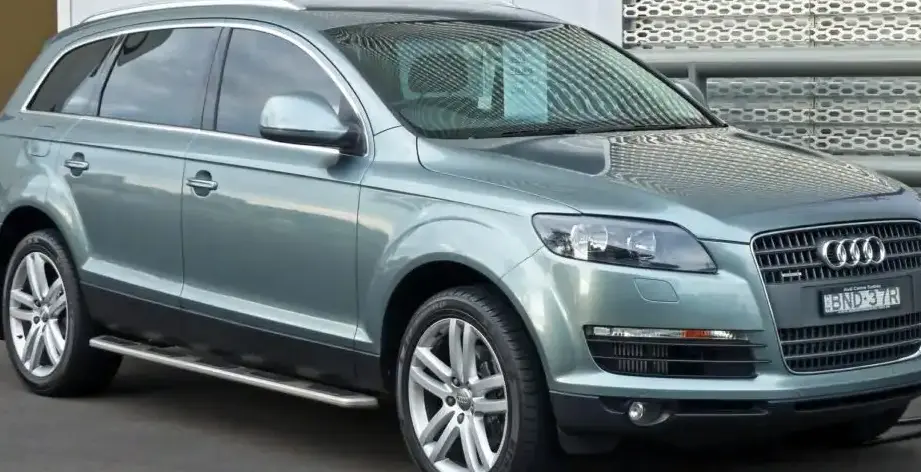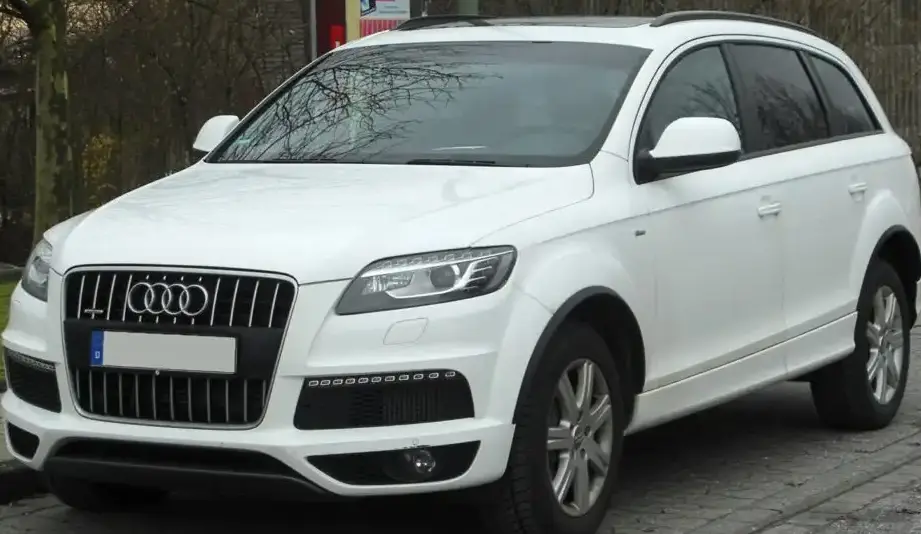
The Audi Q7 3.0 TDI quattro tiptronic, produced from 2009 to 2010, represents a significant iteration of the first-generation (Typ 4L) Q7, following a mid-cycle facelift. This seven-seat SUV combined Audi’s renowned quattro all-wheel-drive system with a potent 3.0-liter turbocharged diesel engine and a six-speed tiptronic automatic transmission. Positioned as a mid-range offering within the Q7 lineup, it aimed to balance performance, fuel efficiency, and practicality for families and those requiring towing capacity. The facelift brought revised styling cues, updated technology, and refinements to the powertrain for improved refinement and efficiency.
Technical Specifications
| Brand | Audi |
| Model | Q7 |
| Generation | Q7 (Typ 4L, facelift 2009) |
| Type (Engine) | 3.0 TDI V6 (225 Hp) quattro 6 tiptronic 7 Seat |
| Start of production | 2009 |
| End of production | 2010 |
| Powertrain Architecture | Internal Combustion engine |
| Body type | SUV |
| Seats | 7 |
| Doors | 5 |
| Fuel consumption (urban) | 13.8 l/100 km (17 US mpg, 20.5 UK mpg) |
| Fuel consumption (extra urban) | 9.4 l/100 km (25 US mpg, 30.1 UK mpg) |
| Fuel consumption (combined) | 11.8 l/100 km (19.9 US mpg, 23.9 UK mpg) |
| Fuel Type | Diesel |
| Acceleration 0 – 60 mph | 8.5 sec |
| Maximum speed | 204 km/h (126.76 mph) |
| Emission standard | ULEV II |
| Weight-to-power ratio | 11.1 kg/Hp, 90 Hp/tonne |
| Weight-to-torque ratio | 4.5 kg/Nm, 220 Nm/tonne |
| Power | 225 Hp @ 3750 rpm |
| Power per litre | 75.8 Hp/l |
| Torque | 550 Nm @ 1750 rpm (405.66 lb.-ft. @ 1750 rpm) |
| Engine layout | Front, Longitudinal |
| Engine Model/Code | CATA |
| Engine displacement | 2967 cm3 (181.06 cu. in.) |
| Number of cylinders | 6 |
| Engine configuration | V-engine |
| Cylinder Bore | 83 mm (3.27 in.) |
| Piston Stroke | 91.4 mm (3.6 in.) |
| Compression ratio | 16.8:1 |
| Number of valves per cylinder | 4 |
| Fuel injection system | Diesel Commonrail |
| Engine aspiration | Turbocharger, Intercooler |
| Valvetrain | DOHC |
| Engine oil capacity | 8.2 l (8.66 US qt | 7.21 UK qt) |
| Coolant | 9 l (9.51 US qt | 7.92 UK qt) |
| Kerb Weight | 2500 kg (5511.56 lbs.) |
| Trunk (boot) space – minimum | 330 l (11.65 cu. ft.) |
| Trunk (boot) space – maximum | 2035 l (71.87 cu. ft.) |
| Fuel tank capacity | 100 l (26.42 US gal | 22 UK gal) |
| AdBlue tank | 23 l (6.08 US gal | 5.06 UK gal) |
| Permitted trailer load with brakes (12%) | 2495 kg (5500.53 lbs.) |
| Length | 5089 mm (200.35 in.) |
| Width | 1983 mm (78.07 in.) |
| Width including mirrors | 2177 mm (85.71 in.) |
| Height | 1737 mm (68.39 in.) |
| Wheelbase | 3002 mm (118.19 in.) |
| Front track | 1651 mm (65 in.) |
| Rear (Back) track | 1681 mm (66.18 in.) |
| Front overhang | 962 mm (37.87 in.) |
| Rear overhang | 1125 mm (44.29 in.) |
| Ride height (ground clearance) | 205 mm (8.07 in.) |
| Drag coefficient (Cd) | 0.37 |
| Minimum turning circle (turning diameter) | 12 m (39.37 ft.) |
| Drivetrain Architecture | The Internal combustion engine (ICE) drives permanently the four wheels of the vehicle. |
| Drive wheel | All wheel drive (4×4) |
| Number of gears and type of gearbox | 6 gears, automatic transmission Tiptronic |
| Front suspension | Coil spring, Double wishbone, Transverse stabilizer, Air Suspension – Optional |
| Rear suspension | Independent multi-link spring suspension with stabilizer, Air Suspension – Optional |
| Front brakes | Ventilated discs, 350×34 mm |
| Rear brakes | Ventilated discs, 330×28 mm |
| Assisting systems | ABS (Anti-lock braking system) |
| Steering type | Steering rack and pinion |
| Power steering | Electric Steering |
| Tires size | 265/50 R19; 275/45 R20; 295/35 R21 |
| Wheel rims size | 8.5J x 19; 9J x 20; 10J x 21 |
Powertrain & Engine Architecture
The heart of the Q7 3.0 TDI was the CATA engine, a 3.0-liter V6 diesel. This engine utilized a common rail direct injection system, delivering fuel at extremely high pressures for optimized combustion. A single turbocharger with an intercooler boosted power output to 225 horsepower at 3750 rpm and a substantial 550 Nm (405.66 lb.-ft.) of torque, readily available from just 1750 rpm. The engine featured a double overhead camshaft (DOHC) valvetrain with four valves per cylinder, enhancing breathing and efficiency. The six-speed tiptronic automatic transmission offered both fully automatic operation and manual gear selection via steering wheel-mounted paddles or the gear selector. This transmission was known for its smooth shifts and ability to handle the engine’s torque output effectively.
Driving Characteristics
The 3.0 TDI tiptronic Q7 offered a comfortable and capable driving experience. While not as overtly sporty as some of its competitors, the engine’s ample torque provided strong acceleration, especially in the mid-range. The 0-60 mph sprint took approximately 8.5 seconds, and top speed was electronically limited to 126.76 mph. The tiptronic transmission, while smooth, wasn’t as quick-shifting as some dual-clutch transmissions found in rival vehicles. The quattro all-wheel-drive system provided excellent traction in all weather conditions, making it a confident performer on slippery surfaces. The gear ratios were tuned for a balance of fuel economy and usability, prioritizing smooth cruising and effortless highway driving.
Equipment & Trim Levels
The Q7 3.0 TDI quattro tiptronic typically came well-equipped as standard. Features included leather upholstery, tri-zone automatic climate control, a premium audio system, power-adjustable front seats, and parking sensors. Optional extras included a panoramic sunroof, adaptive air suspension, navigation system, and advanced driver-assistance systems like adaptive cruise control. Interior trim options varied, allowing buyers to personalize the cabin with different wood or aluminum accents. The seven-seat configuration offered versatility for families, with the third-row seats folding flat to maximize cargo space.
Chassis & Braking
The Q7’s chassis featured a double wishbone front suspension and an independent multi-link rear suspension. While coil springs were standard, an optional air suspension system provided adjustable ride height and improved comfort. The braking system consisted of ventilated discs all around, with larger discs at the front to handle the increased stopping power. Anti-lock brakes (ABS) were standard, along with electronic stability control. The Q7’s weight of 2500 kg (5511.56 lbs.) meant that the braking system needed to be robust to provide confident stopping performance.
Market Reception & Comparison
The Audi Q7 3.0 TDI quattro tiptronic was generally well-received by automotive critics. It was praised for its spacious interior, comfortable ride, and strong diesel engine. However, some reviewers noted that the tiptronic transmission wasn’t as responsive as other options, and the Q7’s size and weight could make it feel cumbersome in tight spaces. Compared to the Q7 3.6 FSI gasoline variant, the 3.0 TDI offered significantly better fuel economy and more torque. Against competitors like the BMW X5 and Mercedes-Benz GL-Class, the Q7 offered a compelling combination of luxury, practicality, and all-weather capability.
Legacy
The 3.0 TDI engine, in various iterations, proved to be a reliable and durable powertrain. The CATA engine code is generally considered robust, though preventative maintenance, particularly regarding the diesel particulate filter (DPF) and turbocharger, is crucial. In the used car market, the 2009-2010 Q7 3.0 TDI quattro tiptronic remains a popular choice for those seeking a spacious, comfortable, and capable SUV. Properly maintained examples continue to offer good value and a refined driving experience. The Q7 helped establish Audi as a major player in the luxury SUV segment, and the 3.0 TDI variant played a key role in its success, particularly in European markets where diesel engines were favored.