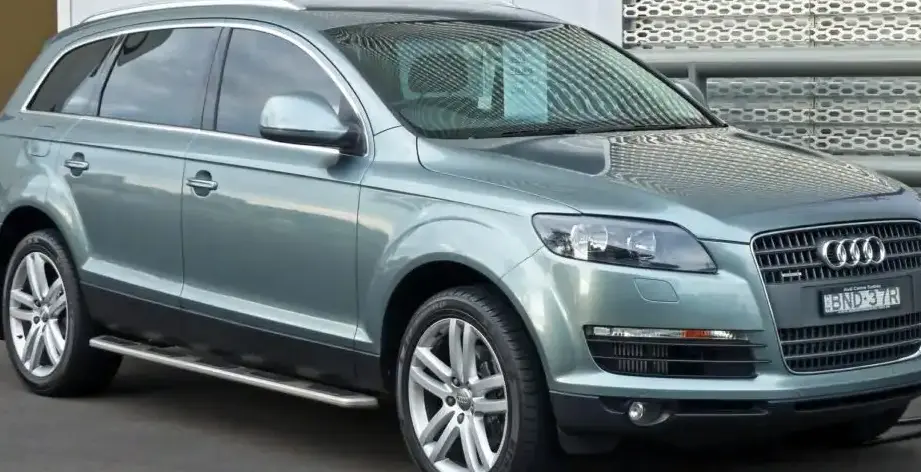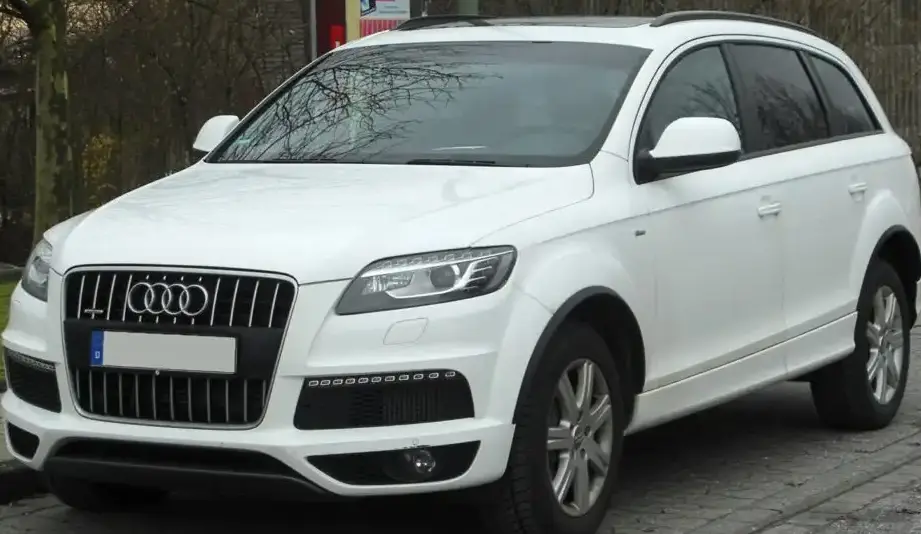
The Audi Q7 3.0 TDI quattro, specifically the facelifted version produced from June 2009 to April 2010, represents a significant iteration of Audi’s first foray into the full-size luxury SUV segment. Built on the Volkswagen Group’s PL46 platform (internally designated Typ 4L), this variant combined a potent 3.0-liter turbocharged diesel V6 engine with Audi’s renowned quattro all-wheel-drive system and a six-speed Tiptronic automatic transmission. Positioned as a mid-to-upper range offering within the Q7 lineup, it aimed to balance performance, fuel efficiency, and luxury features, appealing to buyers seeking a capable and refined SUV for both on-road comfort and occasional off-road excursions. This model year benefitted from styling updates and technological enhancements compared to the initial Q7 launch in 2006.
Technical Specifications
| Brand | Audi |
| Model | Q7 |
| Generation | Q7 (Typ 4L, facelift 2009) |
| Type (Engine) | 3.0 TDI V6 (240 Hp) quattro 6 tiptronic |
| Start of production | June, 2009 |
| End of production | April, 2010 |
| Powertrain Architecture | Internal Combustion engine |
| Body type | SUV |
| Seats | 5 |
| Doors | 5 |
| Fuel consumption (urban) | 11.3 l/100 km (20.8 US mpg, 25 UK mpg, 8.8 km/l) |
| Fuel consumption (extra urban) | 7.8 l/100 km (30.2 US mpg, 36.2 UK mpg, 12.8 km/l) |
| Fuel consumption (combined) | 9.1 l/100 km (25.8 US mpg, 31 UK mpg, 11 km/l) |
| CO2 emissions | 239 g/km |
| Fuel Type | Diesel |
| Acceleration 0 – 100 km/h | 8.5 sec |
| Acceleration 0 – 62 mph | 8.5 sec |
| Acceleration 0 – 60 mph | 8.1 sec |
| Maximum speed | 216 km/h (134.22 mph) |
| Emission standard | Euro 4 |
| Weight-to-power ratio | 9.7 kg/Hp, 103.2 Hp/tonne |
| Weight-to-torque ratio | 4.2 kg/Nm, 236.6 Nm/tonne |
| Power | 240 Hp @ 4000-4400 rpm |
| Power per litre | 80.9 Hp/l |
| Torque | 550 Nm @ 2000-2250 rpm (405.66 lb.-ft. @ 2000-2250 rpm) |
| Engine layout | Front, Longitudinal |
| Engine Model/Code | CASA |
| Engine displacement | 2967 cm3 (181.06 cu. in.) |
| Number of cylinders | 6 |
| Engine configuration | V-engine |
| Cylinder Bore | 83 mm (3.27 in.) |
| Piston Stroke | 91.4 mm (3.6 in.) |
| Compression ratio | 16.8:1 |
| Number of valves per cylinder | 4 |
| Fuel injection system | Diesel Commonrail |
| Engine aspiration | Turbocharger, Intercooler |
| Valvetrain | DOHC |
| Engine oil capacity | 8.2 l (8.66 US qt | 7.21 UK qt) |
| Coolant | 12 l (12.68 US qt | 10.56 UK qt) |
| Kerb Weight | 2325 kg (5125.75 lbs.) |
| Max. weight | 3150 kg (6944.56 lbs.) |
| Max load | 825 kg (1818.81 lbs.) |
| Trunk (boot) space – minimum | 775 l (27.37 cu. ft.) |
| Trunk (boot) space – maximum | 2035 l (71.87 cu. ft.) |
| Fuel tank capacity | 100 l (26.42 US gal | 22 UK gal) |
| Max. roof load | 100 kg (220.46 lbs.) |
| Permitted trailer load with brakes (8%) | 3200 kg (7054.79 lbs.) |
| Permitted trailer load with brakes (12%) | 3200 kg (7054.79 lbs.) |
| Permitted trailer load without brakes | 750 kg (1653.47 lbs.) |
| Permitted towbar download | 130 kg (286.6 lbs.) |
| Length | 5089 mm (200.35 in.) |
| Width | 1983 mm (78.07 in.) |
| Width including mirrors | 2177 mm (85.71 in.) |
| Height | 1737 mm (68.39 in.) |
| Wheelbase | 3002 mm (118.19 in.) |
| Front track | 1651 mm (65 in.) |
| Rear (Back) track | 1681 mm (66.18 in.) |
| Front overhang | 962 mm (37.87 in.) |
| Rear overhang | 1125 mm (44.29 in.) |
| Ride height (ground clearance) | 205 mm (8.07 in.) |
| Drag coefficient (Cd) | 0.37 |
| Minimum turning circle (turning diameter) | 12 m (39.37 ft.) |
| Drive wheel | All wheel drive (4×4) |
| Number of gears and type of gearbox | 6 gears, automatic transmission Tiptronic |
| Front suspension | Independent multi-link suspension |
| Rear suspension | Double wishbone |
| Front brakes | Ventilated discs |
| Rear brakes | Ventilated discs |
| Assisting systems | ABS (Anti-lock braking system) |
| Steering type | Steering rack and pinion |
| Tires size | 235/60 R18 |
| Wheel rims size | 18 |
Powertrain & Engine Architecture
The heart of this Q7 variant is the CASA engine, a 3.0-liter V6 diesel. This engine utilizes a common rail direct injection system, delivering fuel at extremely high pressure for optimized combustion. The CASA engine features a single turbocharger with an intercooler, boosting power and torque output. The valvetrain employs double overhead camshafts (DOHC) with four valves per cylinder, enhancing breathing and efficiency. The six-speed Tiptronic automatic transmission, a torque converter-based unit, provides smooth and relatively quick shifts. ‘Tiptronic’ allows the driver to manually select gears, offering a degree of control over the powertrain. The transmission is designed to handle the substantial 550 Nm (405.66 lb-ft) of torque produced by the engine.
Driving Characteristics
The 240 hp and 550 Nm of torque provide ample power for a vehicle of the Q7’s size and weight. Acceleration from 0-60 mph takes approximately 8.1 seconds, and the Q7 feels responsive in most driving situations. However, it’s not a sports SUV; the focus is on effortless cruising and towing capacity. The Tiptronic transmission, while smooth, isn’t as quick-shifting as some dual-clutch transmissions found in competitors. The quattro all-wheel-drive system provides excellent traction in various conditions, enhancing stability and confidence. The gear ratios are tuned for a balance of acceleration and fuel economy, with a relatively tall final drive.
Equipment & Trim Levels
The 3.0 TDI quattro typically came well-equipped, reflecting its position in the Q7 lineup. Standard features often included leather upholstery, tri-zone automatic climate control, a premium audio system, power-adjustable front seats with memory function, and parking sensors. Optional extras included a panoramic sunroof, adaptive cruise control, navigation system, and upgraded interior trim packages. The facelifted models also benefitted from revised interior materials and updated infotainment systems.
Chassis & Braking
The Q7’s chassis features an independent multi-link suspension at the front and a double wishbone suspension at the rear, providing a comfortable ride quality. The suspension is tuned to prioritize comfort over outright sportiness. Braking duties are handled by ventilated discs on all four wheels, providing ample stopping power. Anti-lock braking system (ABS) is standard, along with electronic stability control. The Q7’s weight necessitates a robust braking system to ensure safe and controlled deceleration.
Market Reception & Comparison
The Q7 3.0 TDI quattro was generally well-received by automotive critics. It was praised for its spacious interior, comfortable ride, and strong diesel engine. The fuel economy, averaging around 25.8 US mpg in combined driving, was a significant selling point. Compared to the 3.6-liter V6 gasoline version, the TDI offered superior fuel economy and torque. Against the higher-performance 4.2-liter V8, the 3.0 TDI provided a more balanced combination of performance and efficiency. Some critics noted the Q7’s size and weight, suggesting it wasn’t as agile as some competitors.
Legacy
The CASA engine, while generally reliable, can be susceptible to issues with the diesel particulate filter (DPF) if not properly maintained with regular highway driving. The Tiptronic transmission is also known to require careful servicing to prevent issues. Today, well-maintained examples of the 2009-2010 Q7 3.0 TDI quattro are sought after in the used car market for their blend of luxury, capability, and fuel efficiency. They represent a compelling option for buyers seeking a large SUV with a proven diesel powertrain, though potential buyers should be aware of the maintenance requirements associated with diesel technology.