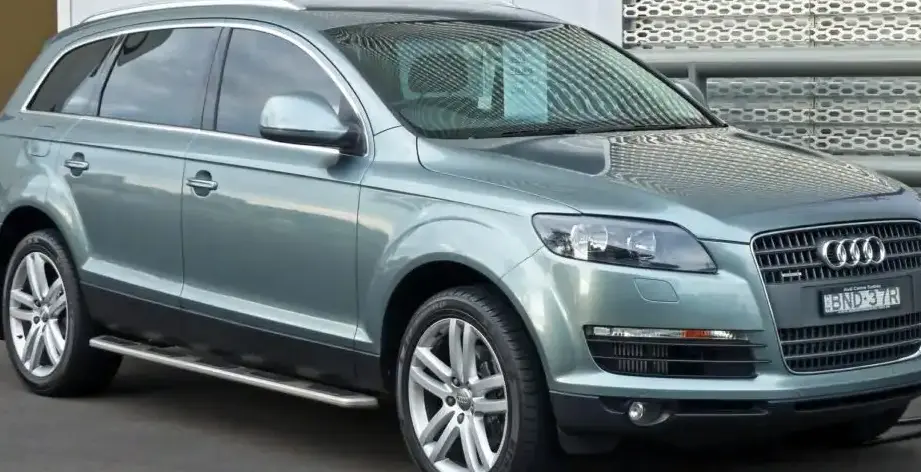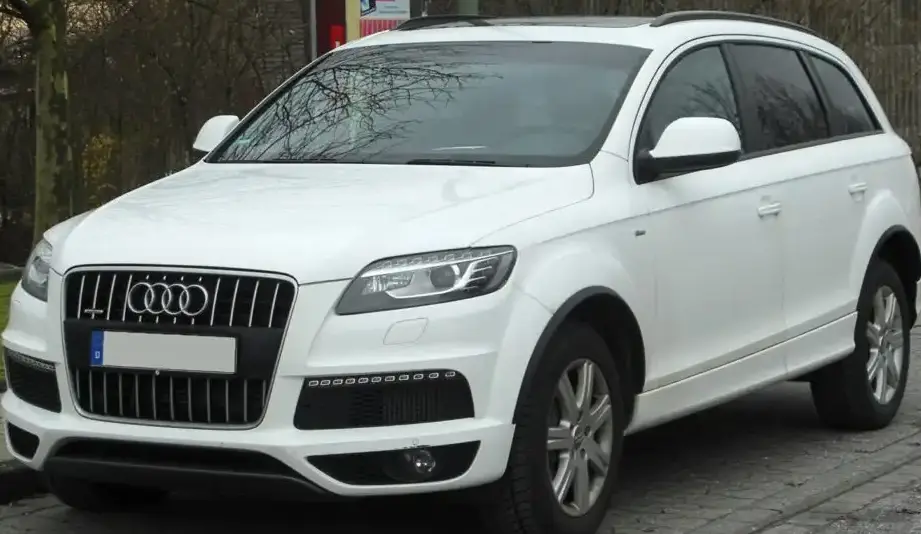
The Audi Q7 3.0 TFSI quattro tiptronic, produced from May 2010 to March 2015, represents a significant iteration of the Typ 4L Q7 generation, following the 2009 facelift. This variant occupied a mid-to-upper position within the Q7 lineup, offering a blend of performance, luxury, and all-weather capability. It was primarily marketed towards families and individuals seeking a spacious, comfortable SUV with strong acceleration and the security of Audi’s quattro all-wheel-drive system. The Q7, as a whole, aimed to compete with vehicles like the BMW X5, Mercedes-Benz GL-Class, and Acura MDX, offering a more refined and technologically advanced experience than many of its competitors.
Technical Specifications
| Brand | Audi |
| Model | Q7 |
| Generation | Q7 (Typ 4L, facelift 2009) |
| Type (Engine) | 3.0 TFSI V6 (272 Hp) quattro tiptronic |
| Start of production | May, 2010 |
| End of production | March, 2015 |
| Powertrain Architecture | Internal Combustion engine |
| Body type | SUV |
| Seats | 5 |
| Doors | 5 |
| Fuel consumption (urban) | 14.4 l/100 km (16.3 US mpg, 19.6 UK mpg, 6.9 km/l) |
| Fuel consumption (extra urban) | 8.5 l/100 km (27.7 US mpg, 33.2 UK mpg, 11.8 km/l) |
| Fuel consumption (combined) | 10.7 l/100 km (22 US mpg, 26.4 UK mpg, 9.3 km/l) |
| CO2 emissions | 249 g/km |
| Fuel Type | Petrol (Gasoline) |
| Acceleration 0 – 100 km/h | 7.9 sec |
| Acceleration 0 – 62 mph | 7.9 sec |
| Acceleration 0 – 60 mph | 7.5 sec |
| Maximum speed | 222 km/h (137.94 mph) |
| Emission standard | Euro 5 |
| Weight-to-power ratio | 8.2 kg/Hp, 122.5 Hp/tonne |
| Weight-to-torque ratio | 5.6 kg/Nm, 180.2 Nm/tonne |
| Power | 272 Hp @ 4750-6500 rpm |
| Power per litre | 90.8 Hp/l |
| Torque | 400 Nm @ 2250-4750 rpm (295.02 lb.-ft. @ 2250-4750 rpm) |
| Maximum engine speed | 6500 rpm |
| Engine layout | Front, Longitudinal |
| Engine Model/Code | CJTC, CJWC |
| Engine displacement | 2995 cm3 (182.77 cu. in.) |
| Number of cylinders | 6 |
| Engine configuration | V-engine |
| Cylinder Bore | 84.5 mm (3.33 in.) |
| Piston Stroke | 89 mm (3.5 in.) |
| Compression ratio | 10.5:1 |
| Number of valves per cylinder | 4 |
| Fuel injection system | Direct injection |
| Engine aspiration | Supercharger, Intercooler |
| Valvetrain | DOHC |
| Engine oil capacity | 6.8 l (7.19 US qt | 5.98 UK qt) |
| Kerb Weight | 2220 kg (4894.26 lbs.) |
| Max. weight | 2945 kg (6492.61 lbs.) |
| Max load | 725 kg (1598.35 lbs.) |
| Trunk (boot) space – minimum | 775 l (27.37 cu. ft.) |
| Trunk (boot) space – maximum | 2035 l (71.87 cu. ft.) |
| Fuel tank capacity | 100 l (26.42 US gal | 22 UK gal) |
| Max. roof load | 100 kg (220.46 lbs.) |
| Permitted trailer load with brakes (8%) | 3500 kg (7716.18 lbs.) |
| Permitted trailer load with brakes (12%) | 3500 kg (7716.18 lbs.) |
| Permitted trailer load without brakes | 750 kg (1653.47 lbs.) |
| Permitted towbar download | 140 kg (308.65 lbs.) |
| Length | 5089 mm (200.35 in.) |
| Width | 1983 mm (78.07 in.) |
| Width including mirrors | 2177 mm (85.71 in.) |
| Height | 1737 mm (68.39 in.) |
| Wheelbase | 3002 mm (118.19 in.) |
| Front track | 1651 mm (65 in.) |
| Rear (Back) track | 1681 mm (66.18 in.) |
| Front overhang | 962 mm (37.87 in.) |
| Rear overhang | 1125 mm (44.29 in.) |
| Ride height (ground clearance) | 205 mm (8.07 in.) |
| Drag coefficient (Cd) | 0.37 |
| Minimum turning circle (turning diameter) | 12 m (39.37 ft.) |
| Approach angle | 21° |
| Departure angle | 23.4° |
| Ramp-over (brakeover) angle | 21.1° |
| Climb angle | 31° |
| Wading depth | 500 mm (19.69 in.) |
| Drivetrain Architecture | The Internal combustion engine (ICE) drives permanently the four wheels of the vehicle. |
| Drive wheel | All wheel drive (4×4) |
| Number of gears and type of gearbox | 8 gears, automatic transmission tiptronic |
| Front suspension | Coil spring, Double wishbone, Transverse stabilizer, Air Suspension – Optional |
| Rear suspension | Double wishbone, Transverse stabilizer, Coil spring, Air Suspension – Optional |
| Front brakes | Ventilated discs |
| Rear brakes | Ventilated discs |
| Assisting systems | ABS (Anti-lock braking system) |
| Steering type | Steering rack and pinion |
| Power steering | Hydraulic Steering |
| Tires size | 235/60 R18; 255/55 R18; 265/50 R19; 275/45 R20; 295/40 R20; 295/35 R21 |
| Wheel rims size | 7.5J x 18; 8J x 18; 8.5J x 19; 9J x 20; 10J x 20; 10J x 21 |
Powertrain & Engine Architecture
At the heart of the Q7 3.0 TFSI lies the CJTC or CJWC engine code, a 2.995-liter V6 engine. This engine utilizes direct fuel injection and is supercharged, providing both immediate throttle response and high peak power. The supercharger, combined with an intercooler, helps to manage intake air temperature, maximizing efficiency and preventing knock. The engine employs a double overhead camshaft (DOHC) valvetrain with four valves per cylinder, optimizing airflow for improved performance. The eight-speed tiptronic automatic transmission is a key component, offering smooth and responsive gear changes. This transmission features a torque converter and allows for manual gear selection, providing the driver with greater control. The transmission’s gear ratios are tuned to balance acceleration with fuel efficiency, with closer ratios in the lower gears for quicker response and taller ratios for relaxed highway cruising.
Driving Characteristics
The 272 horsepower and 400 Nm (295 lb-ft) of torque delivered by the 3.0 TFSI engine provide brisk acceleration. The 0-60 mph sprint takes approximately 7.5 seconds, making it a capable performer for its size. Compared to the base 2.0 TFSI engine, the 3.0 TFSI offers a substantial power increase, resulting in noticeably quicker acceleration and more effortless highway passing. While not as sporty as the Q7’s higher-performance variants (like those with the supercharged 3.0 TFSI producing over 330 hp), the 272 hp version strikes a good balance between performance and fuel economy. The tiptronic transmission contributes to a smooth driving experience, although some drivers may prefer the more engaging feel of a manual transmission. The quattro all-wheel-drive system provides excellent traction in all weather conditions, enhancing stability and confidence.
Equipment & Trim Levels
The Q7 3.0 TFSI typically came well-equipped, featuring standard amenities such as leather upholstery, tri-zone automatic climate control, a premium sound system, and power-adjustable front seats. Optional extras included features like a panoramic sunroof, adaptive cruise control, a navigation system, and rear-seat entertainment. Trim levels varied depending on the market, but generally offered increasing levels of luxury and technology. The base trim provided a comfortable and well-appointed interior, while higher trims added more premium materials and advanced features. The interior design emphasized a clean and modern aesthetic, with high-quality materials and intuitive controls.
Chassis & Braking
The Q7’s chassis is based on a robust platform designed to handle the vehicle’s weight and provide a comfortable ride. The suspension system typically consists of coil springs and double wishbones at both the front and rear, with an optional air suspension system available for enhanced ride quality and adjustability. The air suspension allows the driver to raise or lower the vehicle’s ride height, improving off-road capability or easing entry and exit. Braking duties are handled by ventilated discs at all four corners, providing ample stopping power. The anti-lock braking system (ABS) and electronic stability control (ESC) are standard features, enhancing safety and control.
Market Reception & Comparison
The Audi Q7 3.0 TFSI was generally well-received by automotive critics, who praised its refined driving experience, spacious interior, and advanced technology. The 3.0 TFSI engine was lauded for its smooth power delivery and respectable fuel economy. Compared to the 2.0 TFSI version, the 3.0 TFSI offered a significant performance upgrade, making it a more appealing option for drivers who prioritized acceleration and towing capacity. However, some critics noted that the Q7’s size and weight could make it feel less agile than some of its competitors. Fuel economy, while reasonable for a vehicle of its size, was not class-leading.
Legacy
The Audi Q7 3.0 TFSI (Typ 4L) has proven to be a relatively reliable vehicle, with the 3.0 TFSI engine generally considered durable. However, like any complex vehicle, it is not without its potential issues. Common concerns include carbon buildup on the intake valves (a characteristic of direct-injection engines) and potential oil leaks. Regular maintenance, including oil changes and inspections, is crucial for ensuring long-term reliability. Today, the Q7 3.0 TFSI remains a popular choice in the used car market, offering a compelling combination of luxury, performance, and practicality. Its continued demand reflects its reputation as a well-built and capable SUV.