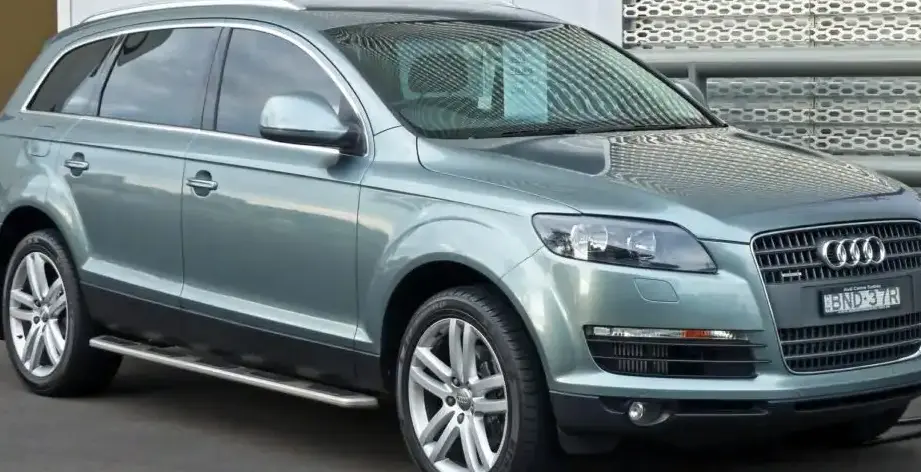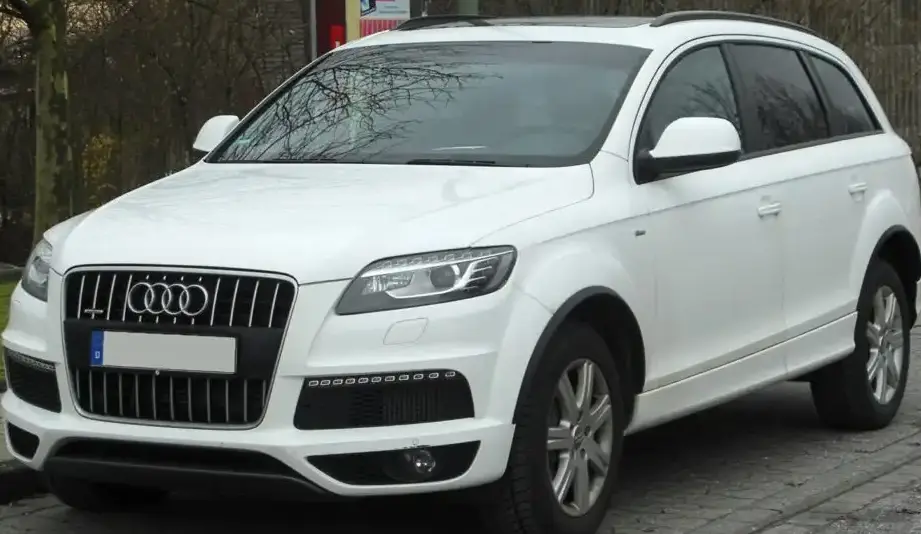
The Audi Q7 (Typ 4L, facelift 2009) 4.2 TDI V8 (340 Hp) quattro 8 Tiptronic represents the pinnacle of performance and luxury within the second-generation Q7 lineup, produced from August 2010 to March 2015. Positioned as the flagship variant, it combined a potent diesel V8 engine with Audi’s renowned quattro all-wheel-drive system and an eight-speed Tiptronic automatic transmission. This model catered to buyers seeking a large, capable SUV with substantial power and a refined driving experience. It built upon the foundation of the 4L platform, first introduced in 2005, offering a significant refresh in styling and technology with the 2009 facelift.
Technical Specifications
| Brand | Audi |
| Model | Q7 |
| Generation | Q7 (Typ 4L, facelift 2009) |
| Type (Engine) | 4.2 TDI V8 (340 Hp) quattro 8 Tiptronic |
| Start of production | August, 2010 |
| End of production | March, 2015 |
| Powertrain Architecture | Internal Combustion engine |
| Body type | SUV |
| Seats | 5 |
| Doors | 5 |
| Fuel consumption (urban) | 12.8 l/100 km (18.4 US mpg, 22.1 UK mpg, 7.8 km/l) |
| Fuel consumption (extra urban) | 8.2 l/100 km (28.7 US mpg, 34.4 UK mpg, 12.2 km/l) |
| Fuel consumption (combined) | 9.9 l/100 km (23.8 US mpg, 28.5 UK mpg, 10.1 km/l) |
| CO2 emissions | 262 g/km |
| Fuel Type | Diesel |
| Acceleration 0 – 100 km/h | 6.4 sec |
| Acceleration 0 – 62 mph | 6.4 sec |
| Acceleration 0 – 60 mph | 6.1 sec |
| Maximum speed | 235 km/h (146.02 mph) |
| Emission standard | Euro 5 |
| Weight-to-power ratio | 7.2 kg/Hp, 138.8 Hp/tonne |
| Weight-to-torque ratio | 3.2 kg/Nm, 310.2 Nm/tonne |
| Power | 340 Hp @ 4000 rpm |
| Power per litre | 82.2 Hp/l |
| Torque | 760 Nm @ 1750-3000 rpm (560.55 lb.-ft. @ 1750-3000 rpm) |
| Engine layout | Front, Longitudinal |
| Engine Model/Code | CCFA |
| Engine displacement | 4134 cm3 (252.27 cu. in.) |
| Number of cylinders | 8 |
| Engine configuration | V-engine |
| Cylinder Bore | 83 mm (3.27 in.) |
| Piston Stroke | 95.5 mm (3.76 in.) |
| Compression ratio | 16.4:1 |
| Number of valves per cylinder | 4 |
| Fuel injection system | Diesel Commonrail |
| Engine aspiration | Twin-Turbo, Intercooler |
| Engine oil capacity | 9 l (9.51 US qt | 7.92 UK qt) |
| Kerb Weight | 2450 kg (5401.33 lbs.) |
| Max. weight | 3275 kg (7220.14 lbs.) |
| Max load | 825 kg (1818.81 lbs.) |
| Trunk (boot) space – minimum | 775 l (27.37 cu. ft.) |
| Trunk (boot) space – maximum | 2035 l (71.87 cu. ft.) |
| Fuel tank capacity | 100 l (26.42 US gal | 22 UK gal) |
| Max. roof load | 100 kg (220.46 lbs.) |
| Permitted trailer load with brakes (8%) | 3200 kg (7054.79 lbs.) |
| Permitted trailer load with brakes (12%) | 3200 kg (7054.79 lbs.) |
| Permitted trailer load without brakes | 750 kg (1653.47 lbs.) |
| Permitted towbar download | 130 kg (286.6 lbs.) |
| Length | 5089 mm (200.35 in.) |
| Width | 1983 mm (78.07 in.) |
| Width including mirrors | 2177 mm (85.71 in.) |
| Height | 1737 mm (68.39 in.) |
| Wheelbase | 3002 mm (118.19 in.) |
| Front track | 1651 mm (65 in.) |
| Rear (Back) track | 1681 mm (66.18 in.) |
| Front overhang | 962 mm (37.87 in.) |
| Rear overhang | 1125 mm (44.29 in.) |
| Ride height (ground clearance) | 240 mm (9.45 in.) |
| Drag coefficient (Cd) | 0.35 |
| Minimum turning circle (turning diameter) | 12 m (39.37 ft.) |
| Drive wheel | All wheel drive (4×4) |
| Number of gears and type of gearbox | 8 gears, automatic transmission Tiptronic |
| Front suspension | Independent multi-link suspension |
| Rear suspension | Double wishbone |
| Front brakes | Ventilated discs |
| Rear brakes | Ventilated discs |
| Assisting systems | ABS (Anti-lock braking system) |
| Steering type | Steering rack and pinion |
| Power steering | Electric Steering |
| Tires size | 255/55 R18 |
| Wheel rims size | 8J x 18 |
INTRODUCTION
The Audi Q7 4.2 TDI, particularly in its facelifted 2009-2015 guise, represented a significant offering in the luxury SUV segment. It was designed to compete with vehicles like the BMW X5, Mercedes-Benz GL-Class, and Porsche Cayenne. The Typ 4L Q7 was Audi’s first foray into the full-size luxury SUV market, and the 4.2 TDI V8 variant was positioned as the performance leader. The facelift brought revised styling, including new headlights, a redesigned grille, and updated interior materials, enhancing the Q7’s overall appeal. This specific engine and transmission combination was aimed at buyers who desired a powerful and capable SUV for towing, long-distance travel, and all-weather driving.
Powertrain & Engine Architecture
At the heart of the Q7 4.2 TDI lies the CCFA engine code, a 4.134-liter V8 diesel engine. This engine utilizes a common rail direct injection system, delivering fuel at extremely high pressure for optimized combustion. It’s equipped with twin turbochargers and an intercooler, which work in concert to boost power and torque while minimizing turbo lag. The engine produces 340 horsepower at 4000 rpm and a substantial 760 Nm (560.55 lb-ft) of torque between 1750 and 3000 rpm. The eight-speed Tiptronic automatic transmission, a staple of Audi’s premium models, provides smooth and responsive gear changes. This transmission allows for both fully automatic operation and manual gear selection via steering wheel-mounted paddles or the gear selector. The transmission’s wide gear ratio spread contributes to both strong acceleration and improved fuel efficiency at highway speeds.
Driving Characteristics
The Q7 4.2 TDI delivers a driving experience that is both powerful and refined. The abundant torque from the V8 diesel engine provides effortless acceleration, making overtaking and towing a breeze. The quattro all-wheel-drive system ensures excellent traction in all conditions, enhancing stability and control. While not a sports car, the Q7 handles surprisingly well for its size, thanks to its sophisticated suspension and precise steering. Compared to the 3.0 TDI variants, the 4.2 TDI offers a noticeable increase in performance and a more authoritative feel. The eight-speed Tiptronic transmission contributes to a smooth and seamless driving experience, although some drivers may prefer the more direct engagement of a manual transmission. The gear ratios are tuned for both acceleration and fuel economy, providing a good balance between performance and efficiency.
Equipment & Trim Levels
The Q7 4.2 TDI typically came well-equipped with standard features such as leather upholstery, tri-zone automatic climate control, a premium sound system, and a power liftgate. Optional extras included features like adaptive cruise control, a panoramic sunroof, heated and ventilated front seats, and a navigation system. Interior trim options ranged from wood veneers to brushed aluminum accents, allowing buyers to personalize the cabin to their preferences. The facelifted models also benefited from Audi’s Multi Media Interface (MMI) system, which provided intuitive control over the vehicle’s various functions.
Chassis & Braking
The Q7 4.2 TDI features an independent multi-link suspension at the front and a double wishbone suspension at the rear, providing a comfortable and controlled ride. The suspension is tuned to balance ride comfort with handling performance. Braking duties are handled by ventilated discs on all four wheels, providing ample stopping power. The Q7 is equipped with Audi’s ABS (Anti-lock braking system), electronic stability control, and traction control systems, enhancing safety and stability. Due to the vehicle’s weight, the rear brakes are larger than those found on lower-trim Q7 models.
Market Reception & Comparison
The Audi Q7 4.2 TDI was generally well-received by automotive critics, who praised its powerful engine, luxurious interior, and capable all-wheel-drive system. However, some critics noted its relatively high fuel consumption and its large size, which could make it challenging to maneuver in tight spaces. Compared to the 3.0 TDI variants, the 4.2 TDI offered significantly more power and performance, but at a higher price point and with slightly lower fuel economy. The 4.2 TDI also offered a more refined and luxurious driving experience than the entry-level Q7 models.
Legacy
The Audi Q7 4.2 TDI, while superseded by newer generations of the Q7, remains a desirable vehicle in the used car market. The CCFA engine, when properly maintained, is known for its durability and reliability. However, potential buyers should be aware of the potential for costly repairs associated with the diesel particulate filter (DPF) and the turbochargers. Regular maintenance, including oil changes and filter replacements, is crucial for ensuring the long-term health of the engine. The Q7 4.2 TDI continues to appeal to buyers who seek a spacious, luxurious, and capable SUV with a powerful diesel engine.