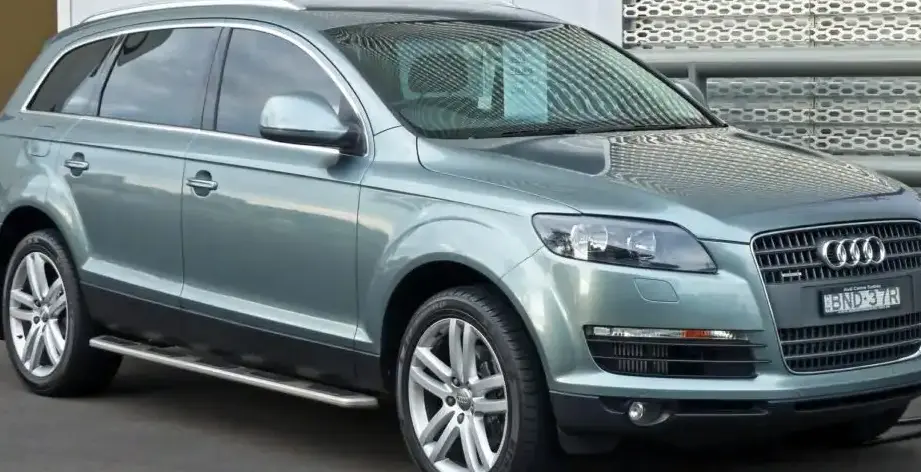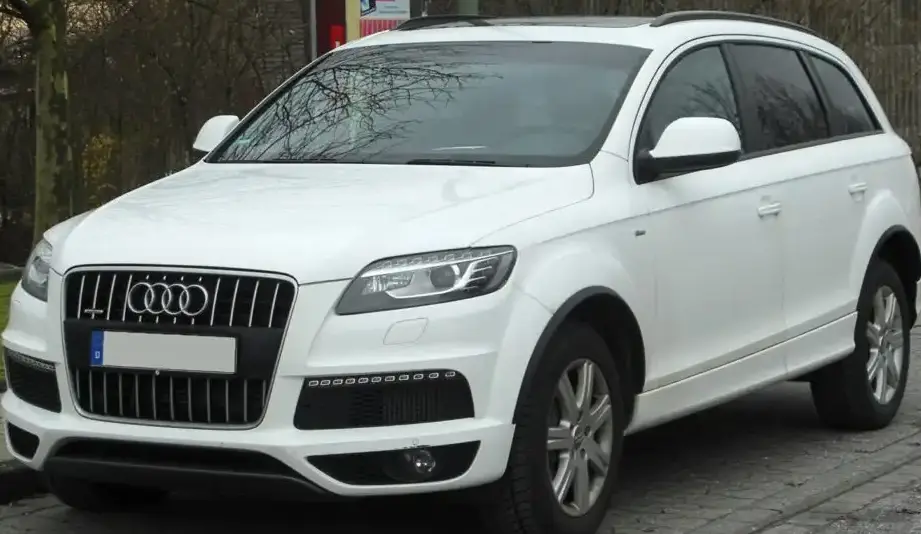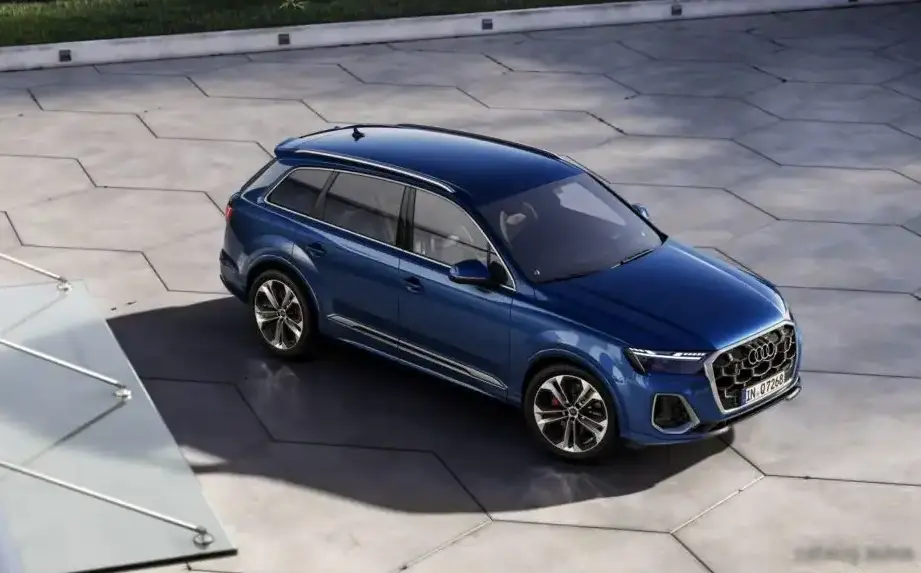
The Audi Q7 (Typ 4M, facelift 2024) 55 TFSI V6 represents the latest iteration of Audi’s flagship seven-seater SUV, introduced in 2024. This variant is positioned as a high-performance, technologically advanced offering within the Q7 range, blending substantial power with mild-hybrid efficiency and Audi’s renowned quattro all-wheel-drive system. It builds upon the foundation of the Typ 4M generation, first launched in 2015, incorporating styling updates, enhanced technology, and refined powertrain options. The 55 TFSI designation signifies a 3.0-liter V6 engine producing 340 horsepower, making it a step up from the base engine options while remaining below the performance-oriented SQ7 model.
Technical Specifications
| Brand | Audi |
| Model | Q7 |
| Generation | Q7 (Typ 4M, facelift 2024) |
| Type (Engine) | 55 TFSI V6 (340 Hp) Mild Hybrid quattro tiptronic 7 seats |
| Start of production | 2024 |
| Powertrain Architecture | MHEV (Mild Hybrid Electric Vehicle) |
| Body type | SUV |
| Seats | 7 |
| Doors | 5 |
| Combined fuel consumption (WLTP) | 10.1-11 l/100 km (23.3 – 21.4 US mpg, 28 – 25.7 UK mpg, 9.9 – 9.1 km/l) |
| CO2 emissions (WLTP) | 229-251 g/km |
| Fuel Type | Petrol (Gasoline) |
| Acceleration 0 – 100 km/h | 5.6 sec |
| Acceleration 0 – 62 mph | 5.6 sec |
| Acceleration 0 – 60 mph | 5.3 sec |
| Maximum speed | 250 km/h (155.34 mph) |
| Emission standard | Euro 6e |
| Weight-to-power ratio | 6.2 kg/Hp, 160.8 Hp/tonne |
| Weight-to-torque ratio | 4.2 kg/Nm, 236.4 Nm/tonne |
| Battery voltage | 48 V |
| Battery technology | Lithium-ion (Li-Ion) |
| Battery location | Under the trunk |
| Electric motor location | Front, Longitudinal |
| Power | 340 Hp @ 5200-6400 rpm |
| Power per litre | 113.5 Hp/l |
| Torque | 500 Nm @ 1370-4500 rpm (368.78 lb.-ft. @ 1370-4500 rpm) |
| Engine layout | Front, Longitudinal |
| Engine displacement | 2995 cm3 (182.77 cu. in.) |
| Number of cylinders | 6 |
| Engine configuration | V-engine |
| Cylinder Bore | 84.5 mm (3.33 in.) |
| Piston Stroke | 89 mm (3.5 in.) |
| Compression ratio | 11.2:1 |
| Number of valves per cylinder | 4 |
| Fuel injection system | Direct injection |
| Engine aspiration | Turbocharger, Intercooler |
| Valvetrain | DOHC |
| Engine oil capacity | 7.6 l (8.03 US qt | 6.69 UK qt) |
| Coolant | 13.7 l (14.48 US qt | 12.05 UK qt) |
| Kerb Weight | 2115 kg (4662.78 lbs.) |
| Max. weight | 2985 kg (6580.8 lbs.) |
| Max load | 870 kg (1918.02 lbs.) |
| Trunk (boot) space – minimum | 780 l (27.55 cu. ft.) |
| Trunk (boot) space – maximum | 1908 l (67.38 cu. ft.) |
| Fuel tank capacity | 85 l (22.45 US gal | 18.7 UK gal) |
| Max. roof load | 100 kg (220.46 lbs.) |
| Permitted trailer load with brakes (8%) | 2800 kg (6172.94 lbs.) |
| Permitted trailer load with brakes (12%) | 2800 kg (6172.94 lbs.) |
| Permitted trailer load without brakes | 750 kg (1653.47 lbs.) |
| Permitted towbar download | 115 kg (253.53 lbs.) |
| Length | 5072 mm (199.69 in.) |
| Width | 1970 mm (77.56 in.) |
| Width including mirrors | 2212 mm (87.09 in.) |
| Height | 1690-1748 mm (66.54 – 68.82 in.) |
| Wheelbase | 2995 mm (117.91 in.) |
| Front track | 1679 mm (66.1 in.) |
| Rear (Back) track | 1690 mm (66.54 in.) |
| Front overhang | 982 mm (38.66 in.) |
| Rear overhang | 1095 mm (43.11 in.) |
| Drag coefficient (Cd) | 0.34 |
| Minimum turning circle (turning diameter) | 12.5 m (41.01 ft.) |
| Front suspension | Independent multi-link suspension, Transverse stabilizer, Air suspension |
| Rear suspension | Independent multi-link suspension, Air suspension, Transverse stabilizer |
| Front brakes | Ventilated discs, 375 mm |
| Rear brakes | Ventilated discs, 350 mm |
| Gearbox | 8 gears, automatic transmission tiptronic |
| Tires size | 255/60 R18 |
| Wheel rims size | 8J x 18 |
Powertrain & Engine Architecture
At the heart of the Q7 55 TFSI lies the 2.9-liter V6 engine, designated as the EA833 series by Audi. This engine utilizes a direct injection system coupled with a twin-scroll turbocharger and an intercooler to deliver a potent blend of power and efficiency. The engine’s architecture incorporates an iron block with aluminum cylinder heads, contributing to both strength and weight reduction. The mild-hybrid system, a 48V setup, employs a belt-driven starter-generator (BSG) that enables features like extended engine-off coasting, regenerative braking, and smoother start-stop operation. This system contributes to improved fuel economy and reduced emissions. The engine is paired with Audi’s eight-speed tiptronic automatic transmission, known for its smooth and responsive shifts. This transmission is specifically tuned to handle the engine’s torque output and provides a wide range of gear ratios for optimal performance in various driving conditions.
Driving Characteristics
The Q7 55 TFSI offers a refined and capable driving experience. The 340 horsepower and 368 lb-ft of torque provide ample power for confident acceleration and effortless highway cruising. The 0-60 mph sprint is achieved in approximately 5.3 seconds. The tiptronic transmission contributes to smooth gear changes, and the quattro all-wheel-drive system ensures excellent traction in all weather conditions. Compared to the base engine Q7 models, the 55 TFSI delivers a noticeably more responsive and engaging driving experience. While not as aggressively tuned as the SQ7, it strikes a good balance between performance and comfort. The air suspension, standard on this trim, further enhances ride quality by absorbing road imperfections effectively.
Equipment & Trim Levels
The 55 TFSI variant typically comes well-equipped with standard features including Audi’s virtual cockpit digital instrument cluster, a large infotainment touchscreen with navigation, leather upholstery, heated front seats, a panoramic sunroof, and a premium sound system. Optional extras often include adaptive cruise control, a head-up display, massaging front seats, and upgraded interior trim packages. The Q7’s interior is characterized by its high-quality materials, meticulous craftsmanship, and user-friendly technology. The seven-seat configuration provides flexibility for families, while the spacious cabin offers ample room for passengers and cargo.
Chassis & Braking
The Q7’s chassis features an independent multi-link suspension at both the front and rear axles, providing a comfortable and controlled ride. The standard air suspension allows for adjustable ride height and damping settings, further enhancing comfort and adaptability. Braking duties are handled by ventilated disc brakes on all four wheels, providing strong and consistent stopping power. The front brakes measure 375mm in diameter, while the rear brakes are 350mm. Audi’s ABS (Anti-lock Braking System) and electronic stability control systems are standard, enhancing safety and stability.
Market Reception & Comparison
The Audi Q7 55 TFSI has been generally well-received by automotive critics, praised for its powerful engine, refined driving dynamics, luxurious interior, and advanced technology. Compared to competitors like the BMW X5 and Mercedes-Benz GLE, the Q7 offers a compelling combination of features and performance. Fuel economy is respectable for a vehicle of its size and performance, with combined WLTP figures ranging from 10.1 to 11 l/100 km. Reliability has been generally good, although some owners have reported minor issues with the infotainment system.
Legacy
The 2.9-liter V6 engine, as used in the Q7 55 TFSI, represents a significant step forward in Audi’s powertrain technology. The integration of a mild-hybrid system demonstrates Audi’s commitment to improving fuel efficiency and reducing emissions. As a used vehicle, the Q7 55 TFSI is expected to hold its value well due to its desirable combination of performance, luxury, and technology. Regular maintenance, including oil changes and adherence to Audi’s recommended service intervals, will be crucial for ensuring the long-term reliability of this powertrain.