Technical Specifications
| Brand | Audi |
| Model | Q7 |
| Generation | Q7 (Typ 4M, facelift 2019) |
| Type (Engine) | 60 TFSI e V6 (462 Hp) Plug-in Hybrid quattro tiptronic |
| Start of production | September, 2020 |
| End of production | July, 2021 |
| Powertrain Architecture | PHEV (Plug-in Hybrid Electric Vehicle) |
| Body type | SUV |
| Seats | 5 |
| Doors | 5 |
| Fuel consumption (combined) | 2.6-2.7 l/100 km (90.5 – 87.1 US mpg) |
| CO2 emissions | 59-62 g/km |
| Fuel Type | Petrol / electricity |
| Acceleration 0 – 100 km/h | 5.4 sec |
| Acceleration 0 – 62 mph | 5.4 sec |
| Acceleration 0 – 60 mph | 5.1 sec |
| Maximum speed | 240 km/h (149.13 mph) |
| Gross battery capacity | 17.9 kWh |
| Net (usable) battery capacity | 14.4 kWh |
| Battery technology | Lithium-ion (Li-Ion) |
| All-electric range (WLTP) | 44-47 km (27.34 – 29.2 mi) |
| Average Energy consumption (WLTP) | 21.7-22.6 kWh/100 km (34.92 – 36.37 kWh/100 mi) |
| Max speed (electric) | 135 km/h (83.89 mph) |
| Electric motor power | 136 Hp |
| Electric motor Torque | 400 Nm (295.02 lb.-ft.) |
| System power | 462 Hp |
| System torque | 700 Nm (516.29 lb.-ft.) |
| Power | 340 Hp @ 5300-6400 rpm |
| Torque | 450 Nm @ 1340-5300 rpm (331.9 lb.-ft. @ 1340-5300 rpm) |
| Engine displacement | 2995 cm3 (182.77 cu. in.) |
| Number of cylinders | 6 |
| Engine configuration | V-engine |
| Compression ratio | 11.2:1 |
| Fuel injection system | Direct injection |
| Engine oil capacity | 7.6 l (8.03 US qt | 6.69 UK qt) |
| Coolant | 10 l (10.57 US qt | 8.8 UK qt) |
| Kerb Weight | 2375 kg (5235.98 lbs.) |
| Max. weight | 3025 kg (6668.98 lbs.) |
| Trunk (boot) space – minimum | 650 l (22.95 cu. ft.) |
| Trunk (boot) space – maximum | 1835 l (64.8 cu. ft.) |
| Fuel tank capacity | 75 l (19.81 US gal | 16.5 UK gal) |
| Number of gears | 8 |
| Type of gearbox | automatic transmission tiptronic |
| Front suspension | Independent multi-link suspension |
| Rear suspension | Independent multi-link suspension |
| Front brakes | Ventilated discs |
| Rear brakes | Ventilated discs |
| Length | 5063 mm (199.33 in.) |
| Width | 1970 mm (77.56 in.) |
| Height | 1739 mm (68.46 in.) |
| Wheelbase | 2995 mm (117.91 in.) |
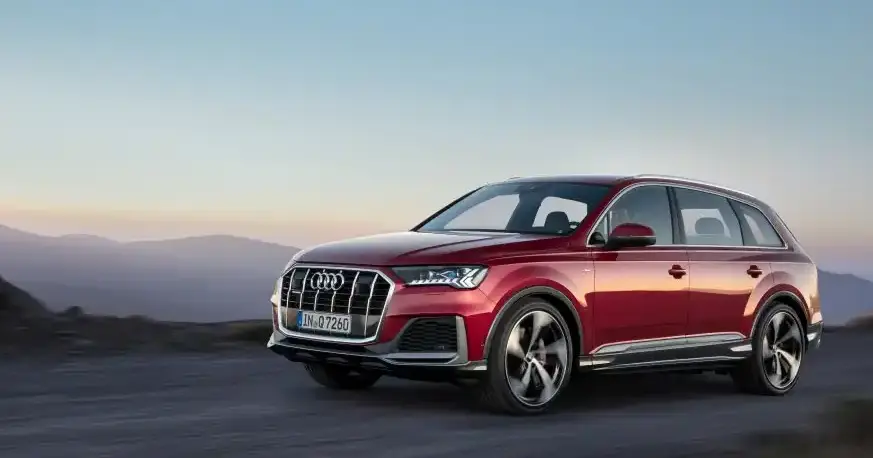
The Audi Q7 60 TFSI e, launched in 2020, is a plug-in hybrid variant of the second-generation Q7 (Typ 4M) which received a significant facelift. Building upon the established Q7 platform, it integrates a powerful V6 engine with an electric motor to deliver enhanced fuel efficiency and reduced emissions. This model was primarily targeted towards European and increasingly North American markets where demand for premium, eco-conscious SUVs was growing. The “60 TFSI e” designation signifies its powertrain configuration – a high-output engine combined with electric drive – and positions it as a flagship offering within the Q7 range.
Powertrain & Engine Architecture
At the heart of the Q7 60 TFSI e lies a 2.9-liter turbocharged V6 engine, internally designated as the DCBE. This engine produces 340 horsepower and 331.9 lb-ft of torque. It utilizes a direct injection system and an intercooled turbocharger to maximize power and efficiency. The engine’s valvetrain employs Dual Overhead Camshafts (DOHC) with four valves per cylinder. Integrated with the engine is a 136-horsepower electric motor, positioned between the engine and the eight-speed tiptronic automatic transmission. This placement allows for seamless integration of power delivery from both sources. The 17.9 kWh (usable 14.4 kWh) lithium-ion battery pack is located under the floor of the vehicle, minimizing impact on passenger and cargo space. The hybrid system allows for electric-only driving for up to 29.2 miles (WLTP) and a combined total range exceeding 300 miles. The tiptronic transmission is specifically calibrated to work with the electric motor, providing smooth and efficient gear changes.
Driving Characteristics
The Q7 60 TFSI e offers a unique driving experience compared to its gasoline-only counterparts. In electric-only mode, the vehicle provides near-silent acceleration and instant torque, making it ideal for city driving. When the engine and motor work in tandem, the combined 462 horsepower delivers brisk acceleration – 0-60 mph in approximately 5.1 seconds. The eight-speed tiptronic transmission is well-tuned, offering smooth shifts and responsive performance. While the added weight of the battery pack (approximately 500 lbs) is noticeable, the quattro all-wheel-drive system maintains excellent handling and stability. Compared to the Q7 3.0T, the 60 TFSI e prioritizes efficiency over outright performance, but still provides ample power for highway cruising and overtaking. The regenerative braking system effectively captures energy during deceleration, further enhancing efficiency.
Equipment & Trim Levels
The Q7 60 TFSI e typically came standard with a high level of equipment, reflecting its premium positioning. Standard features included Audi’s virtual cockpit digital instrument cluster, a large touchscreen infotainment system with navigation, leather upholstery, heated front seats, and a panoramic sunroof. Safety features such as adaptive cruise control, lane departure warning, and automatic emergency braking were also standard. Optional extras included upgraded leather packages, a premium sound system, massaging front seats, and a head-up display. Trim levels were generally aligned with the standard Q7 range (Premium, Premium Plus, Prestige), with the 60 TFSI e often being available in the higher trims.
Chassis & Braking
The Q7 60 TFSI e utilizes an independent multi-link suspension system at both the front and rear axles, providing a comfortable and controlled ride. The suspension is tuned to accommodate the added weight of the battery pack. Ventilated disc brakes are standard on all four wheels, providing ample stopping power. The electronic stability control (ESC) system is integrated with the quattro all-wheel-drive system to enhance stability and traction in various driving conditions. The steering system is an electric power-assisted rack-and-pinion setup, offering precise and responsive steering feel. Stabilizer bars are fitted front and rear to minimize body roll during cornering.
Market Reception & Comparison
The Q7 60 TFSI e was generally well-received by automotive critics. Reviewers praised its blend of performance, efficiency, and luxury. The electric-only range was considered competitive within its segment, and the combined fuel economy was significantly better than that of the gasoline-only Q7 models. Compared to the Q7 3.0T, the 60 TFSI e offered a more environmentally friendly option without sacrificing too much performance. However, some critics noted the higher price tag and the added weight of the battery pack. Compared to other plug-in hybrid SUVs, such as the Volvo XC90 Recharge, the Q7 60 TFSI e offered a more refined driving experience and a more luxurious interior.
Legacy
The Audi Q7 60 TFSI e represents an important step in Audi’s electrification strategy. While production was relatively short-lived, the model demonstrated the feasibility of combining a powerful V6 engine with an electric motor to deliver a compelling plug-in hybrid experience. The powertrain, while complex, has proven to be reasonably reliable in early reports. On the used car market, the Q7 60 TFSI e holds its value well, appealing to buyers seeking a premium, fuel-efficient SUV with all-wheel-drive capability. The technology pioneered in this model paved the way for Audi’s subsequent plug-in hybrid offerings and its broader commitment to electric mobility.