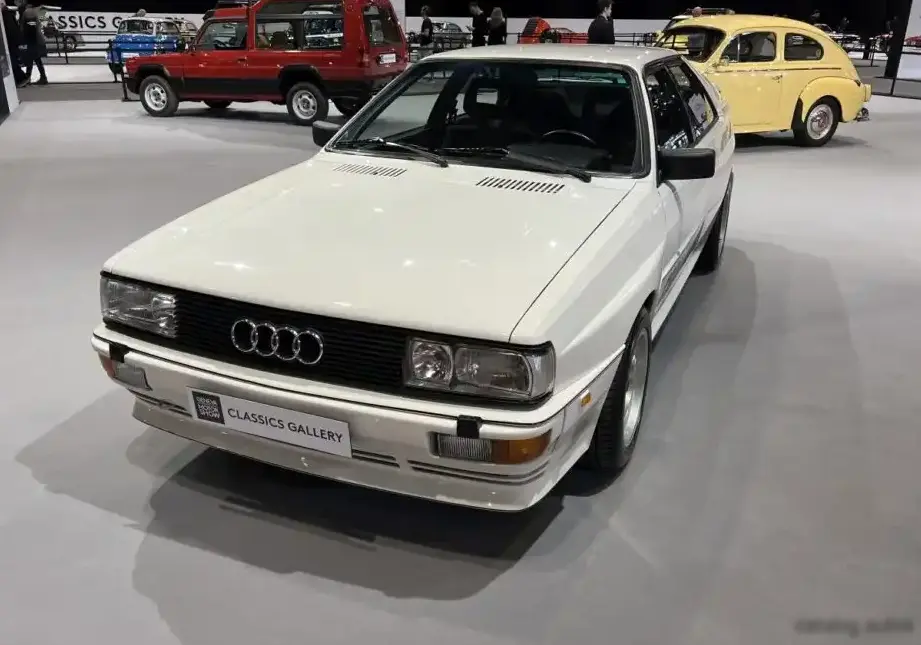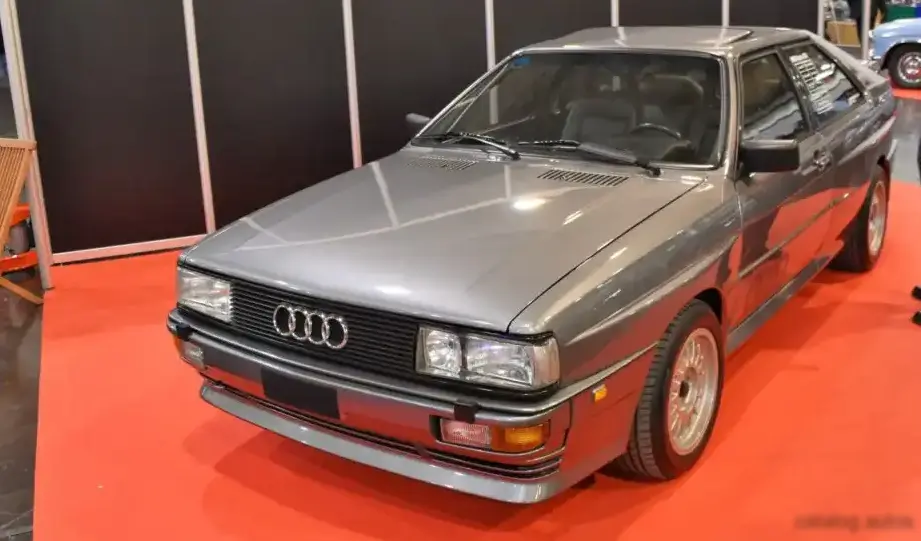
The Audi Quattro (Typ 85) 2.2 20V Turbo CAT, produced from August 1989 to July 1991, represents a high-performance iteration of Audi’s iconic all-wheel-drive coupe. Positioned as a premium offering within the Typ 85 range, it served as a flagship model before the introduction of the later 20V models. This variant built upon the success of the original Quattro, enhancing its performance with a more powerful turbocharged five-cylinder engine and refined features. It was primarily marketed in Europe, where the demand for sophisticated, all-weather performance vehicles was strong. The Typ 85 Quattro, in general, established Audi’s reputation for technological innovation and driving dynamics.
Technical Specifications
| Brand | Audi |
| Model | Quattro |
| Generation | Quattro (Typ 85) |
| Type (Engine) | 2.2 20V Turbo CAT (220 Hp) |
| Start of production | August, 1989 |
| End of production | July, 1991 |
| Powertrain Architecture | Internal Combustion engine |
| Body type | Coupe |
| Seats | 5 |
| Doors | 3 |
| Fuel consumption (economy) – urban | 14.5 l/100 km (16.2 US mpg, 19.5 UK mpg, 6.9 km/l) |
| Fuel consumption (economy) – extra urban | 7.8 l/100 km (30.2 US mpg, 36.2 UK mpg, 12.8 km/l) |
| Fuel consumption (economy) – combined | 9.9 l/100 km (23.8 US mpg, 28.5 UK mpg, 10.1 km/l) |
| Fuel Type | Petrol (Gasoline) |
| Acceleration 0 – 100 km/h | 6.3 sec |
| Acceleration 0 – 62 mph | 6.3 sec |
| Acceleration 0 – 60 mph | 6 sec |
| Maximum speed | 230 km/h (142.92 mph) |
| Weight-to-power ratio | 6.3 kg/Hp, 159.4 Hp/tonne |
| Weight-to-torque ratio | 4.5 kg/Nm, 223.9 Nm/tonne |
| Power | 220 Hp @ 5900 rpm |
| Power per litre | 98.8 Hp/l |
| Torque | 309 Nm @ 1950 rpm (227.91 lb.-ft. @ 1950 rpm) |
| Engine layout | Front, Longitudinal |
| Engine Model/Code | RR |
| Engine displacement | 2226 cm3 (135.84 cu. in.) |
| Number of cylinders | 5 |
| Engine configuration | Inline |
| Cylinder Bore | 81 mm (3.19 in.) |
| Piston Stroke | 86.4 mm (3.4 in.) |
| Compression ratio | 9.3:1 |
| Number of valves per cylinder | 4 |
| Fuel injection system | Multi-port manifold injection |
| Engine aspiration | Turbocharger |
| Valvetrain | DOHC |
| Engine oil capacity | 4.5 l (4.76 US qt, 3.96 UK qt) |
| Coolant | 9.3 l (9.83 US qt, 8.18 UK qt) |
| Kerb Weight | 1380 kg (3042.38 lbs.) |
| Max. weight | 1840 kg (4056.51 lbs.) |
| Max load | 460 kg (1014.13 lbs.) |
| Trunk (boot) space – minimum | 330 l (11.65 cu. ft.) |
| Fuel tank capacity | 90 l (23.78 US gal, 19.8 UK gal) |
| Max. roof load | 75 kg (165.35 lbs.) |
| Permitted trailer load with brakes (12%) | 1500 kg (3306.93 lbs.) |
| Permitted trailer load without brakes | 600 kg (1322.77 lbs.) |
| Length | 4404 mm (173.39 in.) |
| Width | 1723 mm (67.83 in.) |
| Height | 1320 mm (51.97 in.) |
| Wheelbase | 2524 mm (99.37 in.) |
| Front track | 1461 mm (57.52 in.) |
| Rear (Back) track | 1494 mm (58.82 in.) |
| Ride height (ground clearance) | 100 mm (3.94 in.) |
| Minimum turning circle (turning diameter) | 11.5 m (37.73 ft.) |
| Drivetrain Architecture | The Internal combustion engine (ICE) drives permanently the four wheels of the vehicle. |
| Drive wheel | All wheel drive (4×4) |
| Number of gears and type of gearbox | 5 gears, manual transmission |
| Front suspension | Independent, type McPherson with coil spring and anti-roll bar |
| Rear suspension | Independent coil spring, Wishbone |
| Front brakes | Ventilated discs |
| Rear brakes | Ventilated discs |
| Assisting systems | ABS (Anti-lock braking system) |
| Steering type | Steering rack and pinion |
| Power steering | Hydraulic Steering |
| Tires size | 215/50 R15 |
| Wheel rims size | 8J x 15 |
Powertrain & Engine Architecture
The heart of the 2.2 20V Turbo CAT is the RR engine code, a 2.2-liter inline five-cylinder engine. This engine represents a significant evolution of the original Quattro’s powerplant. It features a cast iron block and an aluminum cylinder head, incorporating dual overhead camshafts (DOHC) and four valves per cylinder – hence the “20V” designation. The turbocharger, a Garrett T25 unit, provides forced induction, dramatically increasing power output. Fuel delivery is managed by Bosch Motronic multi-port fuel injection, optimizing the air-fuel mixture for performance and efficiency. The engine’s compression ratio is 9.3:1. The five-speed manual transmission, a robust unit designed to handle the engine’s torque, is standard. This transmission features a dogleg shift pattern, a characteristic of many European performance cars of the era.
Driving Characteristics
The 2.2 20V Turbo CAT delivers a noticeably more engaging driving experience than lower-spec Quattros. The 220 horsepower and 309 Nm (227.91 lb-ft) of torque provide strong acceleration, with 0-60 mph achieved in around 6 seconds and a top speed of 143 mph. The turbocharger introduces a slight degree of lag, but once it spools up, the engine delivers a surge of power. The all-wheel-drive system provides excellent traction, particularly in adverse weather conditions, making the car feel planted and secure. The manual transmission allows for precise control, and the dogleg shift pattern, while unconventional, becomes intuitive with practice. Compared to the later 2.3 20V models, the 2.2 offers a slightly more raw and visceral driving experience.
Equipment & Trim Levels
The 2.2 20V Turbo CAT was well-equipped for its time. Standard features included power windows, central locking, a sunroof, and a high-quality stereo system. The interior typically featured cloth upholstery, although leather was available as an option. The dashboard layout is functional and driver-focused, with clear instrumentation. Optional extras included heated seats, air conditioning, and a more advanced audio system. The exterior styling is characterized by the Quattro’s distinctive wedge shape, with flared wheel arches and a rear spoiler.
Chassis & Braking
The Quattro’s chassis is designed to handle the increased power of the 2.2 20V Turbo CAT. It features independent suspension all around, with McPherson struts at the front and a multi-link setup at the rear. Anti-roll bars are fitted to both axles to reduce body roll during cornering. Braking is provided by ventilated discs on all four wheels, assisted by an ABS (Anti-lock Braking System) to enhance stopping power and stability. The steering is a rack-and-pinion system with hydraulic power assistance, providing precise and responsive handling.
Market Reception & Comparison
The 2.2 20V Turbo CAT was generally well-received by automotive critics. It was praised for its performance, handling, and all-weather capability. However, some reviewers noted the turbo lag and the unconventional dogleg shift pattern. Compared to the naturally aspirated 2.1-liter Quattro, the 2.2 Turbo offered a significant performance boost. It also provided a more refined driving experience than the earlier, less powerful models. Fuel economy, at around 24 mpg combined, was reasonable for a performance car of this era. Reliability was generally good, although the turbocharger and fuel injection system required regular maintenance.
Legacy
The Audi Quattro (Typ 85) 2.2 20V Turbo CAT remains a highly sought-after classic car. Its combination of performance, all-wheel-drive capability, and iconic styling has made it a favorite among enthusiasts. The RR engine, while requiring careful maintenance, is known for its durability and tunability. Today, well-maintained examples command high prices in the used car market. The Typ 85 Quattro, and particularly the 2.2 20V Turbo CAT, played a pivotal role in establishing Audi’s reputation as a manufacturer of high-performance, technologically advanced automobiles, a legacy that continues to this day.