
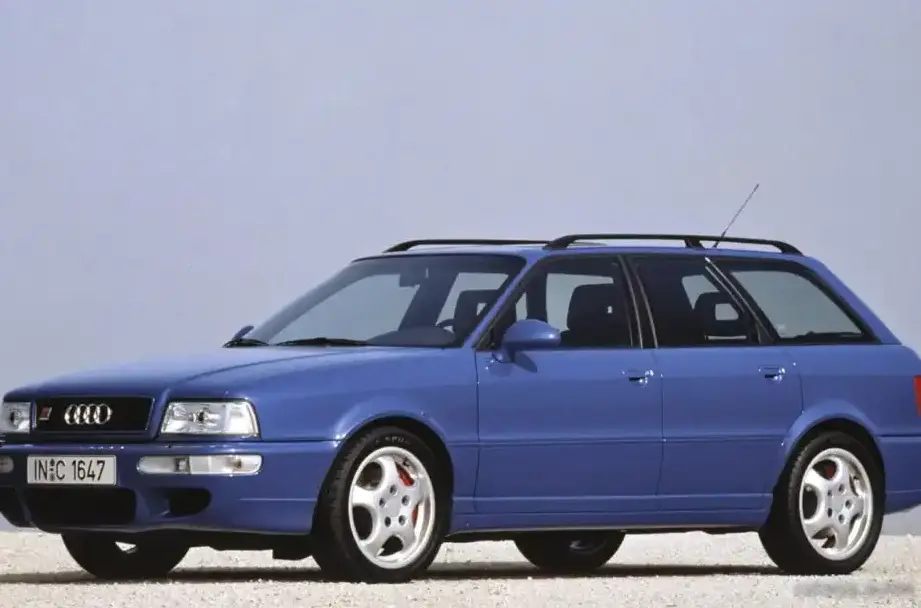
The Audi RS2 Avant, produced between March 1994 and March 1996, represents a pivotal moment in the evolution of high-performance station wagons. Developed in collaboration with Porsche, the RS2 was the first in Audi’s lineage of RS (RennSport – racing sport) models, and it established a benchmark for combining practicality with exhilarating performance. Built on the Audi 80 B4 platform (internally designated as the B4), the RS2 Avant was primarily sold in Europe, though a limited number were imported to other markets. It quickly gained notoriety as a uniquely capable and desirable vehicle, bridging the gap between a family car and a genuine sports machine.
Technical Specifications
| Brand | Audi |
| Model | RS2 |
| Generation | RS2 Avant |
| Type (Engine) | 2.2i (315 Hp) |
| Start of production | March, 1994 |
| End of production | March, 1996 |
| Powertrain Architecture | Internal Combustion engine |
| Body type | Station wagon (estate) |
| Seats | 5 |
| Doors | 5 |
| Fuel consumption (economy) – urban | 14.3 l/100 km (16.4 US mpg, 19.8 UK mpg, 7 km/l) |
| Fuel consumption (economy) – extra urban | 7.7 l/100 km (30.5 US mpg, 36.7 UK mpg, 13 km/l) |
| Fuel Type | Petrol (Gasoline) |
| Acceleration 0 – 100 km/h | 5.4 sec |
| Acceleration 0 – 62 mph | 5.4 sec |
| Acceleration 0 – 60 mph | 5.1 sec |
| Acceleration 0 – 200 km/h | 22.7 sec |
| Maximum speed | 262 km/h (162.8 mph) |
| Emission standard | Euro 2 |
| Weight-to-power ratio | 5.1 kg/Hp, 197.5 Hp/tonne |
| Weight-to-torque ratio | 3.9 kg/Nm, 257.1 Nm/tonne |
| Power | 315 Hp @ 6500 rpm |
| Power per litre | 141.5 Hp/l |
| Torque | 410 Nm @ 3000 rpm (302.4 lb.-ft. @ 3000 rpm) |
| Engine layout | Front, Longitudinal |
| Engine Model/Code | ADU |
| Engine displacement | 2226 cm3 (135.84 cu. in.) |
| Number of cylinders | 5 |
| Engine configuration | Inline |
| Cylinder Bore | 81 mm (3.19 in.) |
| Piston Stroke | 86.4 mm (3.4 in.) |
| Compression ratio | 9.3:1 |
| Number of valves per cylinder | 4 |
| Fuel injection system | Multi-port manifold injection |
| Engine aspiration | Turbocharger, Intercooler |
| Valvetrain | DOHC |
| Engine oil capacity | 4.5 l (4.76 US qt | 3.96 UK qt) |
| Coolant | 8.5 l (8.98 US qt | 7.48 UK qt) |
| Kerb Weight | 1595 kg (3516.37 lbs.) |
| Max. weight | 2100 kg (4629.71 lbs.) |
| Max load | 505 kg (1113.33 lbs.) |
| Trunk (boot) space – minimum | 370 l (13.07 cu. ft.) |
| Trunk (boot) space – maximum | 1200 l (42.38 cu. ft.) |
| Fuel tank capacity | 64 l (16.91 US gal | 14.08 UK gal) |
| Max. roof load | 75 kg (165.35 lbs.) |
| Permitted trailer load with brakes (12%) | 1600 kg (3527.4 lbs.) |
| Permitted trailer load without brakes | 690 kg (1521.19 lbs.) |
| Length | 4510 mm (177.56 in.) |
| Width | 1695 mm (66.73 in.) |
| Height | 1386 mm (54.57 in.) |
| Wheelbase | 2597 mm (102.24 in.) |
| Front track | 1448 mm (57.01 in.) |
| Rear (Back) track | 1474 mm (58.03 in.) |
| Minimum turning circle | 11.2 m (36.75 ft.) |
| Drivetrain Architecture | ICE drives permanently the four wheels |
| Drive wheel | All wheel drive (4×4) |
| Number of gears and type of gearbox | 6 gears, manual transmission |
| Front suspension | Independent, McPherson with coil spring and anti-roll bar |
| Rear suspension | Double wishbone, Transverse stabilizer |
| Front brakes | Ventilated discs |
| Rear brakes | Ventilated discs |
| Assisting systems | ABS (Anti-lock braking system) |
| Steering type | Steering rack and pinion |
| Power steering | Hydraulic Steering |
| Tires size | 245/40 R17 |
| Wheel rims size | 7J x 17 |
Powertrain & Engine Architecture
The heart of the RS2 Avant is the 2.2-liter inline-five cylinder engine, designated the ADU code. This engine wasn’t entirely new to Audi; it was derived from the unit used in the Audi Quattro Rally Group B cars of the 1980s. However, the RS2’s engine received significant upgrades, most notably the addition of a large KKK turbocharger and an intercooler. The engine utilized a Bosch Motronic fuel injection system and a dual overhead camshaft (DOHC) valvetrain. The turbocharger boosted the engine to 315 horsepower at 6500 rpm and 302 lb-ft of torque at 3000 rpm. The engine is longitudinally mounted, driving all four wheels through a six-speed manual transmission. The transmission was sourced from Porsche, reflecting the close collaboration between the two manufacturers.
Driving Characteristics
The RS2 Avant delivered a driving experience that was remarkably ahead of its time. Acceleration from 0 to 60 mph took just over 5 seconds, and it could reach a top speed of 162.8 mph. The all-wheel-drive system provided exceptional traction, particularly in adverse weather conditions. The six-speed manual transmission offered precise shifts, and the turbocharger provided a noticeable surge of power. While the turbo lag was present, it wasn’t overly intrusive. The RS2 wasn’t just about straight-line speed; the chassis was well-balanced, and the suspension provided a firm but compliant ride. Compared to the naturally aspirated 80 models, the RS2 offered a dramatically different level of performance, transforming the practical estate car into a genuine sports machine.
Equipment & Trim Levels
The RS2 Avant was relatively sparsely equipped compared to modern luxury cars, but it focused on performance-oriented features. Standard equipment included Recaro sport seats, a leather-wrapped steering wheel, and a unique instrument cluster with white-faced gauges. The exterior was distinguished by wider wheel arches, a revised front bumper, and a rear spoiler. Optional extras included a sunroof, air conditioning, and upgraded audio systems. The interior trim was generally understated, with a focus on functionality rather than ostentation. The color palette was relatively conservative, with solid colors and metallic finishes available.
Chassis & Braking
The RS2 Avant benefited from a significantly upgraded chassis compared to the standard Audi 80. The suspension was revised with stiffer springs and dampers, and the track was widened to improve handling. The braking system was also upgraded, featuring ventilated disc brakes on all four wheels and an anti-lock braking system (ABS). The front suspension utilized a McPherson strut design, while the rear suspension employed a double wishbone setup. These changes resulted in a more stable and controlled driving experience, allowing the RS2 to handle the increased power and speed.
Market Reception & Comparison
The Audi RS2 Avant was widely praised by automotive journalists for its exceptional performance and practicality. It was seen as a groundbreaking vehicle that redefined the concept of the performance estate car. Critics lauded its powerful engine, all-wheel-drive system, and well-balanced chassis. Compared to other high-performance cars of the era, the RS2 offered a unique combination of speed, handling, and everyday usability. While its fuel economy wasn’t particularly impressive (around 16.4 mpg in the city), it was considered acceptable for a car of its performance capabilities. Reliability was generally good, although the turbocharger and associated components required careful maintenance.
Legacy
The Audi RS2 Avant is now considered a highly collectible classic car. Its limited production run and pioneering status have made it a sought-after vehicle among enthusiasts. The ADU engine, while powerful, requires regular maintenance to ensure its longevity. Turbocharger failure and oil leaks are common issues that potential buyers should be aware of. Despite these potential problems, the RS2 Avant remains a rewarding and exciting car to drive. It laid the foundation for Audi’s subsequent RS models, and it continues to be celebrated as a landmark achievement in automotive engineering. Today, well-maintained examples command high prices in the used car market, reflecting their enduring appeal and historical significance.
