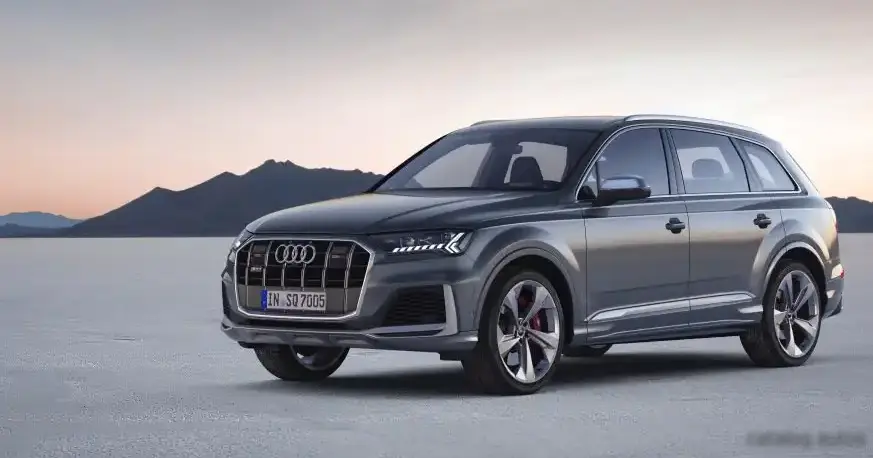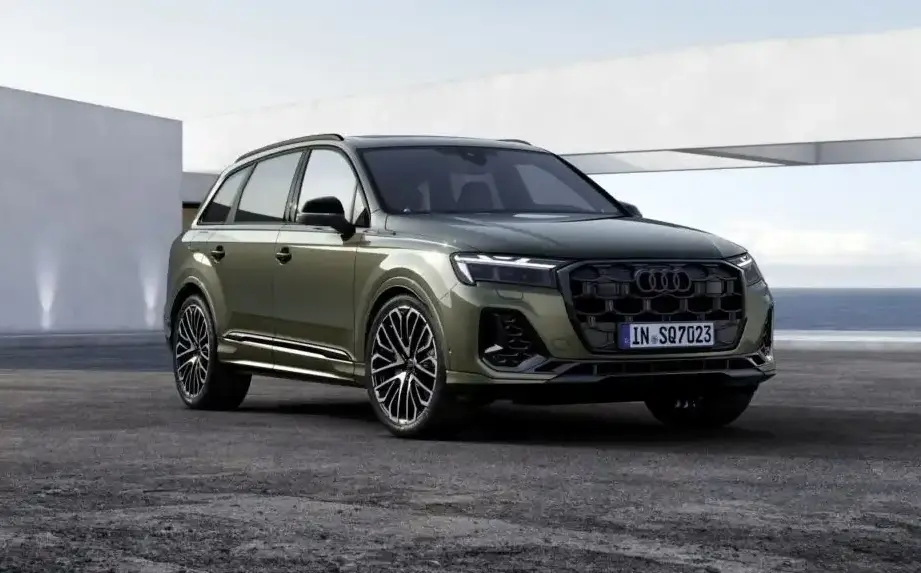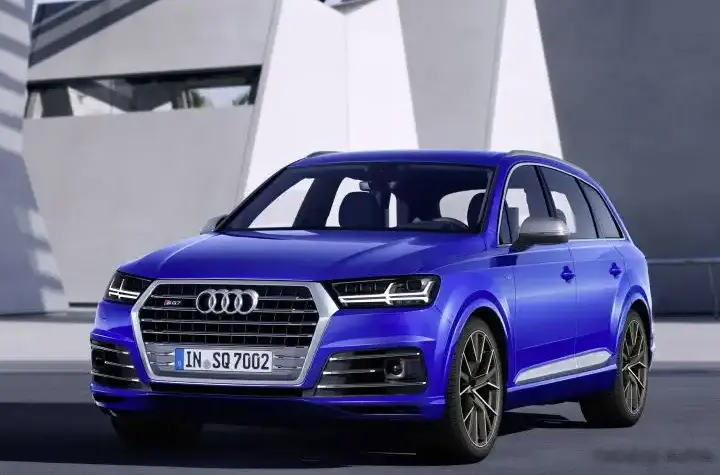
The Audi SQ7 (Typ 4M) 4.0 TDI V8 (435 Hp) quattro Tiptronic represents a high-performance iteration of Audi’s large luxury SUV, the Q7. Introduced in 2016 and continuing through 2019, this variant occupied the top performance tier of the second-generation Q7 lineup (Typ 4M), positioned above the standard Q7 models and serving as a direct competitor to performance SUVs like the Porsche Cayenne S and BMW X5 M50d. It combined a potent diesel V8 engine with Audi’s renowned quattro all-wheel-drive system and a sophisticated eight-speed Tiptronic automatic transmission, delivering a blend of luxury, performance, and practicality.
| Brand | Audi |
| Model | SQ7 |
| Generation | SQ7 (Typ 4M) |
| Type (Engine) | 4.0 TDI V8 (435 Hp) quattro Tiptronic |
| Start of production | 2016 |
| End of production | 2019 |
| Powertrain Architecture | Internal Combustion engine |
| Body type | SUV |
| Seats | 5 |
| Doors | 5 |
| Fuel consumption (urban) | 8.4-8.6 l/100 km (28 – 27.4 US mpg) |
| Fuel consumption (extra urban) | 6.5-6.9 l/100 km (36.2 – 34.1 US mpg) |
| Fuel consumption (combined) | 7.2-7.5 l/100 km (32.7 – 31.4 US mpg) |
| CO2 emissions | 189-198 g/km |
| Fuel Type | Diesel |
| Acceleration 0 – 100 km/h | 4.8 sec |
| Acceleration 0 – 62 mph | 4.8 sec |
| Acceleration 0 – 60 mph | 4.6 sec |
| Maximum speed | 250 km/h (155.34 mph) |
| Emission standard | Euro 6 |
| Weight-to-power ratio | 5.2 kg/Hp, 191.6 Hp/tonne |
| Weight-to-torque ratio | 2.5 kg/Nm, 396.5 Nm/tonne |
| Power | 435 Hp @ 3750-5000 rpm |
| Power per litre | 110 Hp/l |
| Torque | 900 Nm @ 1000-3250 rpm (663.81 lb.-ft. @ 1000-3250 rpm) |
| Maximum engine speed | 5000 rpm |
| Engine layout | Front, Longitudinal |
| Engine Model/Code | CZAC, DHVA |
| Engine displacement | 3956 cm3 (241.41 cu. in.) |
| Number of cylinders | 8 |
| Engine configuration | V-engine |
| Cylinder Bore | 83 mm (3.27 in.) |
| Piston Stroke | 91.4 mm (3.6 in.) |
| Compression ratio | 16:1 |
| Number of valves per cylinder | 4 |
| Fuel injection system | Diesel Commonrail |
| Engine aspiration | Twin-Turbo and Electric Powered Compressor, Intercooler |
| Valvetrain | DOHC |
| Engine oil capacity | 9.1 l (9.62 US qt | 8.01 UK qt) |
| Kerb Weight | 2270 kg (5004.49 lbs.) |
| Max. weight | 3030 kg (6680.01 lbs.) |
| Max load | 760 kg (1675.51 lbs.) |
| Trunk (boot) space – minimum | 805 l (28.43 cu. ft.) |
| Trunk (boot) space – maximum | 1990 l (70.28 cu. ft.) |
| Fuel tank capacity | 85 l (22.45 US gal | 18.7 UK gal) |
| Max. roof load | 100 kg (220.46 lbs.) |
| Permitted trailer load with brakes (8%) | 3500 kg (7716.18 lbs.) |
| Permitted trailer load with brakes (12%) | 3500 kg (7716.18 lbs.) |
| Permitted trailer load without brakes | 750 kg (1653.47 lbs.) |
| Permitted towbar download | 140 kg (308.65 lbs.) |
| Length | 5069 mm (199.57 in.) |
| Width | 1968 mm (77.48 in.) |
| Width including mirrors | 2212 mm (87.09 in.) |
| Height | 1741 mm (68.54 in.) |
| Wheelbase | 2996 mm (117.95 in.) |
| Front track | 1679 mm (66.1 in.) |
| Rear (Back) track | 1679 mm (66.1 in.) |
| Front overhang | 978 mm (38.5 in.) |
| Rear overhang | 1095 mm (43.11 in.) |
| Drag coefficient (Cd) | 0.331 |
| Minimum turning circle (turning diameter) | 12.4 m (40.68 ft.) |
| Drive wheel | All wheel drive (4×4) |
| Number of gears and type of gearbox | 8 gears, automatic transmission Tiptronic |
| Front suspension | Independent multi-link suspension |
| Rear suspension | Independent multi-link suspension |
| Front brakes | Ventilated discs |
| Rear brakes | Ventilated discs |
| Assisting systems | ABS (Anti-lock braking system) |
| Steering type | Steering rack and pinion |
| Power steering | Electric Steering |
| Tires size | 285/45 R20 |
| Wheel rims size | 20 |
Powertrain & Engine Architecture
The heart of the SQ7 (Typ 4M) is the 4.0-liter twin-turbocharged diesel V8 engine, designated CZAC or DHVA depending on the specific production year and market. This engine is a significant departure from naturally aspirated V8s, employing two turbochargers and an electric powered compressor (EPC) to virtually eliminate turbo lag and deliver instant power. The EPC spools up immediately, providing boost at low engine speeds before the larger turbochargers take over. The engine utilizes a Bosch diesel common rail injection system, capable of multiple injections per combustion cycle for optimized efficiency and reduced emissions. The valvetrain features double overhead camshafts (DOHC) with four valves per cylinder. The eight-speed Tiptronic automatic transmission is specifically tuned for the high torque output of the diesel V8, offering smooth and responsive shifts. It features a torque converter lockup clutch for improved efficiency at cruising speeds.
Driving Characteristics
The SQ7 4.0 TDI with the Tiptronic transmission delivers a remarkably smooth and effortless driving experience. The abundance of torque – 900 Nm (663.81 lb-ft) – is available from a very low 1000 rpm, providing strong acceleration in virtually any gear. While not as overtly sporty as some of its gasoline-powered rivals, the SQ7 offers impressive performance, achieving 0-60 mph in around 4.6 seconds. The Tiptronic transmission, while not as engaging as a dual-clutch gearbox, provides quick and seamless shifts, and the driver can manually select gears using the shift lever or steering wheel-mounted paddles. Compared to the standard Q7’s 2.0-liter four-cylinder engine, the SQ7 offers a substantial performance upgrade, and even compared to the Q7 3.0 TDI, the V8 provides a more refined and powerful experience.
Equipment & Trim Levels
The SQ7 (Typ 4M) came generously equipped as standard. Interior features typically included sport seats upholstered in a combination of Alcantara and leather, brushed aluminum trim, a three-spoke multifunction steering wheel, and Audi’s MMI infotainment system with a large central display screen. Standard safety features included Audi’s side assist, rear cross-traffic assist, and a comprehensive airbag system. Optional extras included a panoramic sunroof, adaptive air suspension, a Bang & Olufsen sound system, and various driver-assistance packages. The SQ7 trim level was generally positioned as the top-of-the-line offering, with fewer standalone options available compared to the standard Q7 models.
Chassis & Braking
The SQ7 features a fully independent suspension system, with multi-link setups at both the front and rear. The suspension is tuned for a balance between comfort and handling, providing a relatively compliant ride while minimizing body roll during cornering. Standard brakes consisted of ventilated discs at all four corners, with larger rotors and calipers compared to the standard Q7. The SQ7 also benefited from Audi’s quattro all-wheel-drive system, which provides excellent traction in all weather conditions. The system typically operates with a rear-biased torque distribution, enhancing driving dynamics.
Market Reception & Comparison
The Audi SQ7 (Typ 4M) was generally well-received by automotive critics. It was praised for its powerful engine, smooth transmission, comfortable ride, and luxurious interior. However, some reviewers noted that the SQ7 lacked the outright sportiness of some of its competitors. Fuel economy was considered respectable for a vehicle of its size and performance, averaging around 32.7 – 31.4 US mpg in combined driving. Compared to the Q7 3.0 TDI, the SQ7 offered significantly more performance but at the cost of slightly higher fuel consumption. Reliability reports have been generally positive, with the 4.0 TDI V8 proving to be a robust and durable engine.
Legacy
The SQ7 (Typ 4M) established itself as a compelling alternative in the performance luxury SUV segment. The 4.0 TDI V8 engine, with its innovative twin-turbo and EPC technology, remains a highly regarded powerplant. On the used car market, the SQ7 (Typ 4M) holds its value well, particularly well-maintained examples with low mileage. The combination of performance, luxury, and practicality continues to appeal to buyers seeking a versatile and capable SUV. While newer iterations of the SQ7 have emerged, the Typ 4M remains a desirable and respected vehicle among enthusiasts.