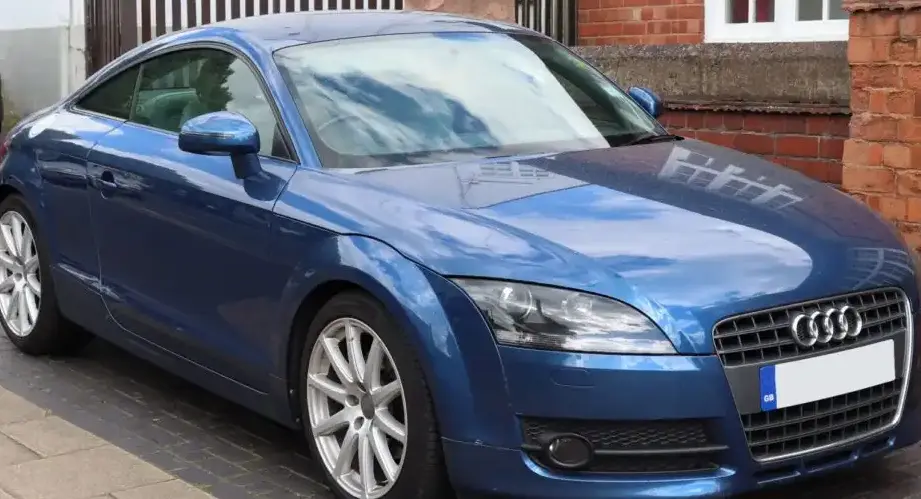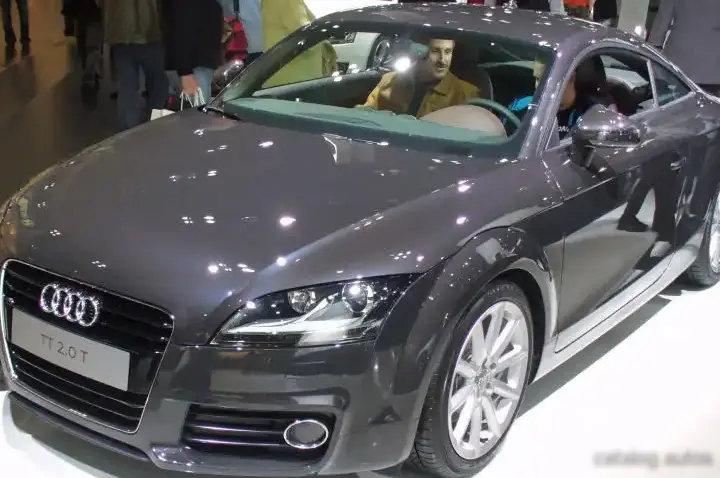
The Audi TT Coupe (8J facelift) 2.0 TFSI quattro S tronic, produced from 2010 to 2014, represents a significant evolution of Audi’s iconic sports coupe. This variant occupied a mid-to-high position within the 8J TT lineup, offering a compelling blend of performance, all-weather capability, and sophisticated technology. It built upon the foundation of the original 8J TT, introduced in 2006, with styling refinements and, crucially, updated engine options and transmission choices. The facelift brought revised front and rear aesthetics, interior enhancements, and improvements to the engine range, solidifying the TT’s appeal as a premium compact sports car.
Technical Specifications
| Brand | Audi |
| Model | TT |
| Generation | TT Coupe (8J, facelift 2010) |
| Type (Engine) | 2.0 TFSI (211 Hp) quattro S tronic |
| Start of production | 2010 |
| End of production | 2014 |
| Powertrain Architecture | Internal Combustion engine |
| Body type | Coupe |
| Seats | 4 |
| Doors | 3 |
| Fuel consumption (economy) – urban (NEDC) | 9.9 l/100 km (23.8 US mpg, 28.5 UK mpg, 10.1 km/l) |
| Fuel consumption (economy) – extra urban (NEDC) | 5.7 l/100 km (41.3 US mpg, 49.6 UK mpg, 17.5 km/l) |
| Fuel consumption (economy) – combined (NEDC) | 7.2 l/100 km (32.7 US mpg, 39.2 UK mpg, 13.9 km/l) |
| CO2 emissions (NEDC) | 169 g/km |
| Fuel Type | Petrol (Gasoline) |
| Acceleration 0 – 100 km/h | 5.7 sec |
| Acceleration 0 – 62 mph | 5.7 sec |
| Acceleration 0 – 60 mph | 5.4 sec |
| Maximum speed | 243 km/h (150.99 mph) |
| Emission standard | Euro 5 |
| Weight-to-power ratio | 6.5 kg/Hp, 152.9 Hp/tonne |
| Weight-to-torque ratio | 3.9 kg/Nm, 253.6 Nm/tonne |
| Power | 211 Hp @ 4300-6000 rpm |
| Power per litre | 106.4 Hp/l |
| Torque | 350 Nm @ 1600-4200 rpm (258.15 lb.-ft. @ 1600-4200 rpm) |
| Engine layout | Front, Transverse |
| Engine Model/Code | EA888 / CESA, CETA |
| Engine displacement | 1984 cm3 (121.07 cu. in.) |
| Number of cylinders | 4 |
| Engine configuration | Inline |
| Cylinder Bore | 82.5 mm (3.25 in.) |
| Piston Stroke | 92.8 mm (3.65 in.) |
| Compression ratio | 9.6:1 |
| Number of valves per cylinder | 4 |
| Fuel injection system | Direct injection |
| Engine aspiration | Turbocharger, Intercooler |
| Valvetrain | DOHC |
| Engine oil capacity | 4.6 l (4.86 US qt | 4.05 UK qt) |
| Coolant | 8.6 l (9.09 US qt | 7.57 UK qt) |
| Kerb Weight | 1380 kg (3042.38 lbs.) |
| Max. weight | 1780 kg (3924.23 lbs.) |
| Max load | 400 kg (881.85 lbs.) |
| Trunk (boot) space – minimum | 292 l (10.31 cu. ft.) |
| Trunk (boot) space – maximum | 700 l (24.72 cu. ft.) |
| Fuel tank capacity | 60 l (15.85 US gal | 13.2 UK gal) |
| Max. roof load | 75 kg (165.35 lbs.) |
| Length | 4198 mm (165.28 in.) |
| Width | 1842 mm (72.52 in.) |
| Width including mirrors | 1952 mm (76.85 in.) |
| Height | 1353 mm (53.27 in.) |
| Wheelbase | 2468 mm (97.17 in.) |
| Front track | 1572 mm (61.89 in.) |
| Rear (Back) track | 1558 mm (61.34 in.) |
| Front overhang | 911 mm (35.87 in.) |
| Rear overhang | 819 mm (32.24 in.) |
| Drag coefficient (Cd) | 0.30 |
| Minimum turning circle | 10.96 m (35.96 ft.) |
| Drivetrain Architecture | All wheel drive (4×4). ICE drives front wheels, rear driven by clutch. |
| Drive wheel | All wheel drive (4×4) |
| Number of gears and type of gearbox | 6 gears, automatic transmission S tronic |
| Front suspension | Independent, McPherson with coil spring and anti-roll bar |
| Rear suspension | Independent multi-link spring suspension with stabilizer |
| Front brakes | Ventilated discs, 312 mm |
| Rear brakes | Disc, 286 mm |
| Assisting systems | ABS (Anti-lock braking system) |
| Steering type | Steering rack and pinion |
| Power steering | Electric Steering |
| Tires size | 225/55 R16 |
| Wheel rims size | 7.5J x 16 |
INTRODUCTION
The 2010-2014 Audi TT Coupe 2.0 TFSI quattro S tronic represents a sweet spot in the 8J generation. Positioned above the base 1.8 TFSI models, it offered a substantial performance upgrade without reaching the higher price point of the TTS. The “quattro” designation signifies Audi’s renowned all-wheel-drive system, providing enhanced traction and stability, particularly valuable in inclement weather. The “S tronic” label denotes Audi’s dual-clutch transmission (DCT), known for its rapid shifts and efficiency. This combination made the 2.0 TFSI quattro S tronic a popular choice for drivers seeking a sporty, yet practical, coupe.
Powertrain & Engine Architecture
At the heart of this TT variant lies the EA888 engine family, specifically the CESA or CETA code depending on the exact production year and market. This is a 1.984-liter (121.07 cubic inches) turbocharged inline-four cylinder engine. The engine utilizes direct fuel injection (FSI) and a turbocharger with an intercooler to deliver 211 horsepower at 4300-6000 rpm and 258.15 lb.-ft. of torque between 1600-4200 rpm. The EA888 engine is known for its robust construction and responsiveness. The dual overhead camshafts (DOHC) and four valves per cylinder contribute to its efficient breathing and power output. The S tronic transmission is a six-speed dual-clutch unit. It operates by utilizing two separate clutches – one for odd gears and one for even gears – allowing for incredibly fast and seamless gear changes. This transmission can be operated in fully automatic mode or manually via steering wheel-mounted paddle shifters or the gear selector.
Driving Characteristics
The 2.0 TFSI quattro S tronic delivers a noticeably more engaging driving experience than the base 1.8 TFSI. The increased horsepower and torque, combined with the quick-shifting S tronic transmission and the grip of the quattro all-wheel-drive system, result in a 0-60 mph time of around 5.4 seconds. The S tronic transmission’s programming prioritizes quick shifts in dynamic mode, while offering smoother transitions in comfort mode. The quattro system provides excellent traction, allowing for confident cornering and acceleration even on slippery surfaces. Compared to the manual transmission versions of the 2.0 TFSI, the S tronic offers slightly reduced driver involvement but compensates with superior acceleration and convenience. The gear ratios are tuned for a balance between performance and fuel efficiency, providing ample power for both highway cruising and spirited driving.
Equipment & Trim Levels
The 2.0 TFSI quattro S tronic typically came well-equipped, though options were plentiful. Standard features generally included leather upholstery, automatic climate control, a multi-function steering wheel, and an Audi Concert audio system. Common optional extras included navigation, upgraded sound systems (Bose or Bang & Olufsen), parking sensors, heated seats, and various styling packages. Interior trim options ranged from standard aluminum accents to carbon fiber or wood veneers. The dashboard layout is driver-focused, with a clean and modern design. The TT’s signature feature – the aluminum-trimmed instrument binnacles – adds a touch of sophistication.
Chassis & Braking
The 8J TT utilizes a McPherson strut front suspension and a multi-link rear suspension. This setup provides a good balance between ride comfort and handling precision. Stabilizer bars are fitted front and rear to reduce body roll during cornering. The 2.0 TFSI quattro models typically featured larger brakes than the base models, with ventilated discs at the front (312mm) and solid discs at the rear (286mm). ABS (Anti-lock Braking System) is standard. The quattro all-wheel-drive system utilizes a Haldex multi-plate clutch to distribute torque between the front and rear axles as needed, providing optimal traction in various conditions.
Market Reception & Comparison
The 2.0 TFSI quattro S tronic was generally well-received by automotive critics. It was praised for its performance, handling, and sophisticated interior. Compared to the 1.8 TFSI, the 2.0 TFSI offered a significant performance boost, justifying the higher price. Against the higher-performance TTS, it provided a more accessible entry point into the TT range, offering a similar driving experience at a lower cost. Fuel economy was respectable for a sports coupe, averaging around 32.7 US mpg in combined driving. Reliability was generally good, although some owners have reported issues with the turbocharger and the S tronic transmission, particularly with later production years.
Legacy
The Audi TT Coupe (8J) 2.0 TFSI quattro S tronic remains a desirable used sports car. The EA888 engine, while not without its potential issues, is generally considered robust and relatively easy to maintain. The S tronic transmission, if properly maintained (regular fluid changes are crucial), can provide years of reliable service. The combination of performance, style, and all-weather capability continues to appeal to enthusiasts. Values have remained relatively stable, reflecting the TT’s enduring popularity and reputation as a well-rounded and enjoyable sports coupe. Finding a well-maintained example with a complete service history is key to ensuring long-term ownership satisfaction.