Technical Specifications
| Brand | Audi |
| Model | TT |
| Generation | TT Coupe (8N, facelift 2000) |
| Type (Engine) | 1.8 T (180 Hp) |
| Start of production | 2000 year |
| End of production | June, 2006 year |
| Powertrain Architecture | Internal Combustion engine |
| Body type | Coupe |
| Seats | 4 |
| Doors | 3 |
| Fuel consumption (economy) – urban | 11.1 l/100 km (21.2 US mpg, 25.4 UK mpg, 9 km/l) |
| Fuel consumption (economy) – extra urban | 6.3 l/100 km (37.3 US mpg, 44.8 UK mpg, 15.9 km/l) |
| Fuel consumption (economy) – combined | 8.1 l/100 km (29 US mpg, 34.9 UK mpg, 12.3 km/l) |
| CO2 emissions | 194 g/km |
| Fuel Type | Petrol (Gasoline) |
| Acceleration 0 – 100 km/h | 7.8 sec |
| Acceleration 0 – 62 mph | 7.8 sec |
| Acceleration 0 – 60 mph | 7.4 sec |
| Maximum speed | 228 km/h (141.67 mph) |
| Emission standard | Euro 4 |
| Weight-to-power ratio | 7.1 kg/Hp, 140.6 Hp/tonne |
| Weight-to-torque ratio | 5.4 kg/Nm, 183.6 Nm/tonne |
| Power | 180 Hp @ 5500 rpm |
| Power per litre | 101.1 Hp/l |
| Torque | 235 Nm @ 1950-5000 rpm (173.33 lb.-ft. @ 1950-5000 rpm) |
| Engine layout | Front, Transverse |
| Engine Model/Code | AJQ, APP, ATC, AUQ |
| Engine displacement | 1781 cm3 (108.68 cu. in.) |
| Number of cylinders | 4 |
| Engine configuration | Inline |
| Cylinder Bore | 81 mm (3.19 in.) |
| Piston Stroke | 86.4 mm (3.4 in.) |
| Compression ratio | 9.5:1 |
| Number of valves per cylinder | 5 |
| Fuel injection system | Multi-port manifold injection |
| Engine aspiration | Turbocharger, Intercooler |
| Valvetrain | DOHC |
| Engine oil capacity | 4.5 l (4.76 US qt | 3.96 UK qt) |
| Coolant | 5 l (5.28 US qt | 4.4 UK qt) |
| Kerb Weight | 1280 kg (2821.92 lbs.) |
| Max. weight | 1665 kg (3670.7 lbs.) |
| Max load | 385 kg (848.78 lbs.) |
| Trunk (boot) space – minimum | 270 l (9.53 cu. ft.) |
| Trunk (boot) space – maximum | 540 l (19.07 cu. ft.) |
| Fuel tank capacity | 55 l (14.53 US gal | 12.1 UK gal) |
| Max. roof load | 75 kg (165.35 lbs.) |
| Length | 4041 mm (159.09 in.) |
| Width | 1764 mm (69.45 in.) |
| Height | 1346 mm (52.99 in.) |
| Wheelbase | 2422 mm (95.35 in.) |
| Front track | 1528 mm (60.16 in.) |
| Rear (Back) track | 1513 mm (59.57 in.) |
| Drag coefficient (Cd) | 0.32 |
| Minimum turning circle | 10.6 m (34.78 ft.) |
| Drivetrain Architecture | The Internal combustion engine (ICE) drives the front wheels of the vehicle. |
| Drive wheel | Front wheel drive |
| Number of gears and type of gearbox | 5 gears, manual transmission |
| Front suspension | Independent, type McPherson with coil spring and anti-roll bar |
| Rear suspension | independent torsion suspension |
| Front brakes | Ventilated discs |
| Rear brakes | Disc |
| Assisting systems | ABS (Anti-lock braking system) |
| Steering type | Steering rack and pinion |
| Power steering | Hydraulic Steering |
| Tires size | 205/55 R16 |
| Wheel rims size | 7J x 16 |
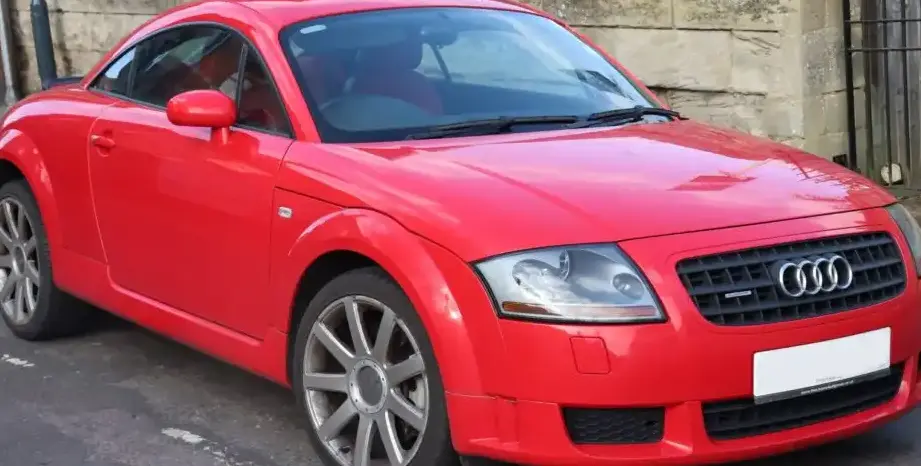
The Audi TT Coupe (8N), particularly the facelifted version introduced in 2000, represented a bold step for the German automaker. Positioned as a sporty and design-focused coupe, the 8N TT aimed to attract a younger demographic to the Audi brand. Production of the facelifted model ran from 2000 through June 2006. Within the 8N range, the 1.8T variant, producing 180 horsepower, served as a compelling entry point into the TT lineup, offering a balance of performance and affordability. It was built on the Volkswagen Group’s A4 (B5) platform, known internally as the 1HX0/A3 platform, which also underpinned models like the Volkswagen Golf and New Beetle.
Powertrain & Engine Architecture
The heart of the 1.8T variant was the 1781cc inline-four cylinder engine, identifiable by engine codes such as AJQ, APP, ATC, and AUQ. This engine was a mainstay of the Volkswagen Group’s offerings during the late 1990s and early 2000s. It featured multi-port fuel injection and, crucially, a turbocharger with an intercooler. The turbocharger significantly boosted power output compared to naturally aspirated versions of the 1.8L engine. The engine utilized a double overhead camshaft (DOHC) valvetrain with five valves per cylinder – three intake and two exhaust – contributing to its relatively high specific output. The 180 horsepower version typically employed a slightly smaller turbocharger and different engine management calibrations compared to the higher-output 225 hp variant found in other TT models. The transmission was a 5-speed manual as standard, providing direct control over the engine’s power.
Driving Characteristics
The 1.8T 180 hp TT offered a spirited driving experience, though it wasn’t as overtly aggressive as the more powerful versions. Acceleration from 0-60 mph took around 7.4 to 7.8 seconds, respectable for the era. The turbocharger provided a noticeable surge of power in the mid-range, making overtaking maneuvers relatively easy. However, the power delivery wasn’t as immediate or linear as a naturally aspirated engine. The 5-speed manual transmission was well-matched to the engine’s characteristics, offering precise shifts. Compared to the 225 hp TT, the 1.8T felt less urgent, but it also offered better fuel economy and a more forgiving powerband for everyday driving. The front-wheel-drive configuration, while contributing to lighter weight, could exhibit torque steer under hard acceleration.
Equipment & Trim Levels
The 1.8T TT typically came with a reasonable level of standard equipment. Interior features included sport seats, a leather-wrapped steering wheel, and air conditioning. The dashboard layout was characterized by its minimalist design, with a focus on the driver. Optional extras included leather upholstery, a sunroof, and a premium sound system. The 1.8T trim often served as a base for customization, allowing buyers to add options to tailor the car to their preferences. Exterior features generally included alloy wheels, though the size and design varied depending on the package selected.
Chassis & Braking
The 8N TT’s chassis was designed to provide a balance of comfort and handling. The front suspension utilized a McPherson strut setup with coil springs and an anti-roll bar, while the rear suspension employed an independent torsion beam arrangement. This configuration provided a relatively compliant ride while still offering good cornering stability. Brakes consisted of ventilated discs at the front and solid discs at the rear. Anti-lock braking system (ABS) was standard. The suspension tuning was generally firmer than that of more mainstream Audi models, reflecting the TT’s sporty aspirations.
Market Reception & Comparison
The 1.8T TT was generally well-received by automotive critics. It was praised for its striking design, engaging driving dynamics, and relatively affordable price point. Compared to the more expensive 225 hp version, the 1.8T offered a more sensible option for buyers who prioritized fuel economy and everyday usability. Fuel economy figures were around 29 US mpg combined, making it reasonably efficient for a sports coupe. Reliability was generally good, although turbocharger issues could occasionally arise with higher-mileage examples. The 1.8T provided a compelling alternative to rivals such as the BMW Z3 and Mercedes-Benz SLK.
Legacy
The Audi TT 8N, and particularly the 1.8T variant, has become a modern classic. The engine, while not without its potential maintenance needs (particularly related to the turbocharger and coil packs), is generally durable. Today, well-maintained examples of the 1.8T TT are sought after by enthusiasts for their combination of style, performance, and relative affordability. The 8N TT played a significant role in establishing Audi as a design leader and attracting a new generation of buyers to the brand. The 1.8T engine, in particular, remains a popular choice for modification and tuning, offering potential for increased power output.