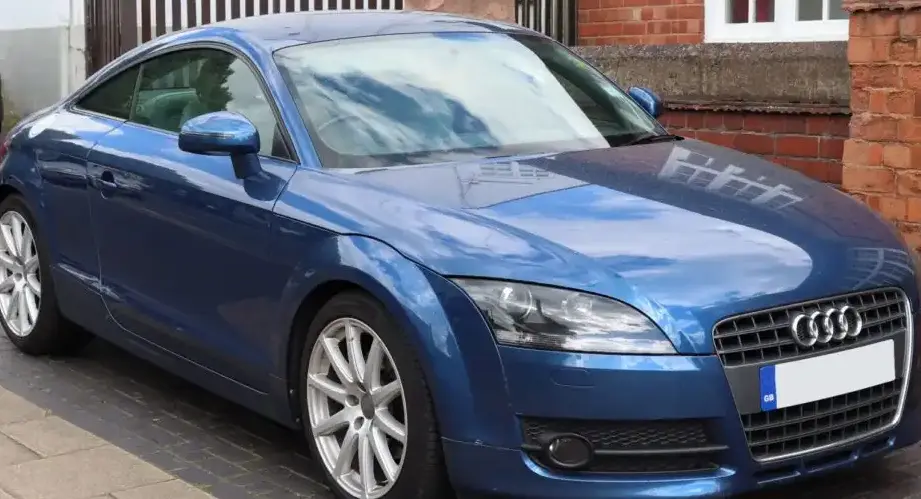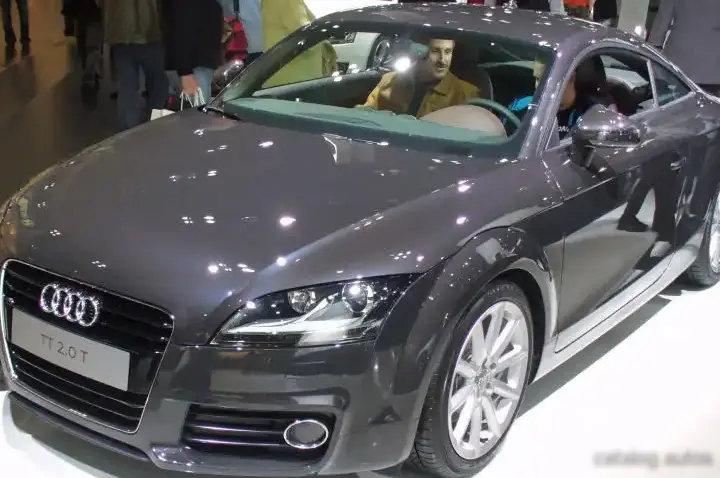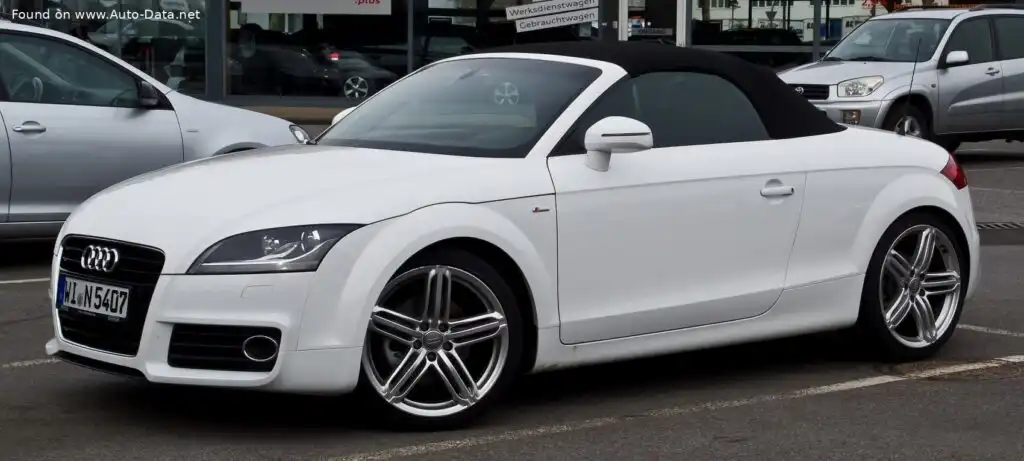
The Audi TT Roadster (8J, facelift) 2.0 TFSI, produced from May 2010 to June 2014, represents a mid-cycle refresh of the first-generation TT Roadster. Positioned as a premium compact roadster, it aimed to blend sporty handling with open-top motoring and Audi’s signature interior quality. This variant, equipped with the 2.0-liter turbocharged four-cylinder engine producing 211 horsepower, occupied a sweet spot in the TT lineup, offering a significant performance upgrade over the base models while remaining more accessible than the range-topping versions. It was a key model for Audi in the European market, appealing to buyers seeking a stylish and engaging driving experience.
Technical Specifications
| Brand | Audi |
| Model | TT |
| Generation | TT Roadster (8J, facelift 2010) |
| Type (Engine) | 2.0 TFSI (211 Hp) |
| Start of production | May, 2010 |
| End of production | June, 2014 |
| Powertrain Architecture | Internal Combustion engine |
| Body type | Roadster |
| Seats | 2 |
| Doors | 2 |
| Fuel consumption (urban) | 9 l/100 km (26.1 US mpg, 31.4 UK mpg, 11.1 km/l) |
| Fuel consumption (extra urban) | 5.4 l/100 km (43.6 US mpg, 52.3 UK mpg, 18.5 km/l) |
| Fuel consumption (combined) | 6.7 l/100 km (35.1 US mpg, 42.2 UK mpg, 14.9 km/l) |
| CO2 emissions | 156 g/km |
| Fuel Type | Petrol (Gasoline) |
| Acceleration 0 – 100 km/h | 6.3 sec |
| Acceleration 0 – 62 mph | 6.3 sec |
| Acceleration 0 – 60 mph | 6 sec (Calculated) |
| Maximum speed | 242 km/h (150.37 mph) |
| Emission standard | Euro 5 |
| Weight-to-power ratio | 6.2 kg/Hp, 160.5 Hp/tonne |
| Weight-to-torque ratio | 3.8 kg/Nm, 266.2 Nm/tonne |
| Power | 211 Hp @ 4500-6200 rpm |
| Power per litre | 106.4 Hp/l |
| Torque | 350 Nm @ 1600-4200 rpm (258.15 lb.-ft. @ 1600-4200 rpm) |
| Engine layout | Front, Transverse |
| Engine Model/Code | CESA, CETA |
| Engine displacement | 1984 cm3 (121.07 cu. in.) |
| Number of cylinders | 4 |
| Engine configuration | Inline |
| Cylinder Bore | 82.5 mm (3.25 in.) |
| Piston Stroke | 92.8 mm (3.65 in.) |
| Compression ratio | 9.6:1 |
| Number of valves per cylinder | 4 |
| Fuel injection system | Direct injection |
| Engine aspiration | Turbocharger, Intercooler |
| Valvetrain | DOHC |
| Engine oil capacity | 4.6 l (4.86 US qt | 4.05 UK qt) |
| Coolant | 8.6 l (9.09 US qt | 7.57 UK qt) |
| Kerb Weight | 1315 kg (2899.08 lbs.) |
| Max. weight | 1635 kg (3604.56 lbs.) |
| Max load | 320 kg (705.48 lbs.) |
| Trunk (boot) space – minimum | 250 l (8.83 cu. ft.) |
| Trunk (boot) space – maximum | 700 l (24.72 cu. ft.) |
| Fuel tank capacity | 55 l (14.53 US gal | 12.1 UK gal) |
| Length | 4198 mm (165.28 in.) |
| Width | 1842 mm (72.52 in.) |
| Width including mirrors | 1952 mm (76.85 in.) |
| Height | 1358 mm (53.46 in.) |
| Wheelbase | 2468 mm (97.17 in.) |
| Front track | 1572 mm (61.89 in.) |
| Rear (Back) track | 1558 mm (61.34 in.) |
| Front overhang | 911 mm (35.87 in.) |
| Rear overhang | 819 mm (32.24 in.) |
| Drag coefficient (Cd) | 0.32 |
| Minimum turning circle | 10.96 m (35.96 ft.) |
| Drivetrain Architecture | Front wheel drive |
| Drive wheel | Front wheel drive |
| Number of gears | 6 gears, manual transmission |
| Front suspension | Independent, type McPherson with coil spring and anti-roll bar |
| Rear suspension | Independent multi-link spring suspension with stabilizer |
| Front brakes | Ventilated discs |
| Rear brakes | Disc |
| Assisting systems | ABS (Anti-lock braking system) |
| Steering type | Steering rack and pinion |
| Tires size | 225/55 R16 |
| Wheel rims size | 7.5J x 16 |
INTRODUCTION
The 8J generation Audi TT Roadster, launched in 2006, marked a departure from the Bauhaus-inspired original. The facelifted version, introduced in 2010, brought revised styling, improved efficiency, and updated technology. The 2.0 TFSI variant with 211 horsepower was a popular choice, offering a compelling balance of performance and practicality. It sat comfortably in the middle of the range, above the entry-level 1.8 TFSI and below the more potent 3.2 V6 and later, the TTS models. This model year saw updates to the front fascia, headlights, and interior trim, further refining the TT’s already attractive design.
Powertrain & Engine Architecture
At the heart of the 2.0 TFSI Roadster lies the CESA or CETA engine code, a 1984cc inline-four cylinder engine. This engine is a direct-injection, turbocharged powerplant, benefiting from Audi’s extensive experience with forced induction. The direct injection system, coupled with the turbocharger and intercooler, allows for precise fuel delivery and increased air density, resulting in improved power and efficiency. The engine utilizes a dual overhead camshaft (DOHC) valvetrain with four valves per cylinder, optimizing gas flow for enhanced performance. The 211 hp output is achieved through careful tuning of the engine management system and turbocharger boost pressure. The engine is transversely mounted in the front of the vehicle, driving the front wheels. The six-speed manual transmission was standard, providing precise gear changes and a direct connection to the engine.
Driving Characteristics
The 211 hp 2.0 TFSI Roadster delivers a spirited driving experience. Acceleration from 0 to 60 mph takes approximately 6 seconds, and the car reaches a top speed of 150 mph. While not as brutally fast as the higher-output models, the 2.0 TFSI provides ample power for everyday driving and enjoyable weekend excursions. The turbocharger provides a noticeable boost in torque, particularly in the mid-range, making overtaking maneuvers effortless. The manual transmission’s gear ratios are well-matched to the engine’s powerband, allowing for responsive acceleration in all gears. Compared to the 1.8 TFSI, the 2.0 TFSI offers a significant performance improvement, while the higher-output TTS model provides even more aggressive acceleration and a more focused driving experience. The front-wheel-drive configuration provides good traction in most conditions, but can exhibit some torque steer under hard acceleration.
Equipment & Trim Levels
The 2.0 TFSI Roadster came standard with a generous array of features, including leather upholstery, automatic climate control, a multi-function steering wheel, and a premium audio system. Optional extras included navigation, heated seats, parking sensors, and a wind deflector to reduce turbulence in the cabin with the top down. Interior trim options allowed buyers to personalize the car to their tastes, with a range of colors and materials available. The dashboard layout is driver-focused, with clear and intuitive controls. The overall interior ambiance is one of quality and sophistication, reflecting Audi’s commitment to craftsmanship.
Chassis & Braking
The TT Roadster’s chassis is based on the Volkswagen Group’s PQ35 platform. The front suspension utilizes a McPherson strut design with coil springs and an anti-roll bar, while the rear suspension employs a multi-link setup, also with a stabilizer bar. This configuration provides a good balance of ride comfort and handling precision. The braking system consists of ventilated discs at the front and solid discs at the rear, providing ample stopping power. Anti-lock braking system (ABS) is standard, enhancing safety and control. The steering is a rack-and-pinion system, offering precise and responsive steering feel.
Market Reception & Comparison
The Audi TT Roadster 2.0 TFSI was generally well-received by automotive critics. It was praised for its stylish design, engaging driving dynamics, and high-quality interior. Fuel economy was considered respectable for a performance roadster, with combined fuel consumption averaging around 35 mpg. Reliability was generally good, although some owners reported minor issues with the turbocharger and direct injection system. Compared to rivals such as the BMW Z4 and Porsche Boxster, the TT Roadster offered a more affordable entry point into the premium roadster segment, while still delivering a compelling driving experience.
Legacy
The 8J generation Audi TT Roadster, particularly the 2.0 TFSI variant, has proven to be a durable and desirable used car. The engine, while requiring regular maintenance, is generally reliable. Common issues include carbon buildup on the intake valves (a characteristic of direct-injection engines) and potential turbocharger wear. However, these issues are typically addressable with proper maintenance and preventative servicing. Today, the 2.0 TFSI Roadster remains a popular choice for buyers seeking a stylish, sporty, and relatively affordable open-top roadster. Its timeless design and engaging driving dynamics ensure its continued appeal for years to come.