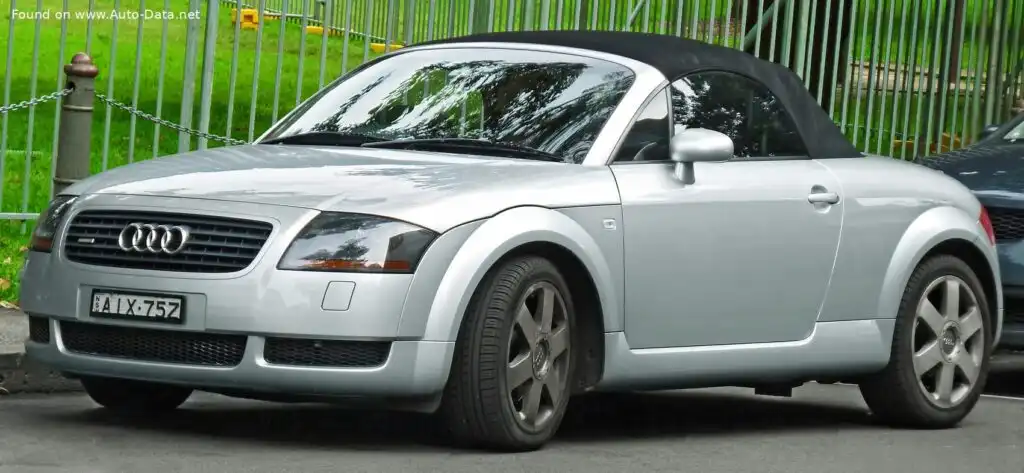
The Audi TT Roadster (8N) 1.8T quattro, produced from October 1998 to 2000, marked Audi’s entry into the accessible sports car market. Built on the Volkswagen Group’s A4/Golf platform – specifically the 1HX0/A3 variant – the first-generation TT aimed to deliver a stylish and engaging driving experience at a competitive price. The 1.8T quattro model held a crucial position in the initial TT lineup, bridging the gap between the base 1.8T front-wheel-drive model and the more powerful 225 horsepower version. It appealed to buyers seeking all-wheel drive security and a performance boost without the higher cost of the flagship engine.
Technical Specifications
| Brand | Audi |
| Model | TT |
| Generation | TT Roadster (8N) |
| Type (Engine) | 1.8 T (180 Hp) quattro |
| Start of production | October, 1998 |
| End of production | 2000 |
| Powertrain Architecture | Internal Combustion engine |
| Body type | Roadster |
| Seats | 2 |
| Doors | 2 |
| Fuel consumption (urban) | 13.3 l/100 km (17.7 US mpg, 21.2 UK mpg, 7.5 km/l) |
| Fuel consumption (extra urban) | 7.5 l/100 km (31.4 US mpg, 37.7 UK mpg, 13.3 km/l) |
| Fuel consumption (combined) | 9.6 l/100 km (24.5 US mpg, 29.4 UK mpg, 10.4 km/l) |
| CO2 emissions | 230 g/km |
| Fuel Type | Petrol (Gasoline) |
| Acceleration 0 – 100 km/h | 7.9 sec |
| Acceleration 0 – 62 mph | 7.9 sec |
| Acceleration 0 – 60 mph | 7.5 sec |
| Maximum speed | 220 km/h (136.7 mph) |
| Emission standard | Euro 2 |
| Weight-to-power ratio | 7.9 kg/Hp, 125.9 Hp/tonne |
| Weight-to-torque ratio | 6.1 kg/Nm, 164.3 Nm/tonne |
| Power | 180 Hp @ 5500 rpm |
| Power per litre | 101.1 Hp/l |
| Torque | 235 Nm @ 1950-5000 rpm (173.33 lb.-ft. @ 1950-5000 rpm) |
| Engine layout | Front, Transverse |
| Engine Model/Code | AJQ, APP, ATC, AUQ |
| Engine displacement | 1781 cm3 (108.68 cu. in.) |
| Number of cylinders | 4 |
| Engine configuration | Inline |
| Cylinder Bore | 81 mm (3.19 in.) |
| Piston Stroke | 86.4 mm (3.4 in.) |
| Compression ratio | 9.5:1 |
| Number of valves per cylinder | 5 |
| Fuel injection system | Multi-port manifold injection |
| Engine aspiration | Turbocharger |
| Valvetrain | DOHC |
| Engine oil capacity | 4.5 l (4.76 US qt | 3.96 UK qt) |
| Coolant | 7 l (7.4 US qt | 6.16 UK qt) |
| Kerb Weight | 1430 kg (3152.61 lbs.) |
| Max. weight | 1730 kg (3814 lbs.) |
| Max load | 300 kg (661.39 lbs.) |
| Trunk (boot) space – minimum | 180 l (6.36 cu. ft.) |
| Fuel tank capacity | 62 l (16.38 US gal | 13.64 UK gal) |
| Length | 4041 mm (159.09 in.) |
| Width | 1764 mm (69.45 in.) |
| Height | 1348 mm (53.07 in.) |
| Wheelbase | 2429 mm (95.63 in.) |
| Front track | 1528 mm (60.16 in.) |
| Rear (Back) track | 1505 mm (59.25 in.) |
| Drag coefficient (Cd) | 0.34 |
| Minimum turning circle | 10.5 m (34.45 ft.) |
| Drive wheel | All wheel drive (4×4) |
| Number of gears | 6 gears, manual transmission |
| Front suspension | Independent, type McPherson with coil spring and anti-roll bar |
| Rear suspension | Independent multi-link spring suspension with stabilizer |
| Front brakes | Ventilated discs |
| Rear brakes | Disc |
| Assisting systems | ABS (Anti-lock braking system) |
| Steering type | Steering rack and pinion |
| Power steering | Hydraulic Steering |
| Tires size | 205/60 R16 |
| Wheel rims size | 7J x 16 |
Powertrain & Engine Architecture
The 1.8T quattro Roadster’s engine was a 1.8-liter, turbocharged inline-four cylinder. Engine codes varied – AJQ, APP, ATC, and AUQ were common – and all utilized a Bosch Motronic engine management system with multi-port fuel injection. The K03 turbocharger significantly boosted power compared to naturally aspirated engines. The engine featured a dual overhead camshaft (DOHC) valvetrain with five valves per cylinder (three intake, two exhaust), enhancing its responsiveness. Audi’s Torsen center differential was central to the quattro all-wheel-drive system, providing a rearward bias for sporty handling and dynamically distributing torque as needed. A 5-speed manual transmission was standard, but a 4-speed automatic was available, though often criticized for slower shifts.
Driving Characteristics
The 180 horsepower and 173 lb-ft of torque enabled 0-60 mph acceleration around 7.5 seconds. While slower than the 225 hp TT, the 180 hp version offered a more accessible powerband, with torque available from 1950 rpm. The quattro system enhanced traction, especially in poor weather. The automatic transmission, while convenient, diminished the driving experience, resulting in slower acceleration and less engagement compared to the manual. Gear ratios balanced acceleration and fuel economy, but the automatic’s programming could feel hesitant during overtaking.
Equipment & Trim Levels
The 1.8T quattro Roadster was well-equipped as standard, featuring sport seats, leather trim, and a multi-function steering wheel. Air conditioning, power windows, and power locks were also included. Optional extras included a premium sound system, heated seats, and a sunroof. The interior was minimalist and driver-focused, with aluminum trim accentuating the sporty character. Exterior options included various wheel designs and paint colors.
Chassis & Braking
The TT Roadster’s chassis featured independent suspension all around: McPherson struts at the front and a multi-link setup at the rear, balancing ride comfort and handling. Brakes were ventilated discs at the front and solid discs at the rear, with standard ABS. The car’s relatively low weight (around 3153 lbs) contributed to its agility. Stabilizer bars front and rear reduced body roll during cornering.
Market Reception & Comparison
The Audi TT Roadster (8N) 1.8T quattro received generally positive reviews. Critics praised its design, handling, and all-weather capability. Some criticized the automatic transmission and the relatively high price. Compared to the 1.8T front-wheel-drive model, the quattro offered improved traction and handling. Against the 225 hp TT, it was a more affordable option, though with a performance deficit. Fuel economy averaged around 24.5 mpg in combined driving.
Legacy
The Audi TT Roadster (8N) 1.8T quattro has proven relatively reliable, with the 1.8T engine known for its durability. Common issues include turbocharger failure (with inadequate maintenance) and occasional electronic throttle control problems. Today, these cars are increasingly sought after by enthusiasts, particularly well-maintained, low-mileage examples. The 1.8T quattro offers a compelling blend of style, performance, and affordability, making it popular in the used car market. Its impact was significant, establishing Audi as a premium brand and popularizing the modern sports roadster.