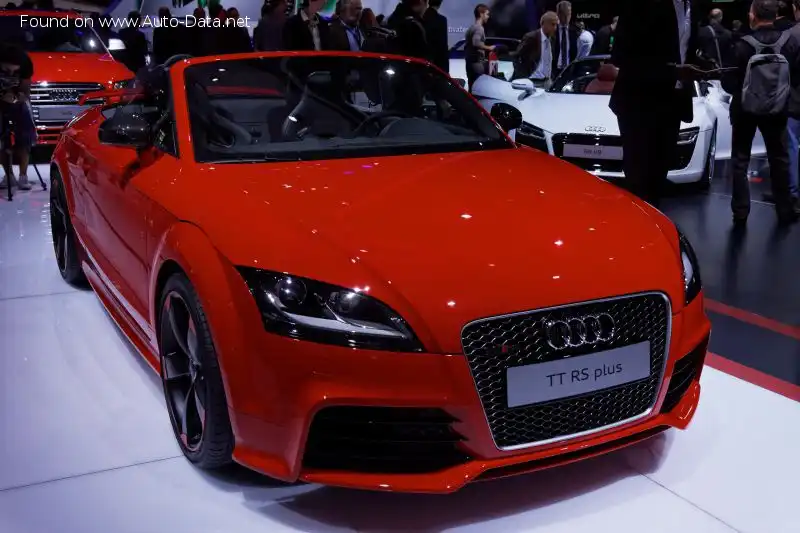
The Audi TT RS Roadster (8J, facelift) with the 2.5 TFSI plus engine, producing 360 horsepower, represents the pinnacle of performance for the second-generation TT Roadster. Introduced in November 2011 and continuing through 2014, this variant was positioned as the highest-performance offering in the TT Roadster lineup, building upon the already sporty foundation of the 8J platform (shared with the Volkswagen Golf Mk5/Mk6 and other models within the Volkswagen Group). It catered to drivers seeking an open-top sports car experience with uncompromising power and handling. This model year received a facelift, incorporating revised styling cues and minor technological updates compared to the earlier 8J TT RS Roadster.
Technical Specifications
| Brand | Audi |
| Model | TT |
| Generation | TT RS Roadster (8J, facelift 2010) |
| Type (Engine) | 2.5 TFSI plus (360 Hp) quattro |
| Start of production | November, 2011 |
| End of production | 2014 |
| Powertrain Architecture | Internal Combustion engine |
| Body type | Roadster |
| Seats | 2 |
| Doors | 2 |
| Fuel consumption (urban) | 12.8 l/100 km (18.4 US mpg, 22.1 UK mpg, 7.8 km/l) |
| Fuel consumption (extra urban) | 7 l/100 km (33.6 US mpg, 40.4 UK mpg, 14.3 km/l) |
| Fuel consumption (combined) | 9.1 l/100 km (25.8 US mpg, 31 UK mpg, 11 km/l) |
| CO2 emissions | 212 g/km |
| Fuel Type | Petrol (Gasoline) |
| Acceleration 0 – 100 km/h | 4.4 sec |
| Acceleration 0 – 62 mph | 4.4 sec |
| Acceleration 0 – 60 mph | 4.2 sec |
| Maximum speed | 280 km/h (173.98 mph) |
| Emission standard | Euro 5 |
| Weight-to-power ratio | 4.2 kg/Hp, 238.4 Hp/tonne |
| Weight-to-torque ratio | 3.2 kg/Nm, 307.9 Nm/tonne |
| Power | 360 Hp @ 5500-6700 rpm |
| Power per litre | 145.2 Hp/l |
| Torque | 465 Nm @ 1650-5400 rpm (342.97 lb.-ft. @ 1650-5400 rpm) |
| Engine layout | Front, Transverse |
| Engine Model/Code | CEPB |
| Engine displacement | 2480 cm3 (151.34 cu. in.) |
| Number of cylinders | 5 |
| Engine configuration | Inline |
| Cylinder Bore | 82.5 mm (3.25 in.) |
| Piston Stroke | 92.8 mm (3.65 in.) |
| Compression ratio | 10:1 |
| Number of valves per cylinder | 4 |
| Fuel injection system | Direct injection |
| Engine aspiration | Turbocharger, Intercooler |
| Valvetrain | DOHC |
| Engine oil capacity | 5.7 l (6.02 US qt | 5.02 UK qt) |
| Coolant | 10 l (10.57 US qt | 8.8 UK qt) |
| Kerb Weight | 1510 kg (3328.98 lbs.) |
| Max. weight | 1830 kg (4034.46 lbs.) |
| Max load | 320 kg (705.48 lbs.) |
| Trunk (boot) space – minimum | 250 l (8.83 cu. ft.) |
| Fuel tank capacity | 60 l (15.85 US gal | 13.2 UK gal) |
| Length | 4198 mm (165.28 in.) |
| Width | 1842 mm (72.52 in.) |
| Width including mirrors | 1952 mm (76.85 in.) |
| Height | 1348 mm (53.07 in.) |
| Wheelbase | 2468 mm (97.17 in.) |
| Front track | 1555 mm (61.22 in.) |
| Rear (Back) track | 1546 mm (60.87 in.) |
| Front overhang | 911 mm (35.87 in.) |
| Rear overhang | 819 mm (32.24 in.) |
| Drag coefficient (Cd) | 0.32 |
| Minimum turning circle (turning diameter) | 10.7 m (35.1 ft.) |
| Drive wheel | All wheel drive (4×4) |
| Number of gears and type of gearbox | 6 gears, manual transmission |
| Front suspension | Independent, type McPherson with coil spring and anti-roll bar |
| Rear suspension | Independent multi-link spring suspension with stabilizer |
| Front brakes | Ventilated discs |
| Rear brakes | Ventilated discs |
| Assisting systems | ABS (Anti-lock braking system) |
| Steering type | Steering rack and pinion |
| Power steering | Electric Steering |
| Tires size | 245/40 R18 |
| Wheel rims size | 9J x 18 |
INTRODUCTION
The Audi TT RS Roadster (8J, facelift) 2.5 TFSI plus quattro is a high-performance, two-seat convertible sports car produced by Audi between 2011 and 2014. It represents the most powerful iteration of the 8J TT Roadster, utilizing a highly tuned version of Audi’s renowned 2.5-liter five-cylinder turbocharged engine. The “plus” designation signifies an increase in power output over the standard TT RS Roadster, elevating its performance credentials. Built on the Volkswagen Group’s PQ35 platform (8J), the TT RS Roadster aimed to deliver a thrilling driving experience combined with the open-air freedom of a convertible.
Powertrain & Engine Architecture
The heart of the TT RS Roadster plus is the CEPB engine code, a 2.480-liter inline-five cylinder engine. This engine is a significant departure from the four-cylinder engines found in many of its competitors, offering a unique sound and character. The engine features direct fuel injection (FSI) and a low-inertia twin-scroll turbocharger, allowing for rapid spool-up and minimal turbo lag. The turbocharger generates substantial boost, contributing to the engine’s impressive 360 horsepower and 465 Nm (343 lb-ft) of torque. The engine’s aluminum block and head contribute to its relatively lightweight construction. The 6-speed manual transmission was standard, delivering power to all four wheels via Audi’s quattro all-wheel-drive system. The quattro system utilizes a multi-plate clutch to distribute torque between the front and rear axles, optimizing traction and handling.
Driving Characteristics
The 360 hp output, combined with the quattro all-wheel-drive system, results in exhilarating acceleration. The 0-60 mph sprint is achieved in approximately 4.2 seconds, and the car boasts a top speed of 174 mph (280 km/h). The engine delivers a broad torque curve, providing strong pull throughout the rev range. The manual transmission offers precise shifts, enhancing driver engagement. While the increased power output is noticeable, the car remains relatively balanced and predictable, thanks to the quattro system and well-tuned suspension. Compared to the standard TT RS Roadster, the “plus” model offers a more aggressive throttle response and a slightly higher redline. The 1.8T models offered a more economical driving experience, but lacked the raw power and performance of the 2.5 TFSI plus.
Equipment & Trim Levels
The TT RS Roadster plus came generously equipped as standard. Interior features included sport seats upholstered in Nappa leather with embossed RS logos, a flat-bottomed steering wheel, aluminum pedal caps, and unique interior trim elements. Standard exterior features included a distinctive RS front bumper, side skirts, a rear diffuser, and a large rear spoiler. Optional extras included a Bang & Olufsen sound system, navigation system, and various customization options for interior and exterior finishes. The overall interior design focused on a driver-centric layout with a sporty and modern aesthetic.
Chassis & Braking
The TT RS Roadster plus features a fully independent suspension system. The front utilizes a McPherson strut setup with coil springs and an anti-roll bar, while the rear employs a multi-link suspension with a stabilizer bar. This configuration provides a good balance between ride comfort and handling precision. Braking duties are handled by ventilated disc brakes on all four wheels, providing ample stopping power. The ABS (Anti-lock Braking System) and Electronic Stability Control (ESC) systems enhance safety and stability. The chassis was specifically tuned to handle the increased power output of the “plus” model, with stiffer springs and dampers compared to the standard TT RS Roadster.
Market Reception & Comparison
The TT RS Roadster plus was generally well-received by automotive critics, who praised its performance, handling, and distinctive engine. It was often compared to rivals such as the Porsche Boxster S and BMW Z4 sDrive35is. While the TT RS Roadster plus offered a more unique engine and all-wheel-drive traction, some critics noted that its interior quality and refinement were not quite on par with the Porsche. Fuel economy, while respectable for a high-performance sports car, was not a primary strength, averaging around 25.8 mpg combined. Reliability was generally good, although the complex turbocharging system required regular maintenance.
Legacy
The Audi TT RS Roadster (8J, facelift) 2.5 TFSI plus quattro remains a sought-after vehicle in the used car market. Its combination of performance, style, and exclusivity has made it a favorite among enthusiasts. The 2.5 TFSI engine is known for its durability, but regular maintenance, including oil changes and turbocharger inspections, is crucial. The car’s unique five-cylinder engine sound and engaging driving experience continue to appeal to drivers seeking a distinctive sports car. The 8J generation TT RS, and particularly the “plus” variant, cemented the TT’s reputation as a capable and desirable performance car within the Audi lineup.