
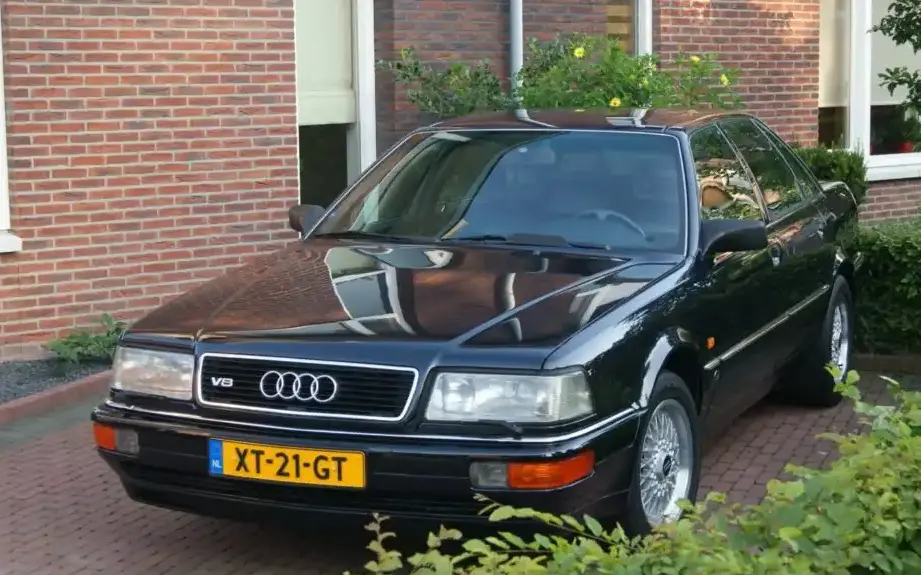
The Audi V8 (D11) 4.2 quattro, produced between October 1991 and November 1993, represented a significant step forward for Audi, marking its return to the high-performance luxury sedan segment. This model, the flagship of the D11 series, was the first Audi to feature the renowned 4.2-liter V8 engine and permanent all-wheel drive (quattro), technologies that would become synonymous with the brand. It served as a technological showcase, intended to elevate Audi’s image and compete with established German rivals like BMW and Mercedes-Benz. The V8 was a relatively short-lived model, superseded by the A8 in 1994, but it laid the groundwork for Audi’s future success in the luxury car market.
Technical Specifications
| Brand | Audi |
| Model | V8 |
| Generation | V8 (D11) |
| Type (Engine) | 4.2 (280 Hp) quattro |
| Start of production | October, 1991 |
| End of production | November, 1993 |
| Powertrain Architecture | Internal Combustion engine |
| Body type | Sedan |
| Seats | 5 |
| Doors | 4 |
| Fuel Type | Petrol (Gasoline) |
| Acceleration 0 – 100 km/h | 6.8 sec |
| Acceleration 0 – 62 mph | 6.8 sec |
| Acceleration 0 – 60 mph | 6.5 sec |
| Maximum speed | 249 km/h (154.72 mph) |
| Weight-to-power ratio | 6.1 kg/Hp, 163.7 Hp/tonne |
| Weight-to-torque ratio | 4.3 kg/Nm, 233.9 Nm/tonne |
| Power | 280 Hp @ 5800 rpm |
| Power per litre | 67.1 Hp/l |
| Torque | 400 Nm @ 4000 rpm (295.02 lb.-ft. @ 4000 rpm) |
| Engine layout | Front, Longitudinal |
| Engine Model/Code | ABH |
| Engine displacement | 4172 cm3 (254.59 cu. in.) |
| Number of cylinders | 8 |
| Engine configuration | V-engine |
| Cylinder Bore | 84.5 mm (3.33 in.) |
| Piston Stroke | 93 mm (3.66 in.) |
| Compression ratio | 10.6:1 |
| Number of valves per cylinder | 4 |
| Fuel injection system | Multi-port manifold injection |
| Engine aspiration | Naturally aspirated engine |
| Engine oil capacity | 7.5 l (7.93 US qt | 6.6 UK qt) |
| Coolant | 8.5 l (8.98 US qt | 7.48 UK qt) |
| Kerb Weight | 1710 kg (3769.9 lbs.) |
| Max. weight | 2310 kg (5092.68 lbs.) |
| Max load | 600 kg (1322.77 lbs.) |
| Trunk (boot) space – minimum | 570 l (20.13 cu. ft.) |
| Fuel tank capacity | 80 l (21.13 US gal | 17.6 UK gal) |
| Length | 4874 mm (191.89 in.) |
| Width | 1814 mm (71.42 in.) |
| Height | 1420 mm (55.91 in.) |
| Wheelbase | 2702 mm (106.38 in.) |
| Front track | 1514 mm (59.61 in.) |
| Rear (Back) track | 1531 mm (60.28 in.) |
| Drag coefficient (Cd) | 0.35 |
| Minimum turning circle | 11.5 m (37.73 ft.) |
| Drive wheel | All wheel drive (4×4) |
| Number of gears | 6 gears, manual transmission |
| Front brakes | Ventilated discs |
| Rear brakes | Ventilated discs |
| Tires size | 215/60 R15 |
| Wheel rims size | 15 |
Powertrain & Engine Architecture
The heart of the Audi V8 quattro was the ABH engine, a 4.2-liter naturally aspirated V8. This engine, derived from the earlier 3.6-liter V8 used in the Audi V8 (D11) models, featured a 90-degree V-angle for optimal balance. It employed multi-port fuel injection and a sophisticated engine management system for its time. The engine produced 280 horsepower at 5800 rpm and 400 Nm (295 lb-ft) of torque at 4000 rpm. The engine’s architecture was notable for its oversquare design (84.5mm bore and 93mm stroke), contributing to its rev-happy nature. The standard transmission was a robust 6-speed manual gearbox, providing precise control and enhancing the driving experience. The quattro all-wheel-drive system, a permanent system utilizing a Torsen differential, distributed power between the front and rear axles, providing excellent traction and stability in all weather conditions.
Driving Characteristics
The Audi V8 4.2 quattro offered a refined and capable driving experience. The 4.2-liter V8 delivered smooth and linear power delivery, making it a comfortable cruiser for long distances. The 6-speed manual transmission allowed drivers to fully exploit the engine’s power, while the quattro system provided exceptional grip and handling. Acceleration from 0 to 60 mph was achieved in approximately 6.5 seconds, and the car had a top speed of 154.72 mph. Compared to the earlier 3.6-liter V8 models, the 4.2 offered a noticeable increase in performance. While not as overtly sporty as some of its rivals, the V8 quattro prioritized comfort and refinement without sacrificing performance. The all-wheel drive system minimized understeer, providing a neutral and balanced handling characteristic.
Equipment & Trim Levels
The Audi V8 quattro was a luxury vehicle and came well-equipped as standard. Standard features included leather upholstery, power-adjustable front seats, climate control, power windows and locks, and an upgraded sound system. The interior was characterized by its high-quality materials and understated elegance. Optional extras included a sunroof, upgraded audio systems, and various trim options. The dashboard layout was functional and driver-focused, with clear instrumentation and intuitive controls. The V8 quattro was positioned as the top-of-the-line model in the D11 range, offering a more luxurious and refined experience than the lower-spec V8 models.
Chassis & Braking
The Audi V8 quattro featured a robust chassis designed to handle the power of the 4.2-liter V8 engine and the demands of all-wheel drive. The suspension consisted of independent suspension all around, with double wishbones at the front and semi-trailing arms at the rear. Ventilated disc brakes were fitted to all four wheels, providing ample stopping power. Anti-lock braking system (ABS) was standard. The car’s weight of 1710 kg (3769.9 lbs) was relatively high for its time, but the quattro system and well-tuned suspension helped to mitigate the effects of the weight, providing a stable and controlled ride.
Market Reception & Comparison
The Audi V8 quattro was generally well-received by automotive critics. It was praised for its refined engine, comfortable ride, and excellent all-weather capability. However, some critics noted that it lacked the outright sportiness of some of its rivals, such as the BMW 5 Series and Mercedes-Benz E-Class. Fuel economy was also a concern, as the 4.2-liter V8 was not particularly fuel-efficient. Compared to the 3.6-liter V8 models, the 4.2 offered a significant performance upgrade, but it also came with a higher price tag. The V8 quattro appealed to buyers who prioritized comfort, refinement, and all-weather capability over outright performance.
Legacy
The Audi V8 quattro, while a relatively short-lived model, played a crucial role in establishing Audi as a serious contender in the luxury car market. It showcased Audi’s technological prowess and laid the foundation for the brand’s future success. The 4.2-liter V8 engine became a hallmark of Audi performance for many years, and the quattro all-wheel-drive system remains a key feature of Audi vehicles today. In the used car market, the V8 quattro is sought after by enthusiasts who appreciate its classic styling, refined engine, and all-weather capability. While maintenance can be expensive due to the car’s age and complexity, the V8 quattro remains a rewarding and enjoyable vehicle to own.
