
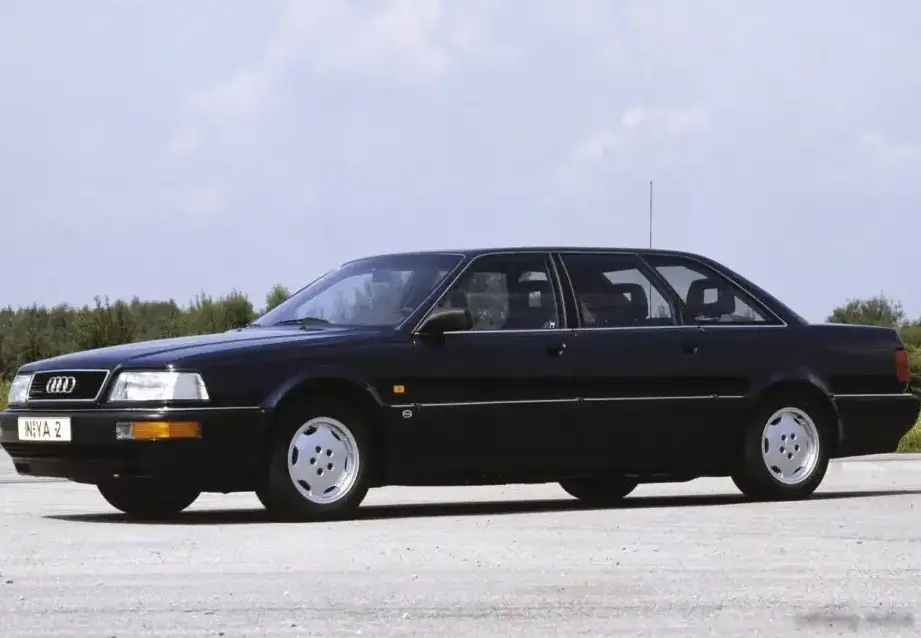
The Audi V8L (D11) 4.2 quattro Automatic, produced between 1991 and 1994, represented a significant step forward for Audi, solidifying its position in the luxury performance sedan market. As an evolution of the original Audi V8 (D11) launched in 1988, the “L” designation denoted a long-wheelbase version, offering increased rear passenger space. This variant, equipped with the 4.2-liter V8 engine and a four-speed automatic transmission, was positioned as the premium offering within the V8 range, appealing to buyers seeking a blend of power, comfort, and all-weather capability. It was a flagship model designed to compete with established German rivals like the BMW 7 Series and Mercedes-Benz S-Class.
Technical Specifications
| Brand | Audi |
| Model | V8 |
| Generation | V8L (D11) |
| Type (Engine) | 4.2 (280 Hp) quattro Automatic |
| Start of production | 1991 |
| End of production | 1994 |
| Powertrain Architecture | Internal Combustion engine |
| Body type | Sedan |
| Seats | 5 |
| Doors | 4 |
| Fuel consumption (urban) | 17.5 l/100 km (13.4 US mpg, 16.1 UK mpg, 5.7 km/l) |
| Fuel consumption (extra urban) | 9.2 l/100 km (25.6 US mpg, 30.7 UK mpg, 10.9 km/l) |
| Fuel Type | Petrol (Gasoline) |
| Acceleration 0 – 100 km/h | 7.9 sec |
| Acceleration 0 – 62 mph | 7.9 sec |
| Acceleration 0 – 60 mph | 7.5 sec |
| Maximum speed | 249 km/h (154.72 mph) |
| Weight-to-power ratio | 6.3 kg/Hp, 158.2 Hp/tonne |
| Weight-to-torque ratio | 4.4 kg/Nm, 226 Nm/tonne |
| Power | 280 Hp @ 5800 rpm |
| Power per litre | 67.1 Hp/l |
| Torque | 400 Nm @ 4000 rpm (295.02 lb.-ft. @ 4000 rpm) |
| Engine layout | Front, Longitudinal |
| Engine Model/Code | ABH |
| Engine displacement | 4172 cm3 (254.59 cu. in.) |
| Number of cylinders | 8 |
| Engine configuration | V-engine |
| Cylinder Bore | 84.5 mm (3.33 in.) |
| Piston Stroke | 93 mm (3.66 in.) |
| Compression ratio | 10.6:1 |
| Number of valves per cylinder | 4 |
| Fuel injection system | Multi-port manifold injection |
| Engine aspiration | Naturally aspirated engine |
| Valvetrain | DOHC |
| Engine oil capacity | 7.5 l (7.93 US qt | 6.6 UK qt) |
| Coolant | 8.5 l (8.98 US qt | 7.48 UK qt) |
| Kerb Weight | 1770 kg (3902.18 lbs.) |
| Max. weight | 2310 kg (5092.68 lbs.) |
| Max load | 540 kg (1190.5 lbs.) |
| Trunk (boot) space – minimum | 570 l (20.13 cu. ft.) |
| Fuel tank capacity | 80 l (21.13 US gal | 17.6 UK gal) |
| Length | 5190 mm (204.33 in.) |
| Width | 1814 mm (71.42 in.) |
| Height | 1420 mm (55.91 in.) |
| Wheelbase | 3018 mm (118.82 in.) |
| Front track | 1514 mm (59.61 in.) |
| Rear (Back) track | 1531 mm (60.28 in.) |
| Drag coefficient (Cd) | 0.34 |
| Minimum turning circle | 12.9 m (42.32 ft.) |
| Drivetrain Architecture | The Internal combustion engine (ICE) drives permanently the four wheels of the vehicle. |
| Drive wheel | All wheel drive (4×4) |
| Number of gears and type of gearbox | 4 gears, automatic transmission |
| Front suspension | Independent, type McPherson with coil spring and anti-roll bar |
| Rear suspension | Double wishbone, Transverse stabilizer, Coil spring |
| Front brakes | Ventilated discs |
| Rear brakes | Ventilated discs |
| Assisting systems | ABS (Anti-lock braking system) |
| Steering type | Steering rack and pinion |
| Power steering | Hydraulic Steering |
| Tires size | 215/60 R15 |
| Wheel rims size | 7.5J x 15 |
Powertrain & Engine Architecture
The heart of the V8L 4.2 was the ABH engine, a 4.2-liter (4172 cc) naturally aspirated V8. This engine featured a 90-degree V-angle, contributing to a smooth power delivery. It utilized a cast iron block with aluminum cylinder heads, a design choice balancing durability and weight. Fuel delivery was managed by a Bosch Motronic multi-port fuel injection system, optimizing combustion efficiency. The engine employed a double overhead camshaft (DOHC) valvetrain with four valves per cylinder, enhancing breathing and high-rpm performance. The four-speed automatic transmission, a ZF 4HP22 unit, was chosen for its smoothness and reliability. While not offering the outright performance of a manual gearbox, it provided a comfortable and effortless driving experience, aligning with the car’s luxury positioning.
Driving Characteristics
The V8L 4.2 Automatic offered a refined and capable driving experience. The 280 horsepower and 400 Nm (295 lb-ft) of torque provided ample power for confident acceleration and effortless highway cruising. The 0-60 mph sprint took approximately 7.5 seconds, and it could achieve a top speed of 154.72 mph. The automatic transmission, while smooth, did result in some power loss compared to the manual versions. Gear ratios were tuned for comfort and fuel economy rather than outright performance. The quattro all-wheel-drive system provided excellent traction in all weather conditions, enhancing stability and driver confidence. However, the car’s considerable weight (1770 kg / 3902 lbs) was noticeable in spirited driving, making it less agile than lighter competitors.
Equipment & Trim Levels
The V8L 4.2 Automatic came generously equipped as standard. Interior features included leather upholstery, power-adjustable front seats, climate control, and a high-quality sound system. Exterior features included alloy wheels, a sunroof, and fog lights. Optional extras included a premium sound system, upgraded leather trim, and a rear seat entertainment system. The long wheelbase provided significantly more rear legroom compared to the standard V8, making it a particularly appealing choice for chauffeur-driven executives or families. The dashboard layout was typical of early 1990s Audis, characterized by a functional and understated design.
Chassis & Braking
The V8L featured an independent suspension system. The front utilized a McPherson strut setup with coil springs and an anti-roll bar, while the rear employed a double wishbone configuration with coil springs and a transverse stabilizer. This setup provided a comfortable ride quality while maintaining reasonable handling characteristics. Braking duties were handled by ventilated disc brakes on all four wheels, assisted by an Anti-lock Braking System (ABS). The braking system was effective, providing ample stopping power for a car of its weight. Steering was via a hydraulic power-assisted rack and pinion system, offering precise and responsive control.
Market Reception & Comparison
The Audi V8L 4.2 Automatic was generally well-received by automotive critics. It was praised for its powerful engine, comfortable ride, and luxurious interior. However, some critics noted its relatively high price and its weight, which limited its agility compared to some rivals. Compared to the standard V8, the “L” model offered increased rear passenger space, making it a more practical choice for those who frequently carried passengers. Compared to the 2.8-liter V6 versions, the 4.2 offered significantly more power and performance, but at the cost of increased fuel consumption. The 4.2 also commanded a higher price tag. Fuel economy was a weak point, averaging around 13.4 US mpg in the city and 25.6 US mpg on the highway.
Legacy
The Audi V8L 4.2 quattro Automatic, while not a high-volume seller, remains a desirable classic car today. The ABH engine is known for its durability and reliability, provided it has been properly maintained. The quattro all-wheel-drive system continues to be a hallmark of Audi vehicles. Finding well-maintained examples can be challenging, and parts availability can be limited. However, the V8L 4.2 offers a unique blend of luxury, performance, and all-weather capability that continues to appeal to enthusiasts. Its status as a precursor to the modern Audi A8 also adds to its historical significance. The car represents a pivotal moment in Audi’s evolution, showcasing its commitment to engineering excellence and innovative technology.
