
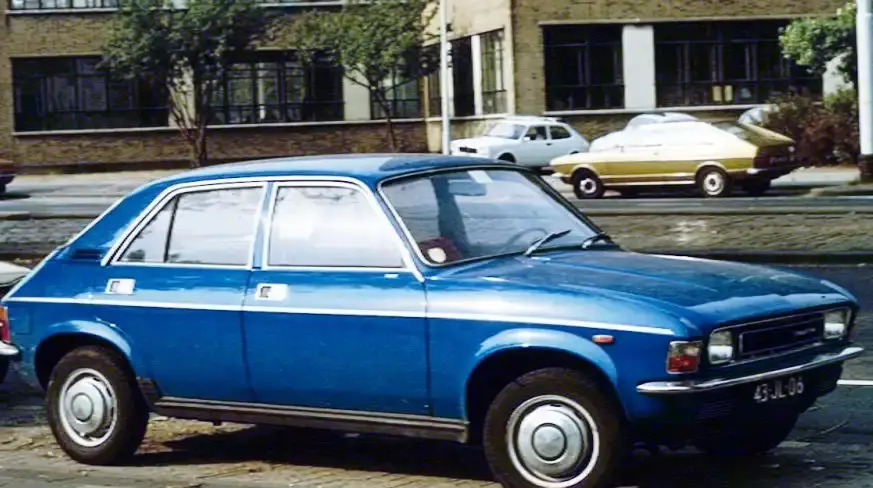
The Austin Allegro 1.3, produced between 1975 and 1979, represented a significant attempt by British Leyland to modernize its small car offerings. Part of the ADO67 (Amalgamated Drawing Office 67) project, the Allegro was intended to replace the Austin 1100 and 1300, offering a more contemporary design and improved practicality. The 1.3-liter variant, producing 58 horsepower, served as the entry-level model in the Allegro range, aimed at budget-conscious buyers and families seeking economical transportation. It occupied a crucial position in a market increasingly dominated by European and Japanese competitors.
Technical Specifications
| Brand | Austin |
| Model | Allegro |
| Generation | Allegro (ADO67) |
| Type (Engine) | 1.3 (58 Hp) |
| Start of Production | 1975 |
| End of Production | 1979 |
| Powertrain Architecture | Internal Combustion Engine |
| Body Type | Hatchback |
| Fuel Type | Petrol (Gasoline) |
| Power | 58 Hp |
| Engine Aspiration | Naturally Aspirated |
| Engine Displacement | 1275 cc |
| Cylinders | 4 |
| Valves per Cylinder | 2 |
| Transmission | 4-speed Manual (primarily, also available with 3-speed Automatic) |
| Weight | Approximately 1,847 lbs (838 kg) |
| Top Speed | Approximately 85 mph (137 km/h) |
| 0-60 mph | Approximately 16.5 seconds |
Powertrain & Engine Architecture
The Austin Allegro 1.3 was powered by a 1275cc inline-four cylinder engine, derived from the A-Series engine family that had been a mainstay of British Leyland for decades. This particular iteration, designated as the 1275cc unit, featured a relatively low compression ratio to accommodate the lower octane fuel commonly available at the time. The engine employed a single SU carburetor for fuel delivery, a system known for its simplicity but less precise control compared to fuel injection. The valvetrain consisted of a single overhead camshaft operating two valves per cylinder. While the engine was robust, it wasn’t particularly sophisticated. The 58 horsepower output was achieved at 5,000 rpm, with a peak torque of around 72 lb-ft at 3,000 rpm. A key feature of the Allegro range was the availability of a three-speed automatic transmission, a relatively uncommon option in the small car segment during the 1970s. However, the automatic version significantly impacted performance.
Driving Characteristics
The Allegro 1.3, particularly in manual form, offered adequate, if uninspiring, performance for everyday driving. The 58 horsepower engine provided sufficient power for urban commutes and moderate highway speeds. However, acceleration was slow, and overtaking required careful planning. The four-speed manual gearbox was generally well-matched to the engine’s characteristics, offering a reasonable spread of ratios. The automatic transmission, while providing convenience, noticeably dulled acceleration and increased fuel consumption. The gear ratios were optimized for economy rather than performance. The car’s handling was considered acceptable for the era, with a focus on ride comfort rather than sporty dynamics. The steering, while light, lacked precision, and the suspension tended towards understeer when pushed hard.
Equipment & Trim Levels
The Austin Allegro 1.3 was positioned as the base model in the Allegro lineup. As such, it featured a relatively sparse equipment list. Standard features typically included cloth upholstery, basic instrumentation (speedometer, fuel gauge, temperature gauge), and a heater. The interior design was characterized by its practicality and durability, although the materials used were generally of low quality. Optional extras included a radio, upgraded upholstery, and a vinyl roof. The Allegro 1.3 was available in a range of solid paint colors, with limited metallic options. The dashboard layout was functional but lacked the aesthetic appeal of some contemporary rivals. Trim levels were fairly basic, with the focus being on providing affordable transportation.
Chassis & Braking
The Allegro utilized a front-wheel-drive layout, a relatively modern configuration for the time. The suspension consisted of independent front suspension with MacPherson struts and a trailing arm rear suspension. The braking system was initially equipped with front disc brakes and rear drum brakes. Later models saw the introduction of rear disc brakes on some variants, but the 1.3 typically retained the drum setup. The brakes were adequate for normal driving conditions, but lacked the stopping power of more sophisticated systems. The steering was a rack and pinion system, providing relatively light steering effort. Stabilizer bars were not standard on the base 1.3 model, contributing to a noticeable degree of body roll during cornering.
Market Reception & Comparison
The Austin Allegro 1.3 received a mixed reception from critics and the public. While praised for its spacious interior and practical hatchback design, it was often criticized for its lackluster performance, unrefined engine, and questionable build quality. Compared to rivals such as the Ford Escort and Vauxhall Astra, the Allegro 1.3 felt underpowered and less polished. Fuel economy was reasonable for the time, but not class-leading. Reliability was also a concern, with reports of electrical issues and mechanical failures. The automatic transmission version was particularly criticized for its sluggish performance and increased fuel consumption. The Allegro 1.3 appealed primarily to buyers seeking an affordable and practical family car, but it struggled to compete with more modern and refined offerings from overseas manufacturers.
Legacy
The Austin Allegro 1.3, while not a resounding success, remains a significant vehicle in British automotive history. It represents a period of decline for British Leyland, but also a genuine attempt to modernize its product range. The 1275cc A-Series engine proved to be relatively durable, and many examples are still on the road today, albeit often requiring significant restoration work. In the used car market, the Allegro 1.3 is considered a classic car, appealing to enthusiasts and collectors interested in preserving a piece of British automotive heritage. However, its reputation for unreliability and its relatively slow performance mean that it commands relatively low prices. The Allegro’s innovative (for the time) features, such as the Hydragas suspension, are remembered fondly by those who owned and maintained them, despite the challenges they presented.
