
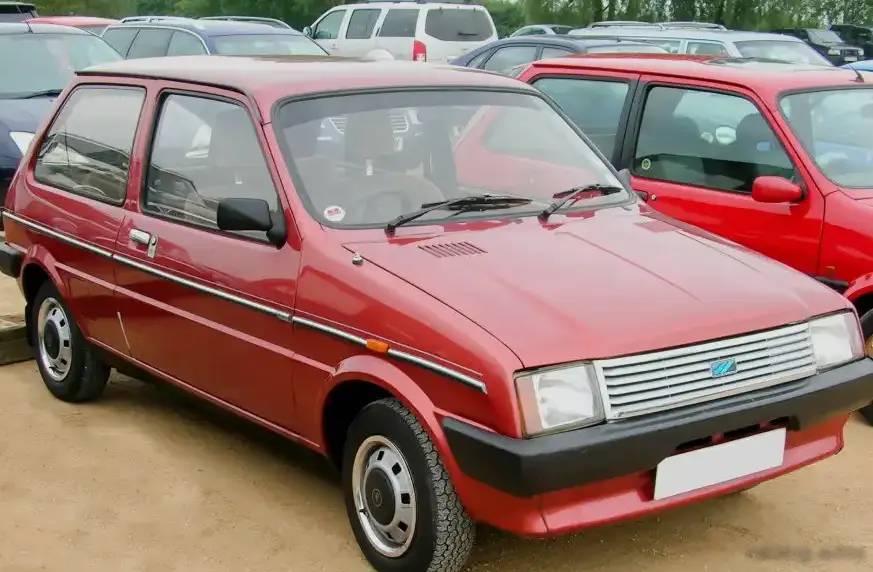
The Austin Metro 1.3, producing 69 horsepower, was a mainstay of the British automotive landscape from 1980 to 1990. It represented a significant step forward for British Leyland (later Austin Rover Group) as a modern, front-wheel-drive supermini intended to replace the aging Mini. The 1.3-liter variant occupied a crucial position in the Metro lineup, serving as the volume seller and offering a balance between affordability, practicality, and reasonable performance. It was built upon the ADO14 platform, a completely new design for the company, and aimed to compete directly with popular European superminis like the Fiat Uno, Renault 5, and Volkswagen Polo.
Technical Specifications
| Brand | Austin |
| Model | Metro |
| Generation | Metro |
| Type (Engine) | 1.3 (69 Hp) |
| Start of Production | 1980 |
| End of Production | 1990 |
| Powertrain Architecture | Internal Combustion Engine |
| Body Type | Hatchback |
| Fuel Type | Petrol (Gasoline) |
| Power | 69 Hp |
| Engine Aspiration | Naturally Aspirated |
Powertrain & Engine Architecture
The Austin Metro 1.3 was powered by the A-Series engine, a long-running and extensively developed inline-four cylinder unit. While the A-Series had roots stretching back to the 1950s, the version used in the Metro was a significantly updated iteration. It featured a displacement of 1275cc (77.7 cubic inches) and utilized a single overhead valve (OHV) configuration with a pushrod valvetrain. The engine employed a single Zenith-Stromberg 175CD carburetor for fuel delivery, a relatively simple system chosen for its reliability and cost-effectiveness. The 69 horsepower output was achieved at 6000 rpm, with peak torque of approximately 72 lb-ft at 3500 rpm.
The transmission was a four-speed manual gearbox, a standard feature on the 1.3 model. An optional three-speed automatic transmission was available, though it was less common and generally resulted in reduced performance and slightly lower fuel economy. The automatic was a Borg-Warner unit, known for its durability but also for its relatively slow shift times. The front wheels were driven via constant velocity joints. The engine was mounted transversely, a configuration that maximized interior space and contributed to the Metro’s compact dimensions.
Driving Characteristics
The Austin Metro 1.3 offered a practical and undemanding driving experience. With 69 horsepower propelling a relatively lightweight car (around 1600 lbs), acceleration was adequate for urban and suburban driving, though it wasn’t particularly brisk. 0 to 60 mph took approximately 14-15 seconds. The four-speed manual gearbox provided a reasonable spread of ratios, allowing the engine to operate efficiently at cruising speeds. The automatic transmission, while convenient, noticeably dulled performance, extending the 0-60 mph time to around 18-20 seconds.
The Metro’s handling was generally considered safe and predictable, though not particularly sporty. The steering was light and easy, making it maneuverable in tight spaces. The suspension, consisting of independent front suspension with MacPherson struts and a twist-beam rear axle, provided a comfortable ride, absorbing bumps and imperfections in the road surface reasonably well. Compared to the higher-performance 1.6-liter versions of the Metro, the 1.3 felt noticeably slower, particularly when fully loaded with passengers or luggage. However, the 1.3’s lighter engine also contributed to slightly better fuel economy and reduced front-end weight, improving handling balance.
Equipment & Trim Levels
The Austin Metro 1.3 was typically offered in basic trim levels, reflecting its position as the entry-level model. Standard equipment included cloth upholstery, a basic instrument panel with speedometer and fuel gauge, and manually operated windows and door locks. A heater was standard, but air conditioning was not available. The interior was functional and durable, though not particularly luxurious.
Optional extras included a radio, upgraded seat fabrics, and a sunroof. Later models saw the introduction of minor cosmetic enhancements, such as revised dashboard trim and improved seat designs. The Metro’s interior space was surprisingly generous for a car of its size, offering comfortable seating for four adults. The hatchback configuration provided a practical and accessible cargo area, further enhancing its practicality.
Chassis & Braking
The Austin Metro featured a monocoque chassis construction, providing a good balance of strength and rigidity. The front suspension utilized MacPherson struts with coil springs and an anti-roll bar, while the rear suspension employed a twist-beam axle with trailing arms and coil springs.
Braking was initially provided by front disc brakes and rear drum brakes. Later models saw the introduction of rear disc brakes on some trim levels, improving braking performance. The braking system was hydraulically operated, providing adequate stopping power for normal driving conditions. The Metro’s relatively light weight contributed to its reasonable braking performance. Steering was rack and pinion, providing precise and responsive control.
Market Reception & Comparison
The Austin Metro 1.3 was generally well-received by the British motoring press and public. It was praised for its practicality, affordability, and modern design. Critics noted its comfortable ride and easy handling, but also pointed out its relatively modest performance. Compared to the 1.6-liter Metro, the 1.3 offered lower running costs and insurance premiums, making it a more attractive option for budget-conscious buyers.
Fuel economy was a strong point for the 1.3, averaging around 45-50 mpg in mixed driving conditions. Reliability was generally good, though the A-Series engine was known to be prone to oil leaks if not properly maintained. The automatic transmission, while convenient, was often criticized for its sluggishness and reduced fuel economy. Against its European rivals, the Metro 1.3 offered a competitive package, though it often lacked the refinement and build quality of some of its competitors.
Legacy
The Austin Metro 1.3 played a significant role in revitalizing the British automotive industry in the 1980s. It was a popular and successful model, selling over 700,000 units during its ten-year production run. While the Metro was eventually replaced by the Rover 100 in 1990, it remains a fondly remembered car among enthusiasts.
Today, the Austin Metro 1.3 is a relatively affordable classic car, with well-maintained examples commanding modest prices. The A-Series engine is known for its durability and ease of maintenance, making it a popular choice for classic car enthusiasts. However, finding parts can sometimes be challenging, and rust is a common issue with older examples. The 1.3 variant, with its simplicity and affordability, remains a particularly appealing option for those looking to experience a piece of British automotive history.
