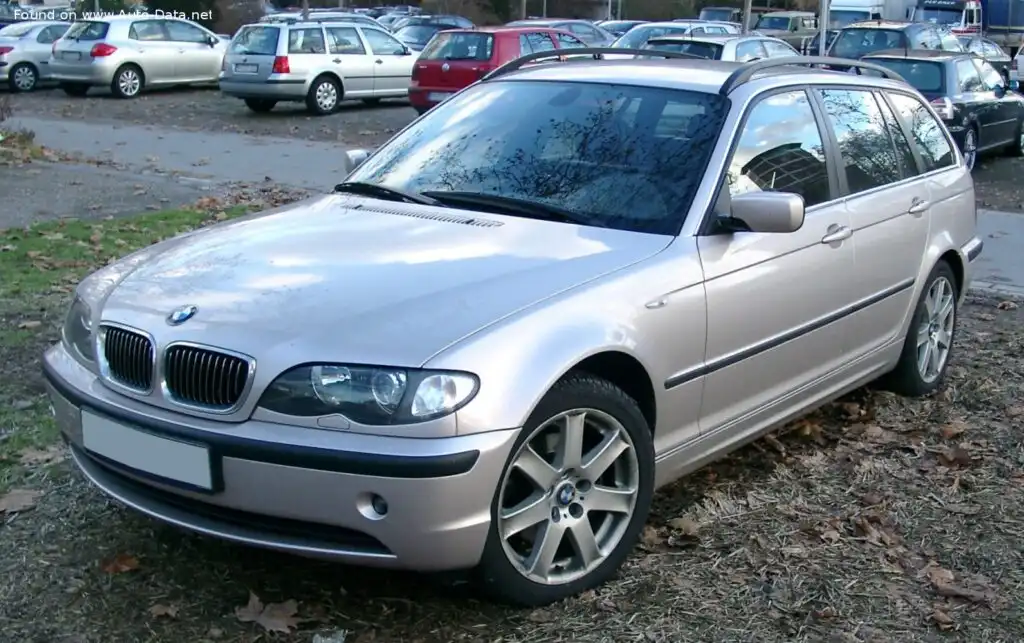
The BMW 3 Series Touring (E46) facelift 320d, produced from 2001 to 2005, represents a significant offering in the compact executive estate car segment. This variant, powered by the M47D20 engine producing 150 horsepower, occupied a middle ground within the E46 Touring lineup, balancing fuel efficiency with respectable performance. It was positioned as a practical and economical choice for buyers seeking the versatility of a wagon without the higher running costs associated with the more powerful 330d models. The facelift, introduced in 2001, brought cosmetic and mechanical updates to the E46 series, enhancing its appeal and addressing some earlier criticisms.
Technical Specifications
| Brand | BMW |
| Model | 3 Series |
| Generation | 3 Series Touring (E46, facelift 2001) |
| Type (Engine) | 320d (150 Hp) |
| Start of production | 2001 |
| End of production | 2005 |
| Powertrain Architecture | Internal Combustion engine |
| Body type | Station wagon (estate) |
| Seats | 5 |
| Doors | 5 |
| Fuel consumption (urban) | 9.7 l/100 km (24.2 US mpg, 29.1 UK mpg, 10.3 km/l) |
| Fuel consumption (extra urban) | 5.5 l/100 km (42.8 US mpg, 51.4 UK mpg, 18.2 km/l) |
| Fuel consumption (combined) | 7.1 l/100 km (33.1 US mpg, 39.8 UK mpg, 14.1 km/l) |
| Fuel Type | Diesel |
| Acceleration 0 – 100 km/h | 9.5 sec |
| Acceleration 0 – 62 mph | 9.5 sec |
| Acceleration 0 – 60 mph | 9 sec |
| Maximum speed | 208 km/h (129.25 mph) |
| Weight-to-power ratio | 10 kg/Hp, 99.7 Hp/tonne |
| Weight-to-torque ratio | 4.6 kg/Nm, 219.3 Nm/tonne |
| Power | 150 Hp @ 4000 rpm |
| Power per litre | 75.2 Hp/l |
| Torque | 330 Nm @ 2000 rpm (243.4 lb.-ft. @ 2000 rpm) |
| Engine layout | Front, Longitudinal |
| Engine Model/Code | M47D20 |
| Engine displacement | 1995 cm3 (121.74 cu. in.) |
| Number of cylinders | 4 |
| Engine configuration | Inline |
| Cylinder Bore | 84 mm (3.31 in.) |
| Piston Stroke | 90 mm (3.54 in.) |
| Compression ratio | 17:1 |
| Number of valves per cylinder | 4 |
| Fuel injection system | Diesel Commonrail |
| Engine aspiration | Turbocharger, Intercooler |
| Valvetrain | DOHC |
| Engine oil capacity | 5.5 l (5.81 US qt | 4.84 UK qt) |
| Coolant | 9.3 l (9.83 US qt | 8.18 UK qt) |
| Kerb Weight | 1505 kg (3317.96 lbs.) |
| Max. weight | 2005 kg (4420.27 lbs.) |
| Max load | 500 kg (1102.31 lbs.) |
| Trunk (boot) space – minimum | 435 l (15.36 cu. ft.) |
| Trunk (boot) space – maximum | 1345 l (47.5 cu. ft.) |
| Fuel tank capacity | 63 l (16.64 US gal | 13.86 UK gal) |
| Length | 4480 mm (176.38 in.) |
| Width | 1740 mm (68.5 in.) |
| Height | 1410 mm (55.51 in.) |
| Wheelbase | 2725 mm (107.28 in.) |
| Front track | 1470 mm (57.87 in.) |
| Rear (Back) track | 1485 mm (58.46 in.) |
| Drivetrain Architecture | Rear wheel drive |
| Drive wheel | Rear wheel drive |
| Number of gears and type of gearbox | 6 gears, manual transmission |
| Front suspension | Wishbone |
| Rear suspension | Coil spring |
| Front brakes | Ventilated discs |
| Rear brakes | Disc |
| Assisting systems | ABS (Anti-lock braking system) |
| Steering type | Steering rack and pinion |
| Power steering | Hydraulic Steering |
| Tires size | 205/55 R16 |
| Wheel rims size | 7J x 16 |
INTRODUCTION
The E46 320d Touring, launched after the 2001 facelift, was a key model in BMW’s strategy to offer a more fuel-efficient and accessible entry point into the premium wagon market. Built on the 1HX0/A3 platform, it combined the practicality of a station wagon with BMW’s renowned driving dynamics. This variant aimed to appeal to families and individuals who needed the extra space of a Touring model but weren’t necessarily seeking the higher performance of the 330d. The facelift brought subtle styling changes, including revised headlights and taillights, along with improvements to the interior and engine refinement.
Powertrain & Engine Architecture
At the heart of the 320d Touring is the M47D20, a 2.0-liter inline-four diesel engine. This engine utilizes a second-generation common rail direct injection system, delivering fuel at extremely high pressure for improved combustion efficiency and reduced emissions. The M47D20 features a single overhead camshaft (SOHC) design for each cylinder bank, operating four valves per cylinder (DOHC). A turbocharger with an intercooler is employed to boost power output, providing 150 horsepower at 4000 rpm and a substantial 330 Nm (243 lb-ft) of torque at just 2000 rpm. The engine’s robust bottom end and efficient combustion process contribute to its longevity and relatively low maintenance requirements. The 320d was typically paired with a Getrag 6-speed manual transmission, although a 5-speed automatic option was also available. The automatic transmission, while offering convenience, slightly impacted fuel economy and acceleration compared to the manual.
Driving Characteristics
The 320d Touring, with its 150 hp and 330 Nm of torque, offered a balanced driving experience. While not as exhilarating as the 330d, it provided ample power for everyday driving and comfortable long-distance cruising. The turbocharger provides a noticeable boost in mid-range acceleration, making overtaking maneuvers relatively effortless. The 6-speed manual transmission allowed for precise gear selection and maximized engine efficiency. The automatic transmission, while smooth, felt less engaging and resulted in slightly slower acceleration times. The rear-wheel-drive configuration, a hallmark of BMW, contributed to the car’s balanced handling and responsive steering. The suspension, tuned for comfort, provided a compliant ride without sacrificing too much handling precision.
Equipment & Trim Levels
The 320d Touring typically came equipped with a respectable level of standard features. These included power windows, central locking, air conditioning, and an AM/FM radio. Higher trim levels offered options such as leather upholstery, sunroof, automatic climate control, and a premium sound system. The interior design was functional and well-built, reflecting BMW’s commitment to quality. The Touring’s rear seats could be folded down to increase cargo capacity, providing flexibility for carrying larger items. Optional extras included parking sensors, heated seats, and a navigation system.
Chassis & Braking
The E46 Touring utilized a MacPherson strut front suspension and a multi-link rear suspension, providing a good balance of ride comfort and handling precision. The chassis was reinforced to accommodate the increased weight and structural demands of the wagon body style. Braking duties were handled by ventilated disc brakes at the front and solid disc brakes at the rear. Anti-lock Braking System (ABS) was standard, enhancing safety and stability during emergency braking. The steering system employed a hydraulic power steering rack and pinion, providing precise and responsive steering feel.
Market Reception & Comparison
The E46 320d Touring was generally well-received by automotive critics. It was praised for its fuel efficiency, comfortable ride, and practical interior. However, some critics noted that the engine could be somewhat noisy and lacked the refinement of some competitors. Compared to the 330d, the 320d offered a more affordable entry point into the E46 Touring range, but at the expense of performance. The 320d also offered better fuel economy than the 330d, making it a more economical choice for high-mileage drivers. Against competitors like the Audi A4 Avant and Volvo V70, the 320d Touring stood out for its engaging driving dynamics and premium feel.
Legacy
The M47D20 engine, found in the E46 320d Touring, has proven to be a relatively reliable powertrain when properly maintained. Common issues include injector wear, turbocharger failure (particularly if not serviced regularly), and occasional problems with the EGR valve. However, these issues are generally manageable and relatively inexpensive to repair. Today, the E46 320d Touring remains a popular choice in the used car market, particularly among those seeking a practical, fuel-efficient, and well-built estate car. Its combination of BMW’s driving dynamics and the versatility of a wagon body style continues to appeal to a wide range of buyers. The availability of parts and a strong enthusiast community further contribute to its enduring appeal.