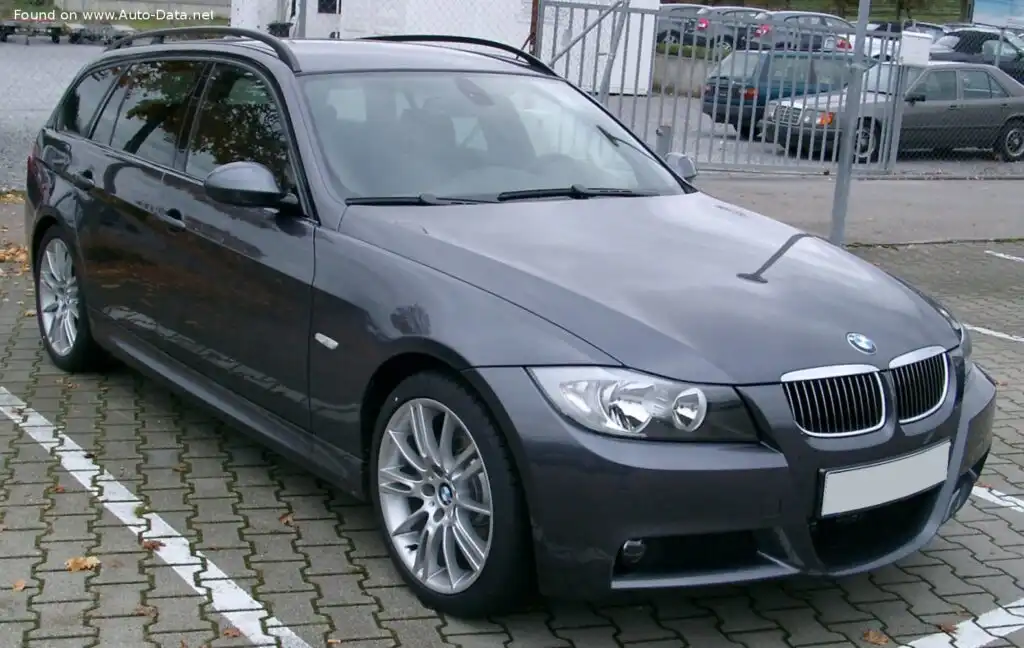
The BMW E91 320d Touring, produced from 2007 to 2008, represents BMW’s entry into the compact executive wagon segment with a diesel powertrain. Part of the E90/E91/E92/E93 3 Series generation, the E91 specifically denotes the Touring (wagon) body style. The 320d variant, equipped with the N47D20C engine producing 177 horsepower, served as a fuel-efficient and practical option within the 3 Series lineup, appealing to buyers prioritizing economy and versatility over outright performance. It was positioned as the base diesel model, sitting below the more powerful 330d and 335d variants.
Technical Specifications
| Brand | BMW |
| Model | 3 Series |
| Generation | 3 Series Touring (E91) |
| Type (Engine) | 320d (177 Hp) DPF |
| Start of production | 2007 |
| End of production | 2008 |
| Powertrain Architecture | Internal Combustion engine |
| Body type | Station wagon (estate) |
| Seats | 5 |
| Doors | 5 |
| Fuel consumption (urban) | 6.1 l/100 km (38.6 US mpg, 46.3 UK mpg, 16.4 km/l) |
| Fuel consumption (extra urban) | 4.2 l/100 km (56 US mpg, 67.3 UK mpg, 23.8 km/l) |
| Fuel consumption (combined) | 4.9 l/100 km (48 US mpg, 57.6 UK mpg, 20.4 km/l) |
| Fuel Type | Diesel |
| Acceleration 0 – 100 km/h | 8.1 sec |
| Acceleration 0 – 62 mph | 8.1 sec |
| Acceleration 0 – 60 mph | 7.7 sec |
| Maximum speed | 228 km/h (141.67 mph) |
| Emission standard | Euro 4 |
| Weight-to-power ratio | 8.9 kg/Hp, 112 Hp/tonne |
| Weight-to-torque ratio | 4.5 kg/Nm, 221.5 Nm/tonne |
| Power | 177 Hp @ 4000 rpm |
| Power per litre | 88.7 Hp/l |
| Torque | 350 Nm @ 1750 rpm (258.15 lb.-ft. @ 1750 rpm) |
| Engine layout | Front, Longitudinal |
| Engine Model/Code | N47D20C |
| Engine displacement | 1995 cm3 (121.74 cu. in.) |
| Number of cylinders | 4 |
| Engine configuration | Inline |
| Cylinder Bore | 84 mm (3.31 in.) |
| Piston Stroke | 90 mm (3.54 in.) |
| Compression ratio | 17:1 |
| Number of valves per cylinder | 4 |
| Fuel injection system | Diesel Commonrail |
| Engine aspiration | Turbocharger, Intercooler |
| Engine oil capacity | 5.2 l (5.49 US qt | 4.58 UK qt) |
| Coolant | 7.5 l (7.93 US qt | 6.6 UK qt) |
| Kerb Weight | 1580 kg (3483.3 lbs.) |
| Max. weight | 2045 kg (4508.45 lbs.) |
| Max load | 465 kg (1025.15 lbs.) |
| Trunk (boot) space – minimum | 460 l (16.24 cu. ft.) |
| Trunk (boot) space – maximum | 1385 l (48.91 cu. ft.) |
| Fuel tank capacity | 61 l (16.11 US gal | 13.42 UK gal) |
| Length | 4520 mm (177.95 in.) |
| Width | 1817 mm (71.54 in.) |
| Height | 1418 mm (55.83 in.) |
| Wheelbase | 2760 mm (108.66 in.) |
| Front track | 1506 mm (59.29 in.) |
| Rear (Back) track | 1525 mm (60.04 in.) |
| Drivetrain Architecture | Rear wheel drive |
| Drive wheel | Rear wheel drive |
| Number of gears and type of gearbox | 6 gears, manual transmission |
| Front suspension | Spring Strut |
| Rear suspension | Coil spring |
| Front brakes | Ventilated discs |
| Rear brakes | Disc |
| Assisting systems | ABS (Anti-lock braking system) |
| Steering type | Steering rack and pinion |
| Power steering | Hydraulic Steering |
| Tires size | 205/55 R16 |
| Wheel rims size | 16 |
Powertrain & Engine Architecture
The heart of the E91 320d Touring is the N47D20C, a 2.0-liter inline-four diesel engine. This engine was a significant step forward for BMW, utilizing second-generation common rail direct injection technology. Piezo injectors, controlled by a sophisticated engine management system, allowed for multiple injection events per combustion cycle, optimizing fuel atomization and reducing noise. The N47 featured a single turbocharger with variable geometry turbine (VGT) technology, providing a broad torque curve and improved responsiveness. The engine produced 177 hp at 4000 rpm and a substantial 350 Nm (258 lb-ft) of torque from as low as 1750 rpm. This torque output was a key characteristic, providing strong pulling power for everyday driving and load-carrying capability. The 6-speed manual transmission was standard, offering precise shifts and contributing to the car’s overall efficiency.
Driving Characteristics
The 320d Touring, with its 177 hp and ample torque, offered a balanced driving experience. Acceleration from 0-60 mph took around 7.7 to 8.1 seconds, respectable for a wagon of its size and weight. While not as quick as the higher-powered 330d or 335d models, the 320d provided sufficient power for comfortable highway cruising and overtaking. The manual transmission’s gear ratios were well-matched to the engine’s torque curve, allowing for relaxed driving in most situations. Compared to the automatic transmission option (available on other 3 Series models), the manual offered a more engaging driving experience and slightly better fuel economy. The rear-wheel-drive configuration contributed to the BMW’s characteristic handling balance, although the added weight of the wagon body and the diesel engine did result in slightly more understeer than the lighter coupe or sedan versions.
Equipment & Trim Levels
The E91 320d Touring typically came equipped with a reasonable level of standard features. These included automatic climate control, power windows and mirrors, a multi-function steering wheel, and a basic audio system. Upholstery was generally cloth, although leather options were available. Optional extras included a sunroof, navigation system, upgraded audio systems (including Harman Kardon), parking sensors, and heated seats. Trim levels varied depending on the market, but generally followed a progression from base models to Sport, Luxury, or M Sport packages. These packages added cosmetic enhancements, such as different alloy wheel designs, sport suspension, and unique interior trim.
Chassis & Braking
The E91 320d Touring utilized a MacPherson strut front suspension and a multi-link rear suspension, providing a good balance of ride comfort and handling precision. Stabilizer bars were fitted front and rear to reduce body roll during cornering. Braking duties were handled by ventilated discs at the front and solid discs at the rear. Anti-lock braking system (ABS) was standard, along with electronic brake-force distribution (EBD). The suspension was tuned to accommodate the increased weight of the wagon body and the diesel engine, providing a stable and controlled ride even when fully loaded.
Market Reception & Comparison
The E91 320d Touring was generally well-received by automotive critics. It was praised for its fuel efficiency, practicality, and comfortable ride. However, some reviewers noted that the engine could be somewhat noisy compared to gasoline engines, and that the performance, while adequate, wasn’t as exhilarating as that of the higher-powered 3 Series models. Compared to the 330d, the 320d offered significantly better fuel economy but lacked the same level of performance. The 320d also represented a more affordable entry point into the 3 Series Touring range, making it an attractive option for buyers prioritizing value and practicality.
Legacy
The N47 engine family, including the N47D20C found in the E91 320d, proved to be relatively reliable, although early versions were known to experience timing chain issues. Proper maintenance, including regular oil changes and timely replacement of the timing chain if necessary, is crucial for long-term reliability. Today, the E91 320d Touring represents a practical and affordable option in the used car market. Its fuel efficiency, spacious interior, and BMW badge continue to appeal to buyers seeking a versatile and well-built wagon. The combination of a diesel engine and a manual transmission makes it a particularly desirable choice for those who value economy and driving engagement.