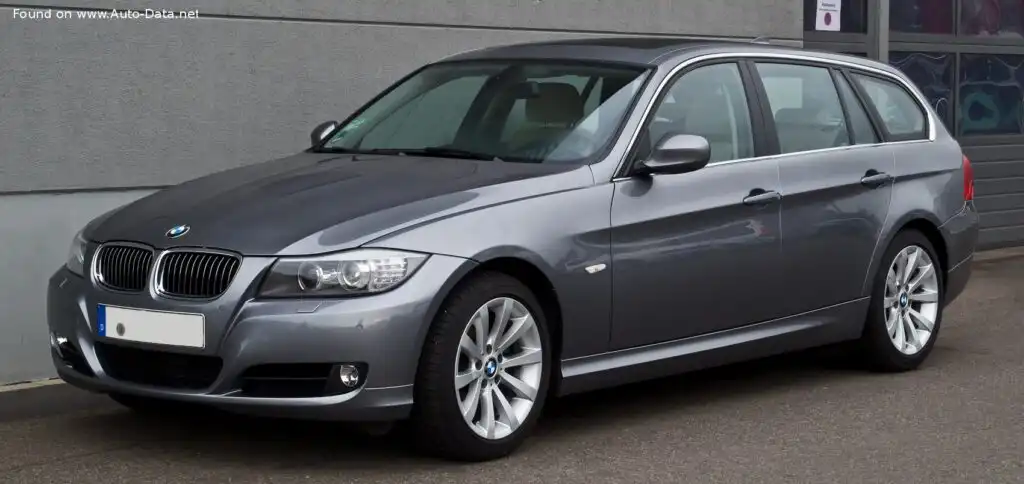
The BMW 3 Series Touring (E91) with the LCI (Life Cycle Impulse) facelift introduced in 2008, represents BMW’s offering in the premium compact executive station wagon segment. The 320d variant, powered by a 2.0-liter turbocharged diesel engine producing 184 horsepower and paired with a six-speed Steptronic automatic transmission, was a popular choice for European buyers seeking a balance of fuel efficiency, practicality, and driving dynamics. Production of this specific configuration ran from 2010 to 2012, falling within the broader E91 lifecycle which spanned from 2005 to 2012. This model aimed to provide a more economical and accessible entry point into the 3 Series Touring range, while still delivering the core BMW driving experience.
Technical Specifications
| Brand | BMW |
| Model | 3 Series |
| Generation | 3 Series Touring (E91 LCI, facelift 2008) |
| Type (Engine) | 320d (184 Hp) Steptronic |
| Start of production | 2010 |
| End of production | 2012 |
| Powertrain Architecture | Internal Combustion engine |
| Body type | Station wagon (estate) |
| Seats | 5 |
| Doors | 5 |
| Fuel consumption (economy) – urban (NEDC) | 6.9 l/100 km (34.1 US mpg, 40.9 UK mpg, 14.5 km/l) |
| Fuel consumption (economy) – extra urban (NEDC) | 4.5 l/100 km (52.3 US mpg, 62.8 UK mpg, 22.2 km/l) |
| Fuel consumption (economy) – combined (NEDC) | 5.4 l/100 km (43.6 US mpg, 52.3 UK mpg, 18.5 km/l) |
| CO2 emissions (NEDC) | 142 g/km |
| Fuel Type | Diesel |
| Acceleration 0 – 100 km/h | 7.9 sec |
| Acceleration 0 – 62 mph | 7.9 sec |
| Acceleration 0 – 60 mph | 7.5 sec |
| Maximum speed | 231 km/h (143.54 mph) |
| Emission standard | Euro 5 |
| Weight-to-power ratio | 8.3 kg/Hp, 121.1 Hp/tonne |
| Weight-to-torque ratio | 4 kg/Nm, 250 Nm/tonne |
| Power | 184 Hp @ 4000 rpm |
| Power per litre | 92.2 Hp/l |
| Torque | 380 Nm @ 1900-2750 rpm (280.27 lb.-ft. @ 1900-2750 rpm) |
| Engine layout | Front, Longitudinal |
| Engine Model/Code | N47D20C |
| Engine displacement | 1995 cm3 (121.74 cu. in.) |
| Number of cylinders | 4 |
| Engine configuration | Inline |
| Cylinder Bore | 84 mm (3.31 in.) |
| Piston Stroke | 90 mm (3.54 in.) |
| Compression ratio | 16.5:1 |
| Number of valves per cylinder | 4 |
| Fuel injection system | Diesel Commonrail |
| Engine aspiration | Turbocharger, Intercooler |
| Valvetrain | DOHC |
| Engine oil capacity | 5.2 l (5.49 US qt | 4.58 UK qt) |
| Coolant | 7.9 l (8.35 US qt | 6.95 UK qt) |
| Kerb Weight | 1520 kg (3351.03 lbs.) |
| Max. weight | 2060 kg (4541.52 lbs.) |
| Max load | 540 kg (1190.5 lbs.) |
| Trunk (boot) space – minimum | 460 l (16.24 cu. ft.) |
| Trunk (boot) space – maximum | 1385 l (48.91 cu. ft.) |
| Fuel tank capacity | 61 l (16.11 US gal | 13.42 UK gal) |
| Max. roof load | 75 kg (165.35 lbs.) |
| Permitted trailer load with brakes (12%) | 1600 kg (3527.4 lbs.) |
| Permitted trailer load without brakes | 745 kg (1642.44 lbs.) |
| Permitted towbar download | 75 kg (165.35 lbs.) |
| Length | 4527 mm (178.23 in.) |
| Width | 1817 mm (71.54 in.) |
| Height | 1418 mm (55.83 in.) |
| Wheelbase | 2760 mm (108.66 in.) |
| Front track | 1506 mm (59.29 in.) |
| Rear (Back) track | 1535 mm (60.43 in.) |
| Ride height (ground clearance) | 141 mm (5.55 in.) |
| Drag coefficient (Cd) | 0.28 |
| Minimum turning circle (turning diameter) | 11 m (36.09 ft.) |
| Drivetrain Architecture | The Internal combustion engine (ICE) drives the rear wheels of the vehicle. |
| Drive wheel | Rear wheel drive |
| Number of gears and type of gearbox | 6 gears, automatic transmission Steptronic |
| Front suspension | Spring Strut, Transverse stabilizer |
| Rear suspension | Independent multi-link spring suspension with stabilizer |
| Front brakes | Ventilated discs |
| Rear brakes | Ventilated discs |
| Assisting systems | ABS (Anti-lock braking system) |
| Steering type | Steering rack and pinion |
| Power steering | Electric Steering |
| Tires size | Front wheel tires: 205/55 R16; 225/50 R16; 225/45 R17; 225/40 R18Rear wheel tires: 205/55 R16; 225/50 R16; 225/45 R17; 255/40 R17; 255/35 R18 |
| Wheel rims size | Front wheel rims: 7J x 16; 8J x 17; 8J x 18Rear wheel rims: 7J x 16; 8J x 17; 8.5J x 17; 8.5J x 18 |
Powertrain & Engine Architecture
The heart of the 320d Touring is the N47D20C, a 2.0-liter inline-four cylinder diesel engine. This engine is a key member of BMW’s modular engine family, known for its efficiency and refinement. The N47 featured second-generation common rail direct injection, operating at pressures up to 1,800 bar, for optimized fuel atomization and combustion. A single turbocharger with variable geometry turbine (VGT) technology provided boost, contributing to the engine’s strong low-end torque. The engine also incorporated a diesel particulate filter (DPF) to meet stringent Euro 5 emissions standards. The six-speed Steptronic automatic transmission, a conventional torque-converter automatic, was specifically tuned to complement the engine’s characteristics, offering smooth shifts and efficient operation. It wasn’t the sportiest transmission available, but it prioritized comfort and fuel economy.
Driving Characteristics
The 184 horsepower and 380 Nm (280 lb-ft) of torque delivered by the 320d Steptronic provided adequate performance for everyday driving. Acceleration from 0-60 mph took around 7.5 to 7.9 seconds, making it competitive within its class. However, it wasn’t a particularly quick car compared to higher-powered 3 Series variants like the 335i. The Steptronic transmission, while smooth, could feel somewhat hesitant during quick downshifts. The gear ratios were geared towards fuel efficiency rather than outright acceleration. Compared to the six-speed manual version, the automatic offered greater convenience, especially in urban traffic, but at the expense of some driver engagement. The engine’s strong low-end torque made it easy to navigate city streets and provided effortless cruising on the highway.
Equipment & Trim Levels
The 320d Touring typically came with a respectable level of standard equipment. This included automatic climate control, a BMW Professional radio system, power windows and mirrors, and alloy wheels. Interior upholstery was usually cloth, with leather options available as an upgrade. Common optional extras included a sunroof, navigation system, parking sensors, and upgraded sound systems. The specific trim level (e.g., Sport, Luxury, Modern) influenced the interior and exterior styling details, such as the choice of trim materials and exterior accents. The 320d sat in the mid-range of the 3 Series Touring lineup, offering a good balance of features and price.
Chassis & Braking
The E91 Touring featured a MacPherson strut front suspension and a multi-link rear suspension, providing a comfortable yet controlled ride. The suspension was tuned to prioritize comfort and stability, rather than outright sportiness. The 320d typically came equipped with ventilated disc brakes on all four wheels, providing ample stopping power. Anti-lock braking system (ABS) was standard, along with electronic brake-force distribution (EBD). The rear suspension geometry and spring rates were adjusted to accommodate the increased weight and altered center of gravity associated with the station wagon body style.
Market Reception & Comparison
The 320d Touring was well-received by critics and buyers alike, particularly in Europe where diesel engines were highly popular. It was praised for its fuel efficiency, practicality, and comfortable ride. Compared to the more powerful 335i or 330d variants, the 320d offered a more affordable entry point into the 3 Series Touring range. However, some critics noted that the Steptronic transmission could feel sluggish at times, and the engine lacked the outright performance of its more potent siblings. Fuel economy was a major selling point, with combined figures around 5.4 l/100 km (43.6 US mpg). Reliability was generally good, although early N47 engines were known to have some issues with timing chain tensioners, which were addressed in later revisions.
Legacy
The N47D20C engine, despite some early reliability concerns, proved to be a durable and efficient powerplant. The 320d Touring remains a popular choice in the used car market today, offering a compelling combination of practicality, fuel economy, and BMW driving dynamics. While not the fastest or most luxurious 3 Series variant, it represents a sensible and well-rounded option for buyers seeking a premium compact executive station wagon. Maintenance costs are generally reasonable, although it’s important to ensure that the timing chain has been inspected and, if necessary, replaced. The E91 320d Touring continues to be appreciated by enthusiasts and everyday drivers alike.