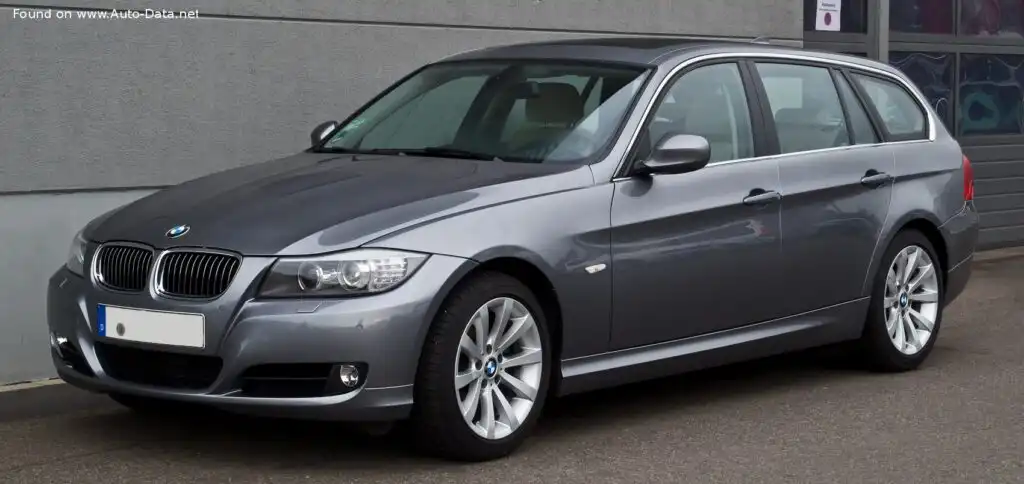
The BMW 3 Series Touring (E91) with the LCI (Life Cycle Impulse) facelift introduced in 2008, represented BMW’s continued commitment to the practical sports wagon segment. The 325d Steptronic variant, produced from 2008 to 2012, occupied a middle ground within the E91 lineup, offering a balance of performance, fuel efficiency, and comfort. This model combined a potent turbocharged diesel engine with a convenient six-speed automatic transmission, appealing to buyers seeking a versatile and refined driving experience. The E91 platform itself was a significant evolution of the E90 sedan, offering increased cargo capacity and retaining the renowned BMW driving dynamics.
Technical Specifications
| Brand | BMW |
| Model | 3 Series |
| Generation | 3 Series Touring (E91 LCI, facelift 2008) |
| Type (Engine) | 325d (197 Hp) Steptronic |
| Start of production | 2008 |
| End of production | 2012 |
| Powertrain Architecture | Internal Combustion engine |
| Body type | Station wagon (estate) |
| Seats | 5 |
| Doors | 5 |
| Fuel consumption (economy) – urban | 8.2 l/100 km (28.7 US mpg, 34.4 UK mpg, 12.2 km/l) |
| Fuel consumption (economy) – extra urban | 5.2 l/100 km (45.2 US mpg, 54.3 UK mpg, 19.2 km/l) |
| Fuel consumption (economy) – combined | 6.3 l/100 km (37.3 US mpg, 44.8 UK mpg, 15.9 km/l) |
| CO2 emissions | 165 g/km |
| Fuel Type | Diesel |
| Acceleration 0 – 100 km/h | 7.7 sec |
| Acceleration 0 – 62 mph | 7.7 sec |
| Acceleration 0 – 60 mph | 7.3 sec |
| Maximum speed | 231 km/h (143.54 mph) |
| Emission standard | Euro 4 |
| Weight-to-power ratio | 8.1 kg/Hp, 123.1 Hp/tonne |
| Weight-to-torque ratio | 4 kg/Nm, 250 Nm/tonne |
| Power | 197 Hp @ 4000 rpm |
| Power per litre | 65.8 Hp/l |
| Torque | 400 Nm @ 1300-3250 rpm (295.02 lb.-ft. @ 1300-3250 rpm) |
| Engine layout | Front, Longitudinal |
| Engine Model/Code | M57D30TU2 |
| Engine displacement | 2993 cm3 (182.64 cu. in.) |
| Number of cylinders | 6 |
| Engine configuration | Inline |
| Cylinder Bore | 84 mm (3.31 in.) |
| Piston Stroke | 90 mm (3.54 in.) |
| Compression ratio | 17:1 |
| Number of valves per cylinder | 4 |
| Fuel injection system | Diesel Commonrail |
| Engine aspiration | Turbocharger, Intercooler |
| Engine oil capacity | 7.5 l (7.93 US qt | 6.6 UK qt) |
| Coolant | 8.2 l (8.66 US qt | 7.21 UK qt) |
| Kerb Weight | 1600 kg (3527.4 lbs.) |
| Max. weight | 2140 kg (4717.89 lbs.) |
| Max load | 540 kg (1190.5 lbs.) |
| Trunk (boot) space – minimum | 460 l (16.24 cu. ft.) |
| Trunk (boot) space – maximum | 1385 l (48.91 cu. ft.) |
| Fuel tank capacity | 61 l (16.11 US gal | 13.42 UK gal) |
| Max. roof load | 75 kg (165.35 lbs.) |
| Permitted trailer load with brakes (12%) | 1800 kg (3968.32 lbs.) |
| Permitted trailer load without brakes | 750 kg (1653.47 lbs.) |
| Permitted towbar download | 75 kg (165.35 lbs.) |
| Length | 4527 mm (178.23 in.) |
| Width | 1817 mm (71.54 in.) |
| Width with mirrors folded | 1989 mm (78.31 in.) |
| Height | 1418 mm (55.83 in.) |
| Wheelbase | 2760 mm (108.66 in.) |
| Front track | 1500 mm (59.06 in.) |
| Rear (Back) track | 1529 mm (60.2 in.) |
| Ride height (ground clearance) | 141 mm (5.55 in.) |
| Drag coefficient (Cd) | 0.29 |
| Minimum turning circle (turning diameter) | 11.0 m (36.09 ft.) |
| Drivetrain Architecture | The Internal combustion engine (ICE) drives the rear wheels of the vehicle. |
| Drive wheel | Rear wheel drive |
| Number of gears and type of gearbox | 6 gears, automatic transmission |
| Front suspension | Independent coil spring |
| Rear suspension | Independent multi-link suspension |
| Front brakes | Ventilated discs |
| Rear brakes | Ventilated discs |
| Assisting systems | ABS (Anti-lock braking system) |
| Steering type | Steering rack and pinion |
| Power steering | Electric Steering |
| Tires size | 225/45 R17 91W |
| Wheel rims size | 8J x 17 |
INTRODUCTION
The BMW 3 Series E91 Touring, particularly the 325d Steptronic, was designed to appeal to European buyers prioritizing practicality without sacrificing the driving pleasure synonymous with the 3 Series nameplate. Introduced with the LCI facelift in 2008, this variant benefited from updated styling, improved efficiency, and enhanced technology. The 325d Steptronic sat in a sweet spot within the E91 range, offering a significant step up in performance and refinement compared to the base 320d models, while remaining more accessible than the higher-performance 335d or 335i variants. It was a popular choice for families and individuals needing a versatile vehicle capable of both daily commuting and long-distance travel.
Powertrain & Engine Architecture
At the heart of the 325d Steptronic lies the M57D30TU2, a 3.0-liter inline-six diesel engine. This engine is a cornerstone of BMW’s diesel technology, known for its robust construction and smooth power delivery. The ‘TU2’ designation indicates an updated version of the M57 engine, featuring improvements to the fuel injection system and turbocharger for increased efficiency and reduced emissions. The engine utilizes a second-generation common rail direct injection system, delivering fuel at extremely high pressures for optimized combustion. A variable geometry turbocharger (VGT) further enhances performance by adjusting the turbine vanes to maximize boost across the engine’s rev range. The six-speed Steptronic automatic transmission, a conventional torque-converter automatic, was specifically tuned to complement the diesel engine’s torque characteristics. It offered smooth shifts and a ‘Sport’ mode for more aggressive acceleration.
Driving Characteristics
The 325d Steptronic provided a relaxed and refined driving experience. The 400 Nm (295 lb-ft) of torque, available from a low 1300 rpm, provided ample pulling power for effortless overtaking and comfortable cruising. While not as overtly sporty as the manual transmission or higher-powered variants, the automatic transmission offered convenience and ease of use, particularly in urban environments. The six-speed automatic was well-matched to the engine’s powerband, providing adequate acceleration. The 0-60 mph time of around 7.3 seconds was respectable for a diesel-powered wagon. The E91’s chassis, inherited from the E90 sedan, delivered the expected BMW handling characteristics – precise steering, well-controlled body roll, and a comfortable ride.
Equipment & Trim Levels
The 325d Steptronic typically came equipped with a generous level of standard features. These included automatic climate control, power windows and mirrors, a multi-function steering wheel, and a BMW Professional radio system. Upholstery was typically cloth or leatherette, with leather being an optional upgrade. Common optional extras included a sunroof, navigation system, upgraded audio system, parking sensors, and heated seats. The LCI facelift brought subtle interior revisions, including updated trim materials and improved infotainment options. Trim levels varied slightly depending on the market, but generally offered a range of customization options to suit individual preferences.
Chassis & Braking
The E91 325d Steptronic featured a sophisticated chassis designed to balance comfort and handling. The front suspension utilized independent coil springs and MacPherson struts, while the rear employed an independent multi-link setup. This configuration provided excellent wheel control and a comfortable ride. Braking duties were handled by ventilated disc brakes on all four wheels, providing ample stopping power. Anti-lock Braking System (ABS) and Electronic Stability Control (ESC) were standard features, enhancing safety and stability. The E91’s suspension was tuned to accommodate the increased weight of the wagon body style, with slightly stiffer springs and dampers compared to the E90 sedan.
Market Reception & Comparison
The 325d Steptronic was generally well-received by automotive critics. It was praised for its refined engine, comfortable ride, and practical wagon body style. Compared to the 320d, the 325d offered a noticeable performance upgrade, while remaining more fuel-efficient than the 335d. The automatic transmission was considered a good match for the engine, although some enthusiasts preferred the engagement of the manual gearbox. Fuel economy was a key selling point, with the 325d achieving combined figures of around 37.3 US mpg. Reliability was generally good, although diesel particulate filter (DPF) issues could occur with infrequent long-distance driving.
Legacy
The BMW E91 325d Steptronic has proven to be a durable and reliable vehicle in the used car market. The M57D30TU2 engine is known for its longevity, provided it has been properly maintained. While older examples may require attention to components like the turbocharger or fuel injectors, the engine itself is generally robust. The E91’s practical wagon body style and comfortable driving experience continue to appeal to buyers seeking a versatile and refined vehicle. Today, well-maintained examples of the 325d Steptronic represent a compelling value proposition for those seeking a capable and enjoyable driving experience.