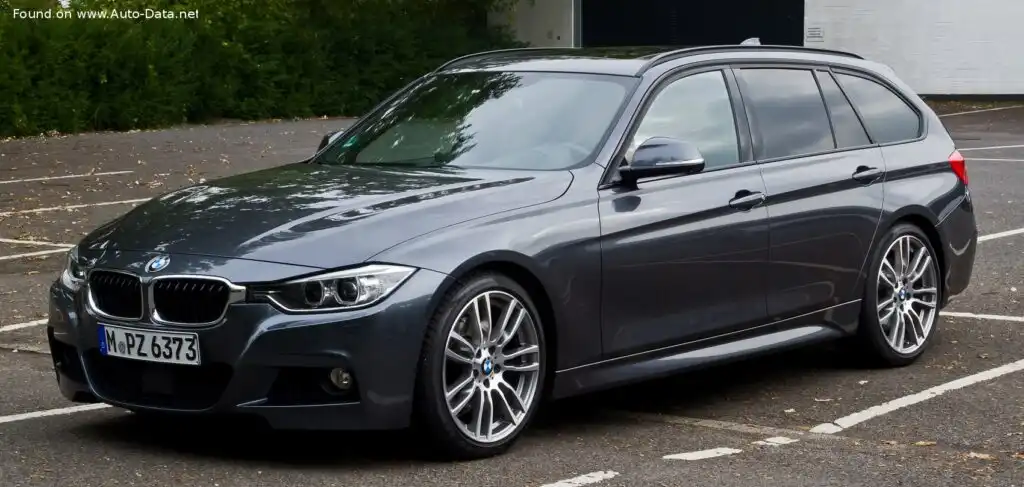
The BMW 3 Series Touring (F31) 328i, produced from 2012 to 2015, represents BMW’s offering in the premium compact executive station wagon segment. Part of the F31 generation of the 3 Series Touring, it combined the practicality of a wagon body style with the sporting characteristics traditionally associated with the 3 Series. This variant occupied a mid-range position within the F31 lineup, offering a balance between performance and efficiency, appealing to buyers seeking a versatile and engaging driving experience. It was a key model for BMW in European markets, where the touring (wagon) body style is particularly popular, and also saw moderate sales in North America.
Technical Specifications
| Brand | BMW |
| Model | 3 Series |
| Generation | 3 Series Touring (F31) |
| Type (Engine) | 328i (245 Hp) |
| Start of production | 2012 |
| End of production | 2015 |
| Powertrain Architecture | Internal Combustion engine |
| Body type | Station wagon (estate) |
| Seats | 5 |
| Doors | 5 |
| Fuel consumption (economy) – urban | 9.2 l/100 km (25.6 US mpg) |
| Fuel consumption (economy) – extra urban | 5.5 l/100 km (42.8 US mpg) |
| Fuel consumption (economy) – combined | 6.8 l/100 km (34.6 US mpg) |
| CO2 emissions | 159 g/km |
| Fuel Type | Petrol (Gasoline) |
| Acceleration 0 – 100 km/h | 6 sec |
| Acceleration 0 – 62 mph | 6 sec |
| Acceleration 0 – 60 mph | 5.7 sec |
| Maximum speed | 250 km/h (155.34 mph) |
| Emission standard | Euro 5 |
| Weight-to-power ratio | 6.1 kg/Hp, 163.3 Hp/tonne |
| Weight-to-torque ratio | 4.3 kg/Nm, 233.3 Nm/tonne |
| Power | 245 Hp @ 5000-6000 rpm |
| Power per litre | 122.7 Hp/l |
| Torque | 350 Nm @ 1250-4800 rpm (258.15 lb.-ft. @ 1250-4800 rpm) |
| Engine layout | Front, Longitudinal |
| Engine Model/Code | N20B20A |
| Engine displacement | 1997 cm3 (121.86 cu. in.) |
| Number of cylinders | 4 |
| Engine configuration | Inline |
| Cylinder Bore | 84 mm (3.31 in.) |
| Piston Stroke | 90.1 mm (3.55 in.) |
| Compression ratio | 10:1 |
| Number of valves per cylinder | 4 |
| Fuel injection system | Direct injection |
| Engine aspiration | Twin-power turbo, Intercooler |
| Engine oil capacity | 5 l (5.28 US qt | 4.4 UK qt) |
| Coolant | 6.9 l (7.29 US qt | 6.07 UK qt) |
| Kerb Weight | 1500 kg (3306.93 lbs.) |
| Max. weight | 2050 kg (4519.48 lbs.) |
| Max load | 550 kg (1212.54 lbs.) |
| Trunk (boot) space – minimum | 495 l (17.48 cu. ft.) |
| Trunk (boot) space – maximum | 1500 l (52.97 cu. ft.) |
| Fuel tank capacity | 60 l (15.85 US gal | 13.2 UK gal) |
| Max. roof load | 75 kg (165.35 lbs.) |
| Permitted trailer load with brakes (12%) | 1600 kg (3527.4 lbs.) |
| Permitted trailer load without brakes | 745 kg (1642.44 lbs.) |
| Permitted towbar download | 75 kg (165.35 lbs.) |
| Length | 4624 mm (182.05 in.) |
| Width | 1811 mm (71.3 in.) |
| Height | 1429 mm (56.26 in.) |
| Wheelbase | 2810 mm (110.63 in.) |
| Front track | 1531 mm (60.28 in.) |
| Rear (Back) track | 1572 mm (61.89 in.) |
| Ride height (ground clearance) | 140 mm (5.51 in.) |
| Drag coefficient (Cd) | 0.32 |
| Minimum turning circle (turning diameter) | 11.3 m (37.07 ft.) |
| Drivetrain Architecture | The Internal combustion engine (ICE) drives the rear wheels of the vehicle. |
| Drive wheel | Rear wheel drive |
| Number of gears and type of gearbox | 6 gears, manual transmission |
| Front suspension | Independent coil spring |
| Rear suspension | Independent multi-link suspension |
| Front brakes | Ventilated discs |
| Rear brakes | Ventilated discs |
| Assisting systems | ABS (Anti-lock braking system) |
| Steering type | Steering rack and pinion |
| Power steering | Electric Steering |
| Tires size | 225/50 R17 94W |
| Wheel rims size | 7.5J x 17 |
Powertrain & Engine Architecture
The heart of the 328i Touring was the BMW N20B20A 2.0-liter inline-four cylinder engine. This engine was a significant departure from BMW’s traditionally larger displacement engines, embracing turbocharging and direct injection to deliver both performance and efficiency. The N20 featured a single twin-scroll turbocharger, which minimized turbo lag and provided a broad torque curve. Direct injection, operating at pressures up to 200 bar, ensured precise fuel delivery and optimized combustion. The engine also incorporated Valvetronic, BMW’s variable valve timing and lift system, allowing for precise control over airflow and further enhancing efficiency. The 328i utilized a six-speed manual transmission as standard, providing drivers with a traditional and engaging driving experience. An optional eight-speed automatic transmission was also available, offering smoother shifts and improved fuel economy.
Driving Characteristics
The 328i Touring with the manual transmission offered a responsive and engaging driving experience. The 245 horsepower and 350 Nm (258 lb-ft) of torque provided ample power for everyday driving and spirited acceleration. The six-speed manual gearbox was well-matched to the engine’s powerband, allowing drivers to make the most of the available torque. The automatic transmission, while offering convenience, slightly dulled the driving experience, with shifts sometimes feeling less decisive than the manual. Compared to the 335i models with their inline-six engines, the 328i offered less outright power, but its lighter weight and more balanced chassis contributed to a nimble and enjoyable driving experience. The wagon body style did introduce a slight increase in weight compared to the sedan, but the impact on handling was minimal thanks to BMW’s well-tuned suspension.
Equipment & Trim Levels
The 328i Touring typically came standard with a comprehensive list of features, including leatherette upholstery, automatic climate control, a BMW iDrive infotainment system with a 6.5-inch display, and power-adjustable front seats. Optional extras included leather upholstery, a premium sound system, navigation, a sunroof, and various driver assistance systems such as lane departure warning and adaptive cruise control. Trim levels were relatively simple, with most options being added individually. Sport Line and Luxury Line packages were available, offering unique styling cues and additional features. The Sport Line focused on a more aggressive appearance and sport-tuned suspension, while the Luxury Line emphasized comfort and refinement.
Chassis & Braking
The F31 328i Touring utilized a MacPherson strut front suspension and a multi-link rear suspension, providing a comfortable yet controlled ride. The suspension was tuned to balance handling and comfort, offering a good compromise for everyday driving. Brakes consisted of ventilated discs all around, providing ample stopping power. ABS (Anti-lock Braking System) was standard, along with electronic stability control and traction control. The steering was precise and well-weighted, providing good feedback to the driver. The 328i typically featured 17-inch alloy wheels as standard, with larger wheels available as an option.
Market Reception & Comparison
The 328i Touring was generally well-received by automotive critics, who praised its blend of performance, practicality, and refinement. It was often seen as a more sensible alternative to the more powerful 335i models, offering a good balance of performance and fuel economy. Compared to its rivals, such as the Audi A4 Avant and the Volvo V60, the 328i Touring was often lauded for its superior handling and more engaging driving experience. Fuel economy was competitive, with combined fuel consumption figures around 6.8 l/100 km (34.6 US mpg). Reliability was generally good, although some owners reported issues with the turbocharger and fuel injectors.
Legacy
The F31 328i Touring remains a popular choice in the used car market, appreciated for its practicality, driving dynamics, and relatively strong build quality. The N20 engine, while generally reliable, requires regular maintenance, including oil changes and inspections of the turbocharger and fuel injectors. The availability of parts is good, and the 328i Touring is relatively easy to maintain. Its blend of performance, practicality, and BMW’s reputation for quality ensures that it continues to be a desirable option for buyers seeking a premium compact executive station wagon.