Technical Specifications
| Brand | BMW |
| Model | 3 Series |
| Generation | 3 Series Touring (F31 LCI, Facelift 2015) |
| Type (Engine) | 330i (252 Hp) Steptronic |
| Start of production | 2015 |
| End of production | 2019 |
| Powertrain Architecture | Internal Combustion engine |
| Body type | Station wagon (estate) |
| Seats | 5 |
| Doors | 5 |
| Fuel consumption (urban) | 7.7-7.3 l/100 km (30.5 – 32.2 US mpg) |
| Fuel consumption (extra urban) | 5.2-4.9 l/100 km (45.2 – 48 US mpg) |
| Fuel consumption (combined) | 6.1-5.8 l/100 km (38.6 – 40.6 US mpg) |
| CO2 emissions | 143-135 g/km |
| Fuel Type | Petrol (Gasoline) |
| Acceleration 0 – 100 km/h | 5.9 sec |
| Acceleration 0 – 62 mph | 5.9 sec |
| Acceleration 0 – 60 mph | 5.6 sec |
| Maximum speed | 250 km/h (155.34 mph) |
| Emission standard | Euro 6 |
| Weight-to-power ratio | 6.2 kg/Hp |
| Weight-to-torque ratio | 4.5 kg/Nm |
| Power | 252 Hp @ 5200-6500 rpm |
| Torque | 350 Nm @ 1450-4800 rpm (258.15 lb.-ft. @ 1450-4800 rpm) |
| Engine layout | Front, Longitudinal |
| Engine Model/Code | B48B20B |
| Engine displacement | 1998 cm3 (121.93 cu. in.) |
| Number of cylinders | 4 |
| Engine configuration | Inline |
| Cylinder Bore | 82 mm (3.23 in.) |
| Piston Stroke | 94.6 mm (3.72 in.) |
| Compression ratio | 10.2:1 |
| Number of valves per cylinder | 4 |
| Fuel injection system | Direct injection |
| Engine aspiration | Twin-power turbo, Intercooler |
| Engine oil capacity | 5 l (5.28 US qt | 4.4 UK qt) |
| Coolant | 7.8 l (8.24 US qt | 6.86 UK qt) |
| Kerb Weight | 1565 kg (3450.23 lbs.) |
| Max. weight | 2125 kg (4684.82 lbs.) |
| Max load | 560 kg (1234.59 lbs.) |
| Trunk (boot) space – minimum | 495 l (17.48 cu. ft.) |
| Trunk (boot) space – maximum | 1500 l (52.97 cu. ft.) |
| Fuel tank capacity | 60 l (15.85 US gal | 13.2 UK gal) |
| Max. roof load | 75 kg (165.35 lbs.) |
| Permitted trailer load with brakes (12%) | 1800 kg (3968.32 lbs.) |
| Permitted trailer load without brakes | 745 kg (1642.44 lbs.) |
| Permitted towbar download | 75 kg (165.35 lbs.) |
| Length | 4633 mm (182.4 in.) |
| Width | 1811 mm (71.3 in.) |
| Height | 1429 mm (56.26 in.) |
| Wheelbase | 2810 mm (110.63 in.) |
| Front track | 1531 mm (60.28 in.) |
| Rear (Back) track | 1572 mm (61.89 in.) |
| Ride height (ground clearance) | 140 mm (5.51 in.) |
| Drag coefficient (Cd) | 0.32 |
| Minimum turning circle (turning diameter) | 11.3 m (37.07 ft.) |
| Drivetrain Architecture | Rear wheel drive |
| Number of gears and type of gearbox | 8 gears, automatic transmission Steptronic |
| Front suspension | Independent coil spring |
| Rear suspension | Independent multi-link suspension |
| Front brakes | Ventilated discs |
| Rear brakes | Ventilated discs |
| Assisting systems | ABS (Anti-lock braking system) |
| Steering type | Steering rack and pinion |
| Power steering | Electric Steering |
| Tires size | 225/50 R17 98W |
| Wheel rims size | 7.5J x 17 |
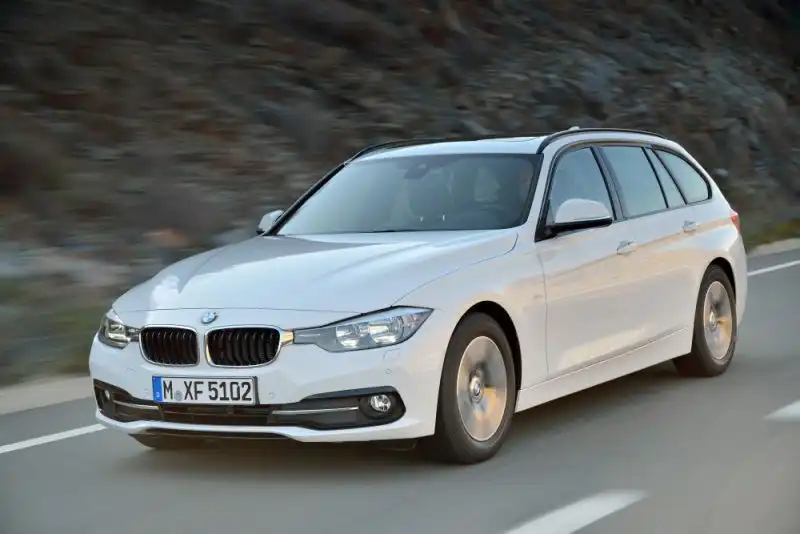
The BMW 3 Series Touring (F31 LCI), specifically the 330i variant equipped with the Steptronic automatic transmission, represents a refined evolution of BMW’s popular compact executive estate car. Produced from 2015 to 2019, this facelifted version of the F31 generation brought subtle styling updates, improved efficiency, and enhanced technology to the 3 Series lineup. Positioned as a mid-range offering, the 330i Touring aimed to bridge the gap between the more economical 320i models and the performance-focused M340i, appealing to buyers seeking a balance of practicality, refinement, and driving enjoyment. It was primarily marketed in Europe and other international markets where the station wagon body style remains highly sought after.
Powertrain & Engine Architecture
The 330i Touring’s powertrain centers around BMW’s B48B20B 2.0-liter turbocharged inline-four engine. This engine is part of BMW’s modular engine family, lauded for its efficiency and performance characteristics. The B48 incorporates direct fuel injection, a twin-scroll turbocharger, and BMW’s variable valve timing (VANOS) and variable valve lift (Valvetronic) technologies to optimize power delivery and fuel economy across a wide range of engine speeds. The engine generates 252 horsepower at 5200-6500 rpm and 350 Nm (258 lb-ft) of torque between 1450 and 4800 rpm. This broad torque curve provides responsive acceleration in typical driving scenarios. The engine is coupled with BMW’s 8-speed Steptronic automatic transmission, known for its smooth and rapid gear changes. This transmission features adaptive learning, which adjusts shift points based on the driver’s individual style.
Driving Characteristics
The 330i Touring with the Steptronic transmission delivers a refined and capable driving experience. While it doesn’t possess the same overtly sporty character as the manual transmission or the higher-performance variants, the automatic provides seamless acceleration and a comfortable ride quality. The 8-speed transmission’s gear ratios are carefully calibrated, offering sufficient power for overtaking maneuvers and maintaining comfortable highway speeds. The rear-wheel-drive configuration contributes to balanced handling, although traction can be compromised in inclement weather. Compared to the 320i, the 330i offers a noticeable increase in performance, while still achieving better fuel economy than the more powerful M340i. The Steptronic transmission, while offering convenience, may not provide the same level of driver engagement as a manual gearbox.
Equipment & Trim Levels
The 330i Touring generally came well-equipped as standard. Typical features included automatic climate control, a BMW iDrive infotainment system with a central display screen, power-adjustable front seats, and a leather-wrapped steering wheel. A range of optional extras were available, including a navigation system, a premium sound system, heated front seats, a panoramic sunroof, and various driver-assistance systems such as lane departure warning and adaptive cruise control. Interior upholstery options ranged from standard cloth to luxurious leather. Trim levels varied depending on the market, but generally offered packages that bundled popular options together for ease of selection.
Chassis & Braking
The F31 Touring utilizes a sophisticated chassis design featuring independent suspension on all four wheels. The front suspension employs coil springs and struts, while the rear utilizes a multi-link setup. This configuration strikes a good balance between ride comfort and handling precision. The 330i typically featured ventilated disc brakes on all four wheels, providing ample stopping power. Anti-lock braking system (ABS) and electronic stability control (ESC) were standard safety features. Stabilizer bars were fitted to both the front and rear axles to minimize body roll during cornering.
Market Reception & Comparison
The 330i Touring was generally well-received by automotive critics. It was praised for its refined engine, comfortable ride, and spacious interior. The combination of performance and practicality made it a popular choice for families and individuals who required a versatile vehicle. Compared to the 320i, the 330i offered a significant performance upgrade, justifying the higher price point for many buyers. When compared to competitors such as the Audi A4 Avant and Mercedes-Benz C-Class Estate, the 330i Touring proved to be a competitive offering, providing a compelling blend of driving dynamics and luxury features.
Legacy
The B48 engine, found in the 330i Touring, has demonstrated a reputation for reliability and durability. While some early production units experienced minor issues with oil leaks, these were largely resolved through software updates and revised component designs. Today, well-maintained 330i Touring models remain a popular choice in the used car market, offering a favorable balance of value, performance, and practicality. The F31 generation, and particularly the LCI facelift, is widely regarded as a refined and well-rounded iteration of the 3 Series, and the 330i variant continues to appeal to buyers seeking a premium estate car.