Technical Specifications
| Brand | BMW |
| Model | 5 Series |
| Generation | 5 Series Touring (E34) |
| Type (Engine) | 525td (115 Hp) |
| Start of production | 1993 |
| End of production | 1997 |
| Powertrain Architecture | Internal Combustion engine |
| Body type | Station wagon (estate) |
| Seats | 5 |
| Doors | 5 |
| Fuel consumption (combined) | 7.6 l/100 km |
| Fuel consumption (US mpg) | 30.9 US mpg |
| Fuel consumption (UK mpg) | 37.2 UK mpg |
| Fuel consumption (km/l) | 13.2 km/l |
| Fuel Type | Diesel |
| Acceleration 0 – 100 km/h | 13.7 sec |
| Acceleration 0 – 62 mph | 13.7 sec |
| Acceleration 0 – 60 mph | 13 sec |
| Maximum speed | 188 km/h (116.82 mph) |
| Weight-to-power ratio | 13.4 kg/Hp |
| Weight-to-torque ratio | 7 kg/Nm |
| Power | 115 Hp @ 4800 rpm |
| Power per litre | 46 Hp/l |
| Torque | 222 Nm @ 1900 rpm (163.74 lb.-ft. @ 1900 rpm) |
| Engine layout | Front, Longitudinal |
| Engine Model/Code | M51D25 |
| Engine displacement | 2498 cm3 (152.44 cu. in.) |
| Number of cylinders | 6 |
| Engine configuration | Inline |
| Cylinder Bore | 80 mm (3.15 in.) |
| Piston Stroke | 82.8 mm (3.26 in.) |
| Compression ratio | 22:1 |
| Number of valves per cylinder | 2 |
| Fuel injection system | Precombustion chamber injection |
| Engine aspiration | Turbocharger, Intercooler |
| Valvetrain | OHC |
| Engine oil capacity | 6.75 l (7.13 US qt | 5.94 UK qt) |
| Coolant capacity | 9.8 l (10.36 US qt | 8.62 UK qt) |
| Kerb Weight | 1545 kg (3406.14 lbs.) |
| Max. weight | 2095 kg (4618.68 lbs.) |
| Max load | 550 kg (1212.54 lbs.) |
| Trunk (boot) space – minimum | 460 l (16.24 cu. ft.) |
| Trunk (boot) space – maximum | 910 l (32.14 cu. ft.) |
| Fuel tank capacity | 80 l (21.13 US gal | 17.6 UK gal) |
| Length | 4720 mm (185.83 in.) |
| Width | 1751 mm (68.94 in.) |
| Height | 1417 mm (55.79 in.) |
| Wheelbase | 2761 mm (108.7 in.) |
| Front track | 1470 mm (57.87 in.) |
| Rear track | 1495 mm (58.86 in.) |
| Drivetrain Architecture | Rear wheel drive |
| Number of gears | 5 |
| Gearbox type | Manual transmission |
| Front suspension | Wishbone |
| Rear suspension | Spring Strut |
| Front brakes | Ventilated discs |
| Rear brakes | Disc |
| Assisting systems | ABS (Anti-lock braking system) |
| Power steering | Hydraulic Steering |
| Tires size | 205/65 R15 |
| Wheel rims size | 15 |
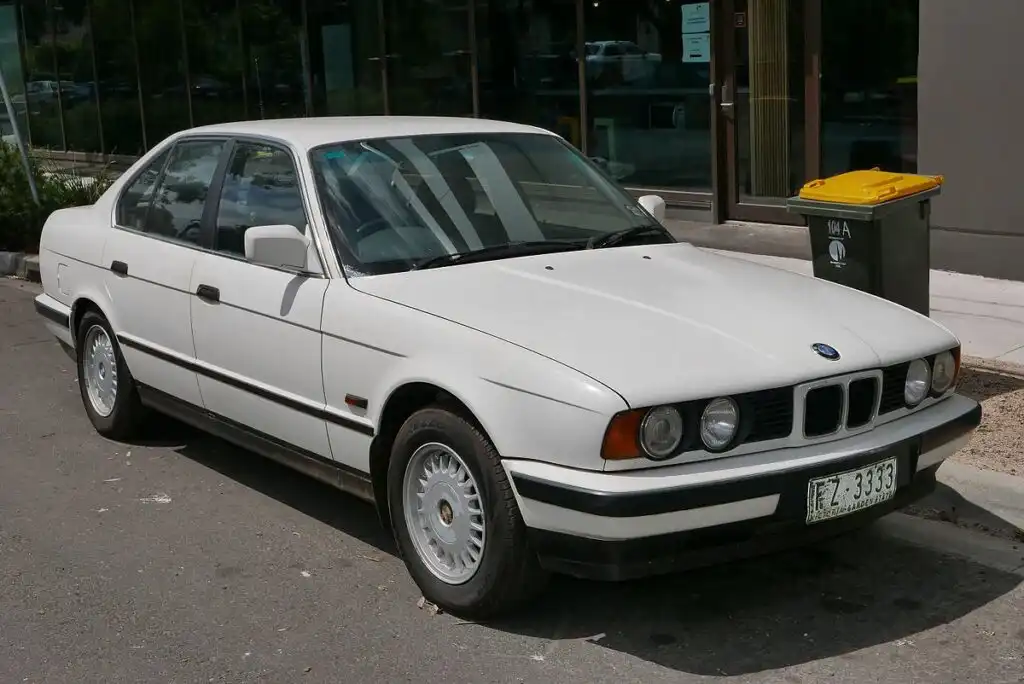
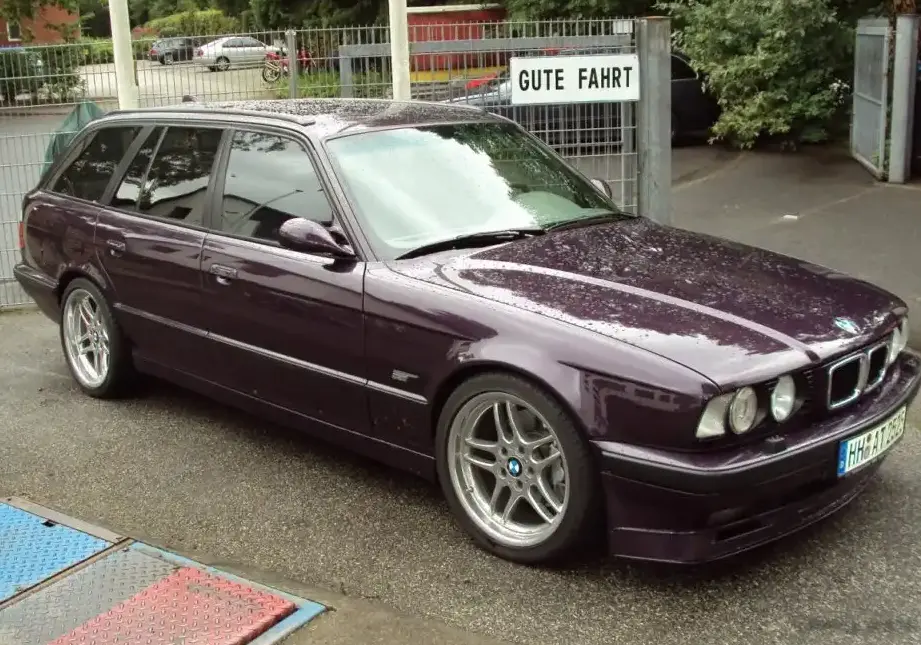
The BMW 5 Series Touring (E34) 525td, produced between 1993 and 1997, represents a distinctive offering within the E34 generation of BMW’s mid-size executive car. This variant combined the practicality of the Touring (station wagon) body style with a turbocharged diesel engine, the M51D25, offering a blend of fuel efficiency and long-distance comfort. Positioned as a more economical alternative to the petrol-powered 5 Series models, the 525td catered to buyers prioritizing lower running costs and torque for towing or carrying loads. It was a particularly popular choice in European markets where diesel fuel was more readily available and favorably taxed.
Powertrain & Engine Architecture
The heart of the 525td is the BMW M51D25 engine, a 2.5-liter inline-six cylinder diesel. This engine utilized precombustion chamber injection, a system prevalent in European diesels of the era, which involved injecting fuel into a small pre-chamber connected to the main combustion chamber. This design promoted more complete combustion and reduced engine noise. The addition of a turbocharger and intercooler significantly boosted power output to 115 horsepower and 222 Nm (163.74 lb-ft) of torque. The M51 engine family was known for its durability and relatively simple mechanical design. Crucially, the 525td was exclusively offered with a 5-speed manual transmission, providing a direct connection to the engine’s power delivery and a more engaging driving experience.
Driving Characteristics
The 525td, equipped with its manual transmission, offered a driving experience markedly different from the higher-powered 525i or 530i petrol variants. Acceleration was modest, requiring approximately 13.7 seconds to reach 62 mph, but the engine’s robust low-end torque made it well-suited for relaxed cruising and effortless overtaking on highways. The gear ratios were carefully optimized for fuel efficiency and maintaining momentum rather than outright performance. Compared to the later 525tds models equipped with automatic transmissions, the manual version felt more responsive and engaging, allowing the driver to fully exploit the engine’s torque band. While not a sports car, the 525td provided a comfortable and capable driving experience, particularly well-suited for long journeys where fuel economy and relaxed cruising were prioritized.
Equipment & Trim Levels
The 525td typically came with a reasonably well-equipped interior, though it generally occupied a position slightly below the higher-specification petrol models in terms of luxury features. Standard equipment included cloth upholstery, manual air conditioning, power windows, and central locking. Optional extras included leather upholstery, a sunroof, upgraded audio systems, and heated front seats. The dashboard layout was consistent with the E34 generation, featuring a driver-focused design and clear, intuitive instrumentation. The Touring body style itself significantly enhanced practicality, offering a generous cargo area accessible through a convenient rear tailgate.
Chassis & Braking
The E34 5 Series chassis was highly regarded for its balanced handling and overall composure. The 525td utilized a wishbone front suspension and a spring strut rear suspension. The braking system consisted of ventilated discs at the front and solid discs at the rear, with ABS (Anti-lock Braking System) included as standard equipment. The suspension was tuned to prioritize ride comfort, while still providing good body control during cornering maneuvers. The weight distribution was reasonably balanced, contributing to the car’s stable and predictable handling characteristics.
Market Reception & Comparison
The 525td was generally well-received by automotive critics as a practical and economical option within the 5 Series range. It was consistently praised for its fuel efficiency, strong torque output, and comfortable ride quality. However, critics also acknowledged that its performance didn’t quite match the exhilaration offered by the petrol-powered models. Compared to the 525i, the 525td delivered significantly superior fuel economy but lacked the same level of refinement and outright acceleration. The 525tds, with its automatic transmission, often drew criticism for feeling sluggish and less engaging to drive. The 525td, with its manual gearbox, provided a more rewarding and driver-focused experience for those prioritizing involvement and control.
Legacy
The BMW E34 525td has earned a reputation as a durable and reliable vehicle, particularly regarding its engine and drivetrain. The M51D25 engine is renowned for its longevity, and numerous examples remain on the road today with substantial mileage. While sourcing certain parts can occasionally present a challenge, the E34 5 Series enjoys a dedicated following among BMW enthusiasts, and a healthy supply of aftermarket parts is readily available. In the current used car market, the 525td is often sought after by enthusiasts seeking a classic BMW that is both practical and economical to operate. Its compelling combination of fuel efficiency, durability, and comfortable ride continues to make it an attractive choice for both enthusiasts and everyday drivers alike.