Technical Specifications
| Brand | BMW |
| Model | 5 Series |
| Generation | 5 Series Touring (E39) |
| Type (Engine) | 523i (170 Hp) Automatic |
| Start of production | 1995 |
| End of production | 1998 |
| Powertrain Architecture | Internal Combustion engine |
| Body type | Station wagon (estate) |
| Seats | 5 |
| Doors | 5 |
| Fuel consumption (economy) – urban | 15.6 l/100 km (15.1 US mpg, 18.1 UK mpg, 6.4 km/l) |
| Fuel consumption (economy) – extra urban | 7.9 l/100 km (29.8 US mpg, 35.8 UK mpg, 12.7 km/l) |
| Fuel Type | Petrol (Gasoline) |
| Acceleration 0 – 100 km/h | 10.2 sec |
| Acceleration 0 – 62 mph | 10.2 sec |
| Acceleration 0 – 60 mph | 9.7 sec |
| Maximum speed | 222 km/h (137.94 mph) |
| Weight-to-power ratio | 9.3 kg/Hp, 107.6 Hp/tonne |
| Weight-to-torque ratio | 6.4 kg/Nm, 155.1 Nm/tonne |
| Power | 170 Hp @ 5500 rpm |
| Power per litre | 68.2 Hp/l |
| Torque | 245 Nm @ 3950 rpm (180.7 lb.-ft. @ 3950 rpm) |
| Engine layout | Front, Longitudinal |
| Engine Model/Code | M52B25 |
| Engine displacement | 2494 cm3 (152.19 cu. in.) |
| Number of cylinders | 6 |
| Engine configuration | Inline |
| Cylinder Bore | 84 mm (3.31 in.) |
| Piston Stroke | 75 mm (2.95 in.) |
| Compression ratio | 10.5:1 |
| Number of valves per cylinder | 4 |
| Fuel injection system | Multi-port manifold injection |
| Engine aspiration | Naturally aspirated engine |
| Valvetrain | DOHC |
| Engine oil capacity | 6.5 l (6.87 US qt | 5.72 UK qt) |
| Coolant | 10.5 l (11.1 US qt | 9.24 UK qt) |
| Kerb Weight | 1580 kg (3483.3 lbs.) |
| Max. weight | 2205 kg (4861.19 lbs.) |
| Max load | 625 kg (1377.89 lbs.) |
| Trunk (boot) space – minimum | 410 l (14.48 cu. ft.) |
| Trunk (boot) space – maximum | 1525 l (53.85 cu. ft.) |
| Fuel tank capacity | 70 l (18.49 US gal | 15.4 UK gal) |
| Length | 4805 mm (189.17 in.) |
| Width | 1800 mm (70.87 in.) |
| Height | 1440 mm (56.69 in.) |
| Wheelbase | 2830 mm (111.42 in.) |
| Front track | 1512 mm (59.53 in.) |
| Rear (Back) track | 1526 mm (60.08 in.) |
| Drivetrain Architecture | The Internal combustion engine (ICE) drives the rear wheels of the vehicle. |
| Drive wheel | Rear wheel drive |
| Number of gears and type of gearbox | 5 gears, automatic transmission |
| Front suspension | Wishbone |
| Rear suspension | Inclined Lever |
| Front brakes | Ventilated discs |
| Rear brakes | Disc |
| Assisting systems | ABS (Anti-lock braking system) |
| Steering type | Steering rack and pinion |
| Power steering | Hydraulic Steering |
| Tires size | 225/60 VR15 |
| Wheel rims size | 15 |
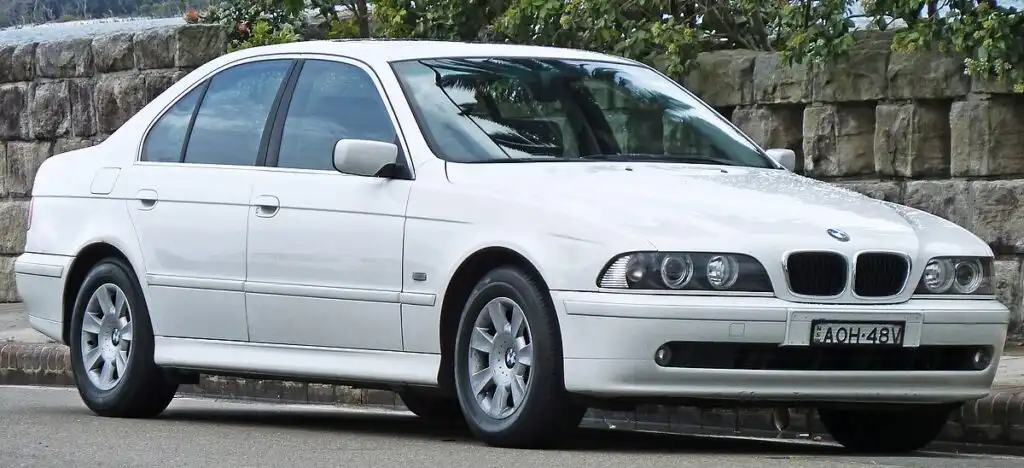
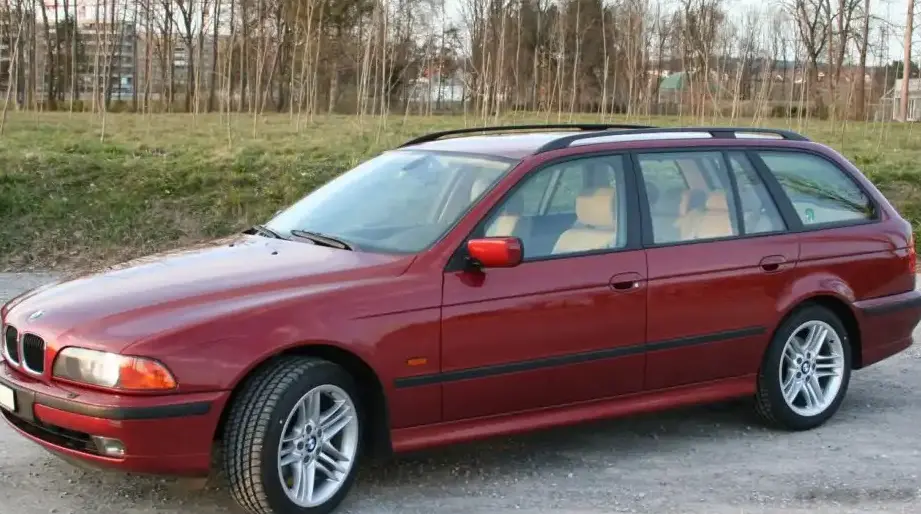
The BMW 5 Series Touring (E39) 523i Automatic, produced from 1995 to 1998, represents a compelling blend of practicality and BMW’s renowned driving dynamics within the E39 generation. As a station wagon (estate) variant of the popular 5 Series, the 523i aimed to provide a more versatile option for families and those requiring additional cargo space without sacrificing the luxury and performance associated with the BMW badge. This particular configuration, pairing a 2.5-liter inline-six engine with a five-speed automatic transmission, occupied a mid-range position in the E39 Touring lineup, offering a balance between affordability, fuel efficiency, and acceptable performance. It served as a stepping stone between the base 520i and the more powerful 528i and 530i models.
Powertrain & Engine Architecture
The heart of the 523i Touring is the M52B25, a 2.5-liter inline-six engine. This engine is a naturally aspirated powerplant known for its smooth operation and relatively high specific output. The M52 featured a cast iron block with an aluminum cylinder head, incorporating double overhead camshafts (DOHC) and four valves per cylinder. Fuel delivery was managed by a Bosch Motronic multi-port fuel injection system, optimizing combustion for both performance and efficiency. The engine produced 170 horsepower at 5500 rpm and 245 Nm (180.7 lb-ft) of torque at 3950 rpm. Paired with this engine was a ZF 5HP18 five-speed automatic transmission. This transmission was a torque converter type, offering smooth shifts and a degree of convenience, but at the expense of some performance compared to the available manual gearbox. The automatic transmission’s gear ratios were tuned for a balance of acceleration and fuel economy, prioritizing comfort over outright sportiness.
Driving Characteristics
The 523i Touring Automatic offered a comfortable and refined driving experience. While not as quick as its higher-powered siblings, the 2.5-liter engine provided adequate power for everyday driving and highway cruising. Acceleration from 0 to 60 mph took approximately 9.7 seconds, and the car had a top speed of 222 km/h (137.94 mph). The automatic transmission, while smooth, did result in some power loss compared to the manual version. Gear changes were generally unobtrusive, but downshifts could sometimes feel hesitant. The Touring’s suspension, tuned for comfort, provided a compliant ride, absorbing bumps and imperfections in the road effectively. However, this did come at the cost of some body roll during cornering. The rear-wheel-drive configuration contributed to balanced handling, but the car wasn’t particularly sporty in its overall demeanor.
Equipment & Trim Levels
The 523i Touring typically came equipped with a respectable level of standard features. These included power windows, power locks, air conditioning, an AM/FM stereo, and alloy wheels. Interior upholstery was typically cloth, although leather was available as an option. Optional extras included a sunroof, heated front seats, a premium sound system, and navigation. The dashboard layout was typical of BMW at the time, with a driver-focused design and intuitive controls. Trim levels were relatively simple, with most options being added individually rather than packaged into distinct tiers.
Chassis & Braking
The E39 Touring utilized a MacPherson strut front suspension and an independent multi-link rear suspension. This setup provided a good balance of ride comfort and handling. The 523i typically featured ventilated disc brakes at the front and solid disc brakes at the rear. Anti-lock braking system (ABS) was standard, enhancing safety and control during emergency braking. The steering was a rack-and-pinion system with hydraulic power assistance, providing precise and responsive steering feel. The 523i’s curb weight of 1580 kg (3483.3 lbs) was relatively moderate for a station wagon of its size, contributing to its manageable handling characteristics.
Market Reception & Comparison
The 523i Touring Automatic was generally well-received by automotive critics. It was praised for its comfortable ride, spacious interior, and practical cargo capacity. However, some reviewers noted that the automatic transmission dulled the engine’s performance and that the car lacked the sporty character of its higher-powered siblings. Compared to the 528i and 530i Touring models, the 523i offered a more affordable entry point into the E39 Touring range. It also provided better fuel economy than the larger-engined variants. Against competitors like the Mercedes-Benz E-Class Estate and the Volvo V70, the 523i Touring offered a more engaging driving experience and a more premium interior.
Legacy
The BMW E39 5 Series is widely regarded as a high point in BMW’s engineering history. The 523i Touring Automatic, while not the most sought-after variant, remains a popular choice among enthusiasts seeking a practical and reliable classic BMW. The M52B25 engine is known for its durability and relatively simple maintenance requirements. However, like all older vehicles, the 523i Touring is susceptible to age-related issues such as corrosion, cooling system failures, and electrical problems. Well-maintained examples are becoming increasingly collectible, and the car continues to offer a compelling blend of luxury, performance, and practicality for those seeking a classic European touring car.