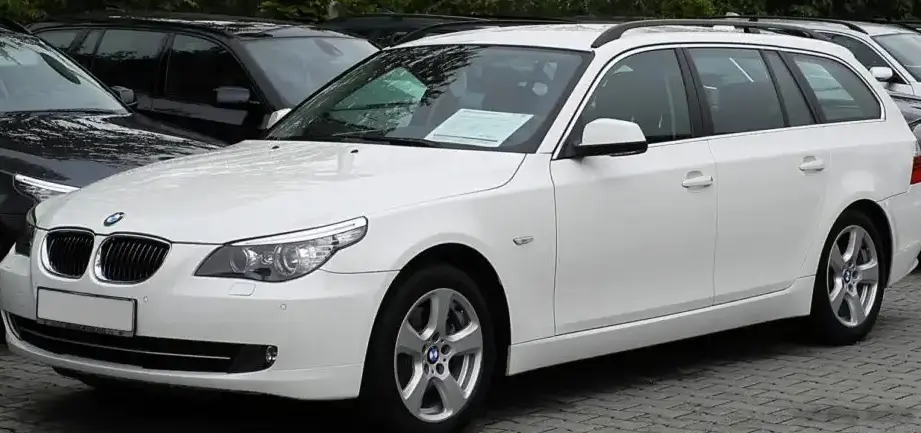
The BMW 5 Series Touring (E61 LCI), specifically the 525d variant produced from 2007 to 2010, represents a significant iteration of BMW’s popular executive wagon. The “LCI” designation stands for Lebenszyklusimpuls, or Lifecycle Impulse, denoting a facelift applied to the E61 generation. This model year brought styling updates, revised engine options, and improvements to interior technology. The 525d, powered by a 3.0-liter inline-six diesel engine producing 197 horsepower, occupied a middle ground in the 5 Series Touring lineup, offering a balance between performance, fuel efficiency, and practicality. It was positioned as a more economical alternative to the higher-performance 535d, while providing more power and refinement than the entry-level 520d.
Technical Specifications
| Brand | BMW |
| Model | 5 Series |
| Generation | 5 Series Touring (E61 LCI, facelift 2007) |
| Type (Engine) | 525d (197 Hp) |
| Start of production | 2007 |
| End of production | 2010 |
| Powertrain Architecture | Internal Combustion engine |
| Body type | Station wagon (estate) |
| Seats | 5 |
| Doors | 5 |
| Fuel consumption (urban) | 8.4 l/100 km (28 US mpg, 33.6 UK mpg, 11.9 km/l) |
| Fuel consumption (extra urban) | 5.2 l/100 km (45.2 US mpg, 54.3 UK mpg, 19.2 km/l) |
| Fuel consumption (combined) | 6.4 l/100 km (36.8 US mpg, 44.1 UK mpg, 15.6 km/l) |
| Fuel Type | Diesel |
| Acceleration 0 – 100 km/h | 7.8 sec |
| Acceleration 0 – 62 mph | 7.8 sec |
| Acceleration 0 – 60 mph | 7.4 sec |
| Maximum speed | 232 km/h (144.16 mph) |
| Emission standard | Euro 4 |
| Weight-to-power ratio | 8.4 kg/Hp, 118.7 Hp/tonne |
| Weight-to-torque ratio | 4.2 kg/Nm, 241 Nm/tonne |
| Power | 197 Hp @ 3750 rpm |
| Power per litre | 65.8 Hp/l |
| Torque | 400 Nm @ 1300-3250 rpm (295.02 lb.-ft. @ 1300-3250 rpm) |
| Engine layout | Front, Longitudinal |
| Engine Model/Code | M57D30 |
| Engine displacement | 2993 cm3 (182.64 cu. in.) |
| Number of cylinders | 6 |
| Engine configuration | Inline |
| Cylinder Bore | 84 mm (3.31 in.) |
| Piston Stroke | 90 mm (3.54 in.) |
| Compression ratio | 17:1 |
| Number of valves per cylinder | 4 |
| Fuel injection system | Diesel Commonrail |
| Engine aspiration | Turbocharger, Intercooler |
| Engine oil capacity | 7.5 l (7.93 US qt | 6.6 UK qt) |
| Coolant | 9.8 l (10.36 US qt | 8.62 UK qt) |
| Kerb Weight | 1660 kg (3659.67 lbs.) |
| Max. weight | 2260 kg (4982.45 lbs.) |
| Max load | 600 kg (1322.77 lbs.) |
| Trunk (boot) space – minimum | 500 l (17.66 cu. ft.) |
| Trunk (boot) space – maximum | 1650 l (58.27 cu. ft.) |
| Fuel tank capacity | 70 l (18.49 US gal | 15.4 UK gal) |
| Length | 4843 mm (190.67 in.) |
| Width | 1846 mm (72.68 in.) |
| Height | 1491 mm (58.7 in.) |
| Wheelbase | 2888 mm (113.7 in.) |
| Front track | 1558 mm (61.34 in.) |
| Rear (Back) track | 1581 mm (62.24 in.) |
| Ride height (ground clearance) | 143 mm (5.63 in.) |
| Drag coefficient (Cd) | 0.29 |
| Minimum turning circle (turning diameter) | 11.4 m (37.4 ft.) |
| Drivetrain Architecture | The Internal combustion engine (ICE) drives the rear wheels of the vehicle. |
| Drive wheel | Rear wheel drive |
| Number of gears and type of gearbox | 6 gears, manual transmission |
| Front brakes | Ventilated discs |
| Rear brakes | Disc |
| Assisting systems | ABS (Anti-lock braking system) |
| Steering type | Steering rack and pinion |
| Tires size | 225/55 R16 W |
| Wheel rims size | 16 |
Powertrain & Engine Architecture
The heart of the 525d Touring LCI is the M57D30, a 3.0-liter inline-six diesel engine. This engine is a member of BMW’s highly regarded M57 family, known for its durability and strong low-end torque. The M57D30 utilizes a common rail direct injection system, delivering fuel at extremely high pressure for optimized combustion. A variable geometry turbocharger (VGT) with an intercooler further enhances performance and efficiency. The engine produces 197 horsepower at 3750 rpm and a substantial 400 Nm (295 lb-ft) of torque available from a low 1300 rpm, sustaining through 3250 rpm. This broad torque curve is a hallmark of the M57 engine family. The 6-speed manual transmission was standard, providing precise gear changes and a direct connection to the engine. While an automatic transmission was available, the manual was favored by enthusiasts for its improved responsiveness.
Driving Characteristics
The 525d Touring LCI offered a refined and capable driving experience. The abundant low-end torque made it effortless to accelerate from a standstill or execute overtaking maneuvers. While not a sports car, the 525d provided ample power for comfortable highway cruising and spirited driving. The manual transmission, with its well-defined gate and relatively short throws, enhanced driver engagement. Compared to the more powerful 535d, the 525d felt less urgent in its acceleration, but the difference was often negligible in everyday driving situations. The 525d’s weight distribution, typical of BMW’s rear-wheel-drive layout, contributed to balanced handling and predictable cornering behavior.
Equipment & Trim Levels
The 525d Touring LCI came reasonably well-equipped as standard. Typical features included automatic climate control, power windows and mirrors, a multi-function steering wheel, and a basic audio system. Upholstery was generally cloth, with leather options available. The LCI facelift brought subtle interior revisions, including updated trim materials and improved switchgear. Optional extras included a premium sound system, navigation system, sunroof, sport seats, and parking sensors. The “Sport” package added aesthetic enhancements like unique alloy wheels, sport suspension, and aluminum interior trim.
Chassis & Braking
The E61 Touring utilized BMW’s sophisticated chassis design, featuring a multi-link rear suspension for excellent ride comfort and handling. The front suspension employed MacPherson struts. The 525d typically came equipped with ventilated disc brakes at the front and solid discs at the rear. Anti-lock braking system (ABS) was standard, along with electronic brake-force distribution (EBD). The suspension was tuned to provide a balance between comfort and handling, leaning towards the former in the 525d trim. Stabilizer bars were fitted front and rear to reduce body roll during cornering.
Market Reception & Comparison
The 525d Touring LCI was generally well-received by automotive critics. It was praised for its fuel efficiency, comfortable ride, and spacious interior. The diesel engine was lauded for its refinement and strong torque output. Compared to the 520d, the 525d offered a noticeable performance upgrade, making it a more appealing option for drivers who frequently traveled long distances or carried passengers and cargo. Against the 535d, the 525d represented a more sensible choice for those prioritizing fuel economy and value. Reliability was generally good, although, like all modern diesel engines, the 525d could be susceptible to issues with the diesel particulate filter (DPF) if not properly maintained.
Legacy
The BMW 525d Touring (E61 LCI) remains a popular choice in the used car market. The M57D30 engine is known for its longevity, and well-maintained examples can still provide years of reliable service. However, potential buyers should be aware of the potential for DPF issues and the cost of maintaining a complex diesel engine. The E61 Touring, in general, is appreciated for its practicality, comfort, and driving dynamics, making it a compelling alternative to more modern, but potentially less characterful, station wagons.