Technical Specifications
| Brand | BMW |
| Model | M2 |
| Generation | M2 coupe (F87) |
| Type (Engine) | 3.0 (370 Hp) DCT |
| Start of production | October, 2015 |
| End of production | June, 2018 |
| Powertrain Architecture | Internal Combustion engine |
| Body type | Coupe |
| Seats | 4 |
| Doors | 2 |
| Fuel consumption (economy) – urban | 10.5 l/100 km (22.4 US mpg) |
| Fuel consumption (economy) – extra urban | 6.4 l/100 km (36.8 US mpg) |
| Fuel consumption (economy) – combined | 7.9 l/100 km (29.8 US mpg) |
| CO2 emissions | 185 g/km |
| Fuel Type | Petrol (Gasoline) |
| Acceleration 0 – 100 km/h | 4.3 sec |
| Acceleration 0 – 62 mph | 4.3 sec |
| Acceleration 0 – 60 mph | 4.1 sec |
| Maximum speed | 250 km/h (155.34 mph) |
| Emission standard | Euro 6 |
| Weight-to-power ratio | 4.1 kg/Hp |
| Weight-to-torque ratio | 3.3 kg/Nm |
| Power | 370 Hp @ 6500 rpm |
| Torque | 465 Nm @ 1400-5560 rpm (342.97 lb.-ft. @ 1400-5560 rpm) |
| Engine layout | Front, Longitudinal |
| Engine Model/Code | N55B30A |
| Engine displacement | 2979 cm3 (181.79 cu. in.) |
| Number of cylinders | 6 |
| Engine configuration | Inline |
| Cylinder Bore | 84 mm (3.31 in.) |
| Piston Stroke | 89.6 mm (3.53 in.) |
| Compression ratio | 10.2:1 |
| Number of valves per cylinder | 4 |
| Fuel injection system | Direct injection |
| Engine aspiration | Twin-power turbo, Intercooler |
| Engine oil capacity | 6.5 l (6.87 US qt | 5.72 UK qt) |
| Coolant | 7.2 l (7.61 US qt | 6.34 UK qt) |
| Kerb Weight | 1520 kg (3351.03 lbs.) |
| Max. weight | 2010 kg (4431.29 lbs.) |
| Max load | 490 kg (1080.27 lbs.) |
| Trunk (boot) space – minimum | 390 l (13.77 cu. ft.) |
| Fuel tank capacity | 52 l (13.74 US gal | 11.44 UK gal) |
| Max. roof load | 75 kg (165.35 lbs.) |
| Length | 4468 mm (175.91 in.) |
| Width | 1854 mm (72.99 in.) |
| Height | 1410 mm (55.51 in.) |
| Wheelbase | 2693 mm (106.02 in.) |
| Front track | 1579 mm (62.17 in.) |
| Rear (Back) track | 1601 mm (63.03 in.) |
| Ride height (ground clearance) | 123 mm (4.84 in.) |
| Drag coefficient (Cd) | 0.35 |
| Minimum turning circle (turning diameter) | 11.7 m (38.39 ft.) |
| Drivetrain Architecture | Rear wheel drive |
| Number of gears and type of gearbox | 7 gears, automatic transmission DCT |
| Front suspension | Independent coil spring |
| Rear suspension | Independent multi-link suspension |
| Front brakes | Ventilated discs |
| Rear brakes | Ventilated discs |
| Assisting systems | ABS (Anti-lock braking system) |
| Steering type | Steering rack and pinion |
| Power steering | Electric Steering |
| Tires size | 245/35 ZR19 93Y; 265/35 ZR19 98Y |
| Wheel rims size | 9.0J x 19; 10.0J x 19 |
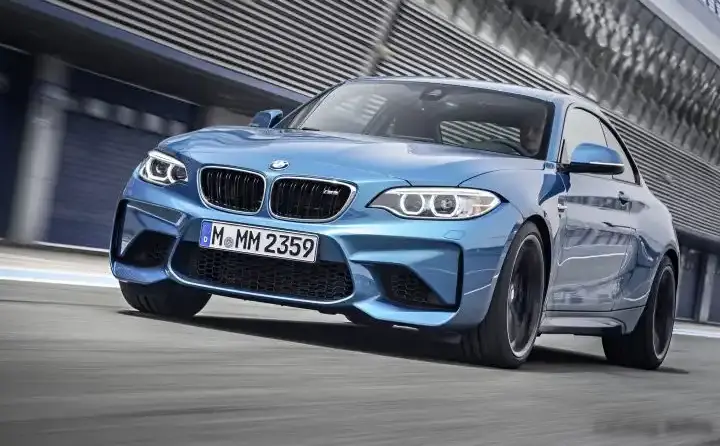
The F87 M2, particularly the 3.0-liter DCT variant, was designed to be a purist’s sports car. Built on the F22 2 Series platform, it benefited from a shortened wheelbase and wider track compared to its 3 and 4 Series siblings, contributing to its agile handling. The M2 aimed to deliver a raw, engaging driving experience, harking back to the classic BMW coupes of the past. This specific configuration, combining the potent N55 engine with the quick-shifting DCT, was a popular choice, offering a balance between performance and usability.
Powertrain & Engine Architecture
At the heart of the M2 is the N55B30A, a 3.0-liter inline-six cylinder engine. This engine, while not the newest BMW powerplant at the time (it was superseded by the B58), was a well-developed and robust unit. It features direct fuel injection, a twin-scroll turbocharger, and variable valve timing (VANOS) and valve lift (Valvetronic) systems. These technologies work in concert to deliver a broad torque curve and impressive horsepower output. The engine produces 370 hp at 6500 rpm and 343 lb-ft of torque between 1400 and 5560 rpm.
The 7-speed dual-clutch transmission (DCT) is a crucial component of this variant. Unlike a traditional automatic, the DCT utilizes two separate clutches – one for odd gears and one for even gears – allowing for incredibly fast and seamless gear changes. This contributes significantly to the M2’s acceleration and responsiveness. The DCT also offers a manual shift mode, allowing drivers to control gear selection via steering wheel-mounted paddles.
Driving Characteristics
The M2 3.0 DCT delivers a thrilling driving experience. The combination of the powerful engine and the quick-shifting DCT results in a 0-60 mph time of around 4.1 seconds. The DCT’s programming is tuned for both spirited driving and everyday usability. In automatic mode, it provides smooth and comfortable shifts, while in manual mode, it responds instantly to driver inputs. Compared to the 6-speed manual version, the DCT offers slightly quicker acceleration and a more forgiving driving experience, particularly for less experienced drivers. However, some purists prefer the greater engagement of the manual transmission.
The M2’s chassis is well-balanced, with precise steering and minimal body roll. The suspension is firm but not overly harsh, providing a good compromise between comfort and handling. The car feels planted and confident in corners, inspiring confidence in the driver.
Equipment & Trim Levels
The M2 came standard with a generous amount of equipment, including leather upholstery, power-adjustable seats, a premium sound system, and a suite of driver-assistance features. Optional extras included a sunroof, upgraded interior trim, and a Competition Package, which added more aggressive styling cues, a sport exhaust system, and a slightly stiffer suspension. The interior design is driver-focused, with a clear and concise instrument panel and ergonomically placed controls.
Chassis & Braking
The M2 features a robust chassis with a MacPherson strut front suspension and a multi-link rear suspension. The suspension components are specifically tuned for performance, with stiffer springs and dampers compared to the standard 2 Series. Braking duties are handled by large, ventilated discs at all four corners, providing ample stopping power. The M2 also includes ABS, dynamic stability control (DSC), and other advanced braking and stability systems.
Market Reception & Comparison
The BMW M2 was widely praised by automotive critics for its exceptional performance, engaging driving dynamics, and relatively affordable price. It was often compared to the Porsche 718 Cayman, with many reviewers finding the M2 to be a more practical and accessible alternative. Compared to the higher-output M4, the M2 was seen as a more focused and rewarding driver’s car, thanks to its smaller size and lighter weight. Fuel economy, while not a primary concern for M2 buyers, was respectable for a high-performance coupe, averaging around 29.8 US mpg in combined driving.
Legacy
The F87 M2 has quickly become a modern classic, highly sought after by enthusiasts and collectors. The 3.0-liter DCT variant is particularly desirable due to its combination of performance, usability, and relative rarity. The N55 engine is known for its reliability, although regular maintenance is essential. The DCT transmission is also generally reliable, but it can be expensive to repair if issues arise. On the used car market, well-maintained M2s command a premium price, reflecting their enduring appeal and status as one of BMW’s most successful performance cars of the 21st century.