Technical Specifications
| Brand | BMW |
| Model | M5 |
| Generation | M5 (E34) |
| Type (Engine) | 3.8 (340 Hp) |
| Start of production | 1992 |
| End of production | 1994 |
| Powertrain Architecture | Internal Combustion engine |
| Body type | Sedan |
| Seats | 5 |
| Doors | 4 |
| Fuel consumption (economy) – urban | 18 l/100 km (13.1 US mpg, 15.7 UK mpg, 5.6 km/l) |
| Fuel consumption (economy) – extra urban | 8.3 l/100 km (28.3 US mpg, 34 UK mpg, 12 km/l) |
| Fuel consumption (economy) – combined | 9.6 l/100 km (24.5 US mpg, 29.4 UK mpg, 10.4 km/l) |
| Fuel Type | Petrol (Gasoline) |
| Acceleration 0 – 100 km/h | 5.9 sec |
| Acceleration 0 – 62 mph | 5.9 sec |
| Acceleration 0 – 60 mph | 5.6 sec |
| Maximum speed | 250 km/h (155.34 mph) |
| Weight-to-power ratio | 4.9 kg/Hp, 206.1 Hp/tonne |
| Weight-to-torque ratio | 4.1 kg/Nm, 242.4 Nm/tonne |
| Power | 340 Hp @ 6900 rpm |
| Power per litre | 89.6 Hp/l |
| Torque | 400 Nm @ 4750 rpm (295.02 lb.-ft. @ 4750 rpm) |
| Engine layout | Front, Longitudinal |
| Engine Model/Code | S38B38 |
| Engine displacement | 3795 cm3 (231.59 cu. in.) |
| Number of cylinders | 6 |
| Engine configuration | Inline |
| Cylinder Bore | 94.6 mm (3.72 in.) |
| Piston Stroke | 90 mm (3.54 in.) |
| Compression ratio | 10.5:1 |
| Number of valves per cylinder | 4 |
| Fuel injection system | Multi-port manifold injection |
| Engine aspiration | Naturally aspirated engine |
| Valvetrain | DOHC |
| Engine oil capacity | 5.8 l (6.13 US qt | 5.1 UK qt) |
| Coolant | 13.3 l (14.05 US qt | 11.7 UK qt) |
| Kerb Weight | 1650 kg (3637.63 lbs.) |
| Max. weight | 2150 kg (4739.94 lbs.) |
| Max load | 500 kg (1102.31 lbs.) |
| Trunk (boot) space – minimum | 460 l (16.24 cu. ft.) |
| Fuel tank capacity | 90 l (23.78 US gal | 19.8 UK gal) |
| Max. roof load | 100 kg (220.46 lbs.) |
| Permitted trailer load with brakes (12%) | 1400 kg (3086.47 lbs.) |
| Permitted trailer load without brakes | 700 kg (1543.24 lbs.) |
| Length | 4720 mm (185.83 in.) |
| Width | 1751 mm (68.94 in.) |
| Height | 1392 mm (54.8 in.) |
| Wheelbase | 2761 mm (108.7 in.) |
| Front track | 1474 mm (58.03 in.) |
| Rear (Back) track | 1496 mm (58.9 in.) |
| Drag coefficient (Cd) | 0.33 |
| Minimum turning circle (turning diameter) | 11.6 m (38.06 ft.) |
| Drivetrain Architecture | The Internal combustion engine (ICE) drives the rear wheels of the vehicle. |
| Drive wheel | Rear wheel drive |
| Number of gears and type of gearbox | 5 gears, manual transmission |
| Front suspension | Wishbone |
| Rear suspension | Coil spring |
| Front brakes | Ventilated discs |
| Rear brakes | Ventilated discs |
| Assisting systems | ABS (Anti-lock braking system) |
| Steering type | Steering rack and pinion |
| Power steering | Hydraulic Steering |
| Tires size | 235/45 R17; 250/40 R17 |
| Wheel rims size | 8J x 17; 9J x 17 |
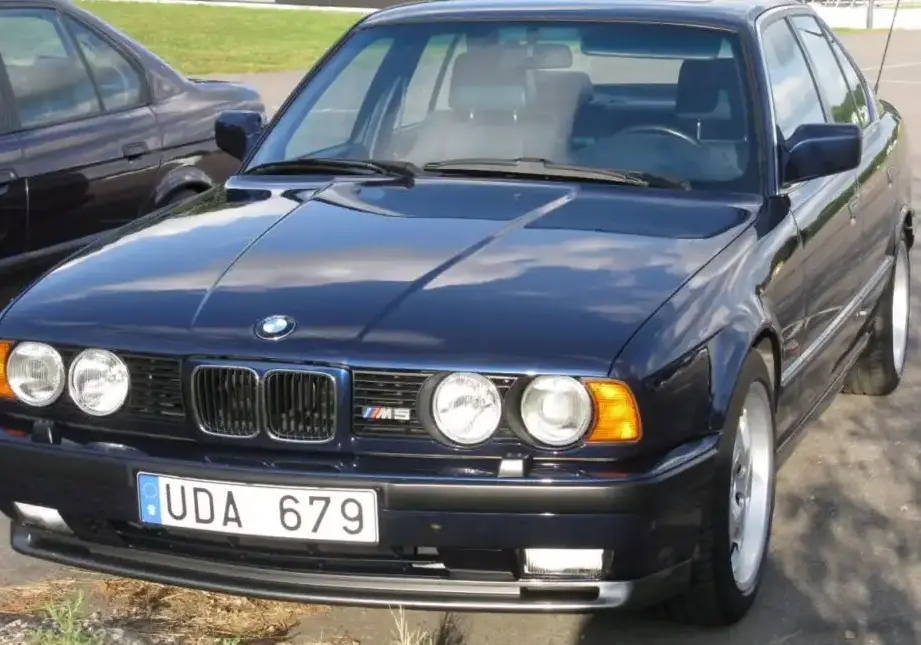
The E34 M5 3.8 represented the culmination of BMW’s efforts to create a truly exceptional performance sedan. Building upon the already impressive E34 platform, the 3.8-liter engine significantly increased power output, addressing criticisms leveled at the earlier 3.5-liter models. While the E34 M5 was always a relatively low-volume model, the 3.8 variant was the rarest, making it highly sought after by collectors and enthusiasts. It was positioned as the top-tier M5, offering a more refined and powerful driving experience than its predecessors.
Powertrain & Engine Architecture
The heart of the E34 M5 3.8 is the S38B38 engine, a 3.8-liter inline-six cylinder powerplant. This engine was derived from the S38B35 found in earlier M5s, but with a larger bore (94.6mm) and stroke (90mm) increasing displacement. The engine featured a dual overhead camshaft (DOHC) valvetrain with four valves per cylinder, optimized for high-RPM performance. Bosch Motronic 3.1 fuel injection managed the air-fuel mixture, ensuring precise control and efficient combustion. The engine’s internals were strengthened to handle the increased power, including forged pistons and a reinforced crankshaft. The engine was longitudinally mounted, driving the rear wheels. The 3.8-liter M5 exclusively came with a 5-speed manual transmission, providing direct control and enhancing the driving experience.
Driving Characteristics
The E34 M5 3.8 delivered a thrilling driving experience characterized by its responsive engine, precise handling, and robust braking. The increased displacement and power of the 3.8-liter engine resulted in noticeably quicker acceleration compared to the 3.5-liter models. The 5-speed manual transmission offered precise gear changes, allowing drivers to fully exploit the engine’s powerband. The chassis, already well-regarded in the E34 5 Series, was further enhanced with stiffer springs and dampers, improving handling and reducing body roll. The car felt planted and stable at high speeds, inspiring confidence in the driver. While not a lightweight car, the M5 3.8’s power-to-weight ratio provided exhilarating performance.
Equipment & Trim Levels
The E34 M5 3.8 was generously equipped, reflecting its status as the flagship model. Standard features included leather upholstery, power-adjustable front seats, air conditioning, a sunroof, and an upgraded sound system. The interior trim was typically finished in dark wood or carbon fiber, adding a touch of luxury and sportiness. Optional extras included a limited-slip differential, which further enhanced handling, and a more comprehensive sound system. The exterior styling was subtle but distinctive, with a rear spoiler, aerodynamic side mirrors, and unique M5 badging.
Chassis & Braking
The E34 M5 3.8 utilized a modified version of the E34 5 Series chassis, with significant upgrades to the suspension and braking systems. The front suspension featured MacPherson struts with anti-roll bar, while the rear suspension employed a semi-trailing arm design with coil springs and an anti-roll bar. Ventilated disc brakes were fitted to all four wheels, providing ample stopping power. The anti-lock braking system (ABS) was standard, enhancing safety and control. The suspension was tuned to provide a balance between comfort and performance, offering a firm but not overly harsh ride.
Market Reception & Comparison
The E34 M5 3.8 was widely praised by automotive journalists for its exceptional performance, handling, and refinement. It was often compared favorably to other high-performance sedans of the era, such as the Porsche 911 and the Mercedes-Benz 500E. Critics noted the M5’s superior handling and more engaging driving experience. Compared to the earlier 3.5-liter M5, the 3.8-liter version offered a significant increase in power and torque, resulting in quicker acceleration and improved overall performance. Fuel economy, however, remained relatively poor, typical for a high-performance vehicle of this era.
Legacy
The E34 M5 3.8 has become a highly collectible and sought-after classic car. Its rarity, combined with its exceptional performance and driving dynamics, has made it a favorite among enthusiasts. The S38B38 engine is renowned for its durability and reliability, provided it is properly maintained. Today, well-maintained examples of the E34 M5 3.8 command high prices in the used car market. It remains a benchmark for high-performance sedans, and a testament to BMW’s engineering prowess.