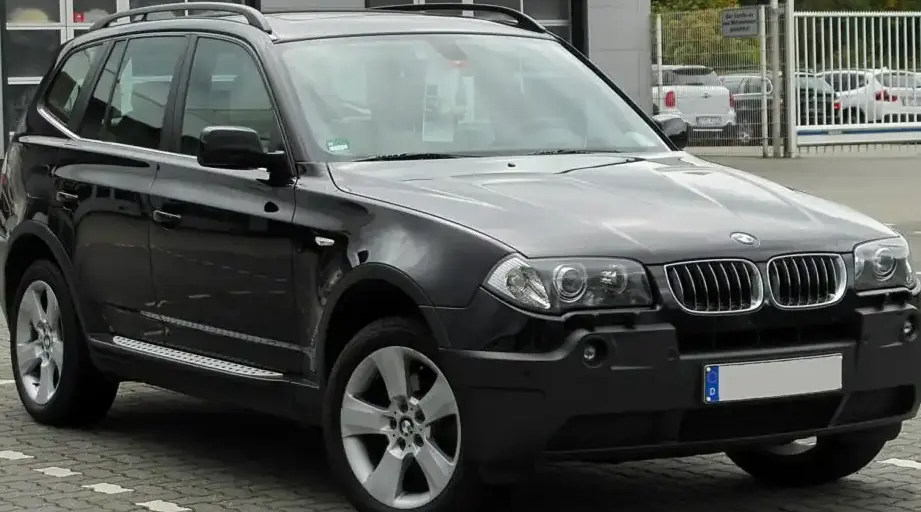
The BMW X3 (E83) 3.0d, produced from 2003 to 2004, represented BMW’s initial foray into the burgeoning compact luxury SUV segment. Positioned as a premium offering, the E83 aimed to deliver a blend of BMW’s renowned driving dynamics with the practicality of a sport utility vehicle. The 3.0d variant, equipped with a 3.0-liter inline-six diesel engine producing 204 horsepower, was a key model in the European market, offering a balance of performance and fuel efficiency. It was built on the BMW E83 platform, sharing components with the E81/E87 1-Series and E90 3-Series.
Technical Specifications
| Brand | BMW |
| Model | X3 |
| Generation | X3 (E83) |
| Type (Engine) | 3.0d (204 Hp) |
| Start of production | 2003 |
| End of production | 2004 |
| Powertrain Architecture | Internal Combustion engine |
| Body type | SUV |
| Seats | 5 |
| Doors | 5 |
| Fuel consumption (urban) | 11.1 l/100 km (21.2 US mpg) |
| Fuel consumption (extra urban) | 6.9 l/100 km (34.1 US mpg) |
| Fuel consumption (combined) | 8.4 l/100 km (28 US mpg) |
| Fuel Type | Diesel |
| Acceleration 0 – 100 km/h | 7.9 sec |
| Acceleration 0 – 62 mph | 7.9 sec |
| Acceleration 0 – 60 mph | 7.5 sec |
| Maximum speed | 210 km/h (130.49 mph) |
| Weight-to-power ratio | 9 kg/Hp |
| Weight-to-torque ratio | 4.5 kg/Nm |
| Power | 204 Hp @ 4000 rpm |
| Torque | 410 Nm @ 1500 rpm (302.4 lb.-ft. @ 1500 rpm) |
| Engine layout | Front, Longitudinal |
| Engine Model/Code | M57D30 |
| Engine displacement | 2993 cm3 (182.64 cu. in.) |
| Number of cylinders | 6 |
| Engine configuration | Inline |
| Cylinder Bore | 84 mm (3.31 in.) |
| Piston Stroke | 90 mm (3.54 in.) |
| Compression ratio | 17:1 |
| Number of valves per cylinder | 4 |
| Fuel injection system | Diesel Commonrail |
| Engine aspiration | Turbocharger, Intercooler |
| Engine oil capacity | 7.5 l (7.93 US qt | 6.6 UK qt) |
| Coolant capacity | 10.4 l (10.99 US qt | 9.15 UK qt) |
| Kerb Weight | 1835 kg (4045.48 lbs.) |
| Max. weight | 2350 kg (5180.86 lbs.) |
| Max load | 515 kg (1135.38 lbs.) |
| Trunk (boot) space – minimum | 500 l (17.66 cu. ft.) |
| Trunk (boot) space – maximum | 1560 l (55.09 cu. ft.) |
| Fuel tank capacity | 67 l (17.7 US gal | 14.74 UK gal) |
| Length | 4569 mm (179.88 in.) |
| Width | 1853 mm (72.95 in.) |
| Height | 1674 mm (65.91 in.) |
| Wheelbase | 2795 mm (110.04 in.) |
| Front track | 1524 mm (60 in.) |
| Rear (Back) track | 1542 mm (60.71 in.) |
| Ride height (ground clearance) | 200 mm (7.87 in.) |
| Drive wheel | All wheel drive (4×4) |
| Number of gears | 6 |
| Gearbox type | Manual transmission |
| Front suspension | Coil spring |
| Rear suspension | Coil spring |
| Front brakes | Disc |
| Rear brakes | Disc |
| Assisting systems | ABS (Anti-lock braking system) |
| Steering type | Steering rack and pinion |
| Power steering | Hydraulic Steering |
| Tires size | 235/55 R17 |
| Wheel rims size | 8.0J x 17 |
Introduction
The BMW X3 (E83) 3.0d, launched in 2003, was a significant addition to BMW’s lineup, marking the brand’s entry into the compact luxury SUV market. It was designed to appeal to customers seeking a more manageable and fuel-efficient alternative to the larger X5. The 3.0d variant, powered by the M57D30 engine, was particularly popular in Europe where diesel engines held a strong market share. This model aimed to provide a premium experience with BMW’s signature driving dynamics, packaged in a versatile SUV body style. Production of this specific configuration lasted until 2004, before being superseded by later iterations of the E83.
Powertrain & Engine Architecture
At the heart of the X3 3.0d lies the M57D30, a 3.0-liter inline-six diesel engine. This engine is a robust and well-regarded unit, known for its durability and strong low-end torque. The M57D30 utilizes a common rail direct injection system, delivering fuel directly into the cylinders at extremely high pressure for optimized combustion. It features four valves per cylinder and a single turbocharger with an intercooler to boost power output. The engine’s architecture is longitudinal, meaning it’s mounted lengthwise in the chassis, contributing to a balanced weight distribution. The 6-speed manual transmission paired with the engine was chosen for its driver engagement and efficiency. The transmission’s gear ratios were tuned to maximize the engine’s torque, providing strong acceleration in everyday driving situations.
Driving Characteristics
The X3 3.0d offered a noticeably different driving experience compared to its gasoline-powered siblings. The diesel engine’s abundant torque, available from as low as 1500 rpm, provided strong pulling power and effortless cruising. While not as rev-happy as the gasoline engines, the 3.0d delivered a smooth and refined driving experience. The manual transmission allowed for precise control, and the all-wheel-drive system provided excellent traction in various conditions. Compared to the higher-output X3 3.0i, the 3.0d prioritized fuel economy and usability over outright performance. The 3.0d felt more relaxed and composed on long journeys, while the 3.0i offered a more sporty and engaging driving experience. The gear ratios were optimized for fuel efficiency and torque delivery, resulting in a slightly less responsive feel than the gasoline variants.
Equipment & Trim Levels
The X3 3.0d typically came well-equipped, reflecting its premium positioning. Standard features included automatic climate control, power windows and locks, a multi-function steering wheel, and an audio system. Upholstery was typically cloth, with leather options available as an upgrade. Optional extras included a sunroof, navigation system, heated seats, and upgraded audio systems. Trim levels varied depending on the market, but generally offered increasing levels of luxury and convenience features. The interior design was functional and driver-focused, with a clear and intuitive layout. The X3’s interior space was competitive within its class, offering comfortable seating for five passengers and a reasonably sized cargo area.
Chassis & Braking
The X3 E83 featured a robust chassis designed to handle both on-road and light off-road conditions. The suspension consisted of coil springs and shock absorbers all around, providing a comfortable ride while maintaining good handling characteristics. The front suspension utilized MacPherson struts, while the rear employed a multi-link setup. Braking duties were handled by disc brakes on all four wheels, providing ample stopping power. An Anti-lock Braking System (ABS) was standard, enhancing safety and control. The X3 3.0d’s weight, approximately 1835 kg (4045.48 lbs), was relatively moderate for its class, contributing to its agile handling. Stabilizer bars were fitted front and rear to reduce body roll during cornering.
Market Reception & Comparison
The BMW X3 3.0d was generally well-received by automotive critics. It was praised for its strong diesel engine, comfortable ride, and engaging handling. Critics noted that the 3.0d offered a compelling alternative to other compact luxury SUVs, particularly for those prioritizing fuel economy and torque. Compared to the X3 3.0i, the 3.0d offered better fuel economy and a more relaxed driving experience, but lacked the gasoline engine’s outright performance. The 3.0d also proved to be a reliable vehicle, with the M57D30 engine being known for its longevity. However, some critics noted that the interior space was slightly less generous than some competitors.
Legacy
The BMW X3 (E83) 3.0d has proven to be a durable and reliable vehicle in the used car market. The M57D30 engine is known for its longevity, and with proper maintenance, can provide many years of service. Today, well-maintained examples of the X3 3.0d are sought after by enthusiasts who appreciate its blend of performance, fuel efficiency, and BMW driving dynamics. While newer SUVs offer more advanced technology and features, the E83 3.0d remains a capable and enjoyable vehicle, representing a significant milestone in BMW’s SUV history. Its robust build quality and relatively simple mechanicals make it a relatively affordable and easy-to-maintain option for those seeking a premium compact SUV.