Technical Specifications
| Brand | BMW |
| Model | X3 |
| Generation | X3 (E83) |
| Type (Engine) | 3.0d (204 Hp) Steptronic |
| Start of production | 2003 |
| End of production | 2004 |
| Powertrain Architecture | Internal Combustion engine |
| Body type | SUV |
| Seats | 5 |
| Doors | 5 |
| Fuel consumption (urban) | 12.1 l/100 km (19.4 US mpg, 23.3 UK mpg, 8.3 km/l) |
| Fuel consumption (extra urban) | 7.3 l/100 km (32.2 US mpg, 38.7 UK mpg, 13.7 km/l) |
| Fuel consumption (combined) | 9.1 l/100 km (25.8 US mpg, 31 UK mpg, 11 km/l) |
| Fuel Type | Diesel |
| Acceleration 0 – 100 km/h | 8.2 sec |
| Acceleration 0 – 62 mph | 8.2 sec |
| Acceleration 0 – 60 mph | 7.8 sec |
| Maximum speed | 210 km/h (130.49 mph) |
| Weight-to-power ratio | 9.4 kg/Hp, 106 Hp/tonne |
| Weight-to-torque ratio | 4.7 kg/Nm, 213 Nm/tonne |
| Power | 204 Hp @ 4000 rpm |
| Power per litre | 68.2 Hp/l |
| Torque | 410 Nm @ 1500 rpm (302.4 lb.-ft. @ 1500 rpm) |
| Engine layout | Front, Longitudinal |
| Engine Model/Code | M57D30 |
| Engine displacement | 2993 cm3 (182.64 cu. in.) |
| Number of cylinders | 6 |
| Engine configuration | Inline |
| Cylinder Bore | 84 mm (3.31 in.) |
| Piston Stroke | 90 mm (3.54 in.) |
| Compression ratio | 17:1 |
| Number of valves per cylinder | 4 |
| Fuel injection system | Diesel Commonrail |
| Engine aspiration | Turbocharger, Intercooler |
| Engine oil capacity | 7.5 l (7.93 US qt | 6.6 UK qt) |
| Coolant capacity | 10.4 l (10.99 US qt | 9.15 UK qt) |
| Kerb Weight | 1925 kg (4243.9 lbs.) |
| Max. weight | 2350 kg (5180.86 lbs.) |
| Max load | 425 kg (936.96 lbs.) |
| Trunk (boot) space – minimum | 500 l (17.66 cu. ft.) |
| Trunk (boot) space – maximum | 1560 l (55.09 cu. ft.) |
| Fuel tank capacity | 67 l (17.7 US gal | 14.74 UK gal) |
| Length | 4569 mm (179.88 in.) |
| Width | 1853 mm (72.95 in.) |
| Height | 1674 mm (65.91 in.) |
| Wheelbase | 2795 mm (110.04 in.) |
| Front track | 1524 mm (60 in.) |
| Rear (Back) track | 1542 mm (60.71 in.) |
| Ride height (ground clearance) | 200 mm (7.87 in.) |
| Drive wheel | All wheel drive (4×4) |
| Number of gears and type of gearbox | 5 gears, automatic transmission |
| Front suspension | Coil spring |
| Rear suspension | Coil spring |
| Front brakes | Disc |
| Rear brakes | Disc |
| Assisting systems | ABS (Anti-lock braking system) |
| Steering type | Steering rack and pinion |
| Power steering | Hydraulic Steering |
| Tires size | 235/55 R17 |
| Wheel rims size | 8.0J X 17 |
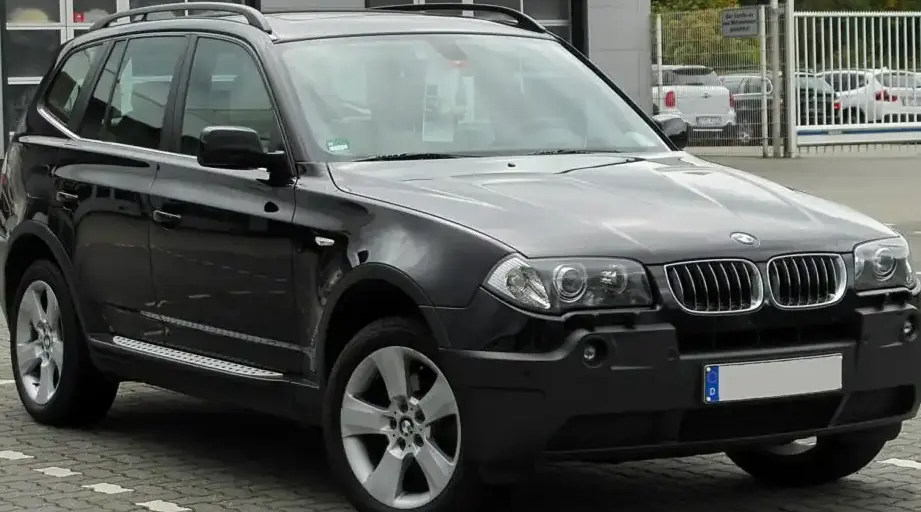
The BMW X3 (E83) 3.0d Steptronic, produced from 2003 to 2004, marked BMW’s initial entry into the burgeoning compact luxury SUV market. Positioned as a mid-range offering within the E83 X3 lineup, it aimed to combine BMW’s renowned driving dynamics with the practicality expected of a small SUV. This variant featured a 3.0-liter inline-six diesel engine coupled with a five-speed automatic transmission, providing a distinct experience compared to the gasoline-powered models and the available manual transmissions. Its primary market was Europe, where diesel engines enjoyed significant popularity, and it represented a key element in BMW’s strategy to appeal to customers prioritizing fuel efficiency and torque.
Powertrain & Engine Architecture
The core of the X3 3.0d Steptronic is the M57D30, a 3.0-liter inline-six diesel engine. This engine was a mainstay of BMW’s diesel range in the early 2000s, celebrated for its robust construction and refined operation. It incorporated a cast iron block and an aluminum cylinder head, utilizing a common rail direct injection system to deliver fuel at exceptionally high pressures for optimized combustion. The M57D30 employed a variable geometry turbocharger (VGT) and an intercooler to enhance power and torque while minimizing turbo lag. The engine generated 204 horsepower at 4000 rpm and a substantial 410 Nm (302 lb-ft) of torque from as low as 1500 rpm. The five-speed automatic transmission, branded as “Steptronic,” was a conventional torque converter automatic, offering smooth shifts but lacking the responsiveness of more contemporary transmissions. It was tuned for comfort and fuel economy rather than outright performance.
Driving Characteristics
The X3 3.0d Steptronic delivered a noticeably different driving experience compared to its gasoline siblings. The diesel engine’s high torque output provided strong acceleration from low speeds, making it well-suited for daily driving and towing. While the 0-60 mph time of approximately 7.8 seconds was respectable, the engine didn’t rev as freely as the gasoline engines. The Steptronic transmission, while smooth, could sometimes feel hesitant during quick downshifts. The all-wheel-drive system (BMW’s xDrive) provided excellent traction in various conditions, boosting stability and driver confidence. Compared to the six-speed manual versions of the 3.0d, the automatic offered less driver engagement but greater convenience. The automatic’s gear ratios were optimized for fuel economy, resulting in a slightly less sporty feel.
Equipment & Trim Levels
The X3 3.0d Steptronic generally came equipped with a reasonable array of standard features. These included automatic climate control, power windows and locks, a CD stereo system, and alloy wheels. Leather upholstery was often standard, along with wood trim accents. Optional extras included a sunroof, navigation system, heated seats, and upgraded audio systems. The trim level was typically positioned as a mid-range offering, bridging the gap between the base 2.0d models and the higher-performance 3.0i gasoline variants. The emphasis was on providing a comfortable and well-equipped SUV experience without the premium price tag of the top-spec models.
Chassis & Braking
The E83 X3 featured a fully independent suspension system, with MacPherson struts at the front and a multi-link suspension at the rear. This setup provided a good balance between ride comfort and handling. The 3.0d Steptronic models typically came with disc brakes on all four wheels, providing ample stopping power. An anti-lock braking system (ABS) was standard. The suspension was tuned to accommodate the higher weight of the diesel engine and the all-wheel-drive system. Stabilizer bars were fitted front and rear to minimize body roll during cornering.
Market Reception & Comparison
The X3 3.0d Steptronic was generally well-received by automotive critics, particularly in Europe. Reviewers lauded the engine’s torque and fuel efficiency, as well as the X3’s comfortable ride and spacious interior. However, some criticized the Steptronic transmission for its lack of responsiveness and the X3’s somewhat understated styling. Compared to the 2.0d models, the 3.0d offered significantly more performance and refinement. Compared to the 3.0i gasoline models, the 3.0d provided better fuel economy and a more relaxed driving experience, but lacked the gasoline engine’s high-revving character. Reliability was generally good, although some owners reported issues with the turbocharger and fuel injection system.
Legacy
The BMW X3 (E83) 3.0d Steptronic, while not a high-volume seller in the US market, firmly established BMW as a serious competitor in the compact luxury SUV segment. The M57D30 engine proved to be a durable and reliable powerplant, and many examples remain on the road today. In the used car market, these models are often sought after by buyers looking for a fuel-efficient and capable SUV with the BMW badge. Maintenance costs can be higher than for some competitors, particularly if the turbocharger or fuel injection system requires attention. Nevertheless, the X3 3.0d Steptronic remains a compelling option for those seeking a blend of luxury, performance, and practicality.