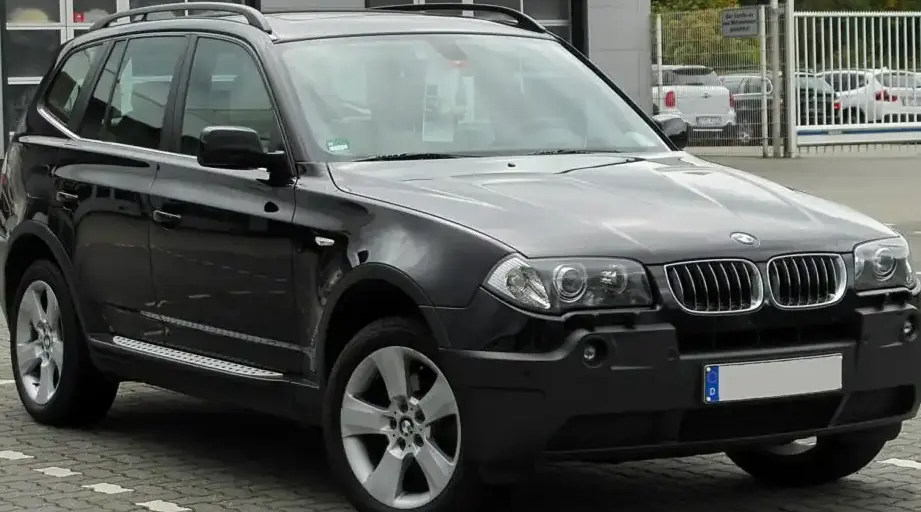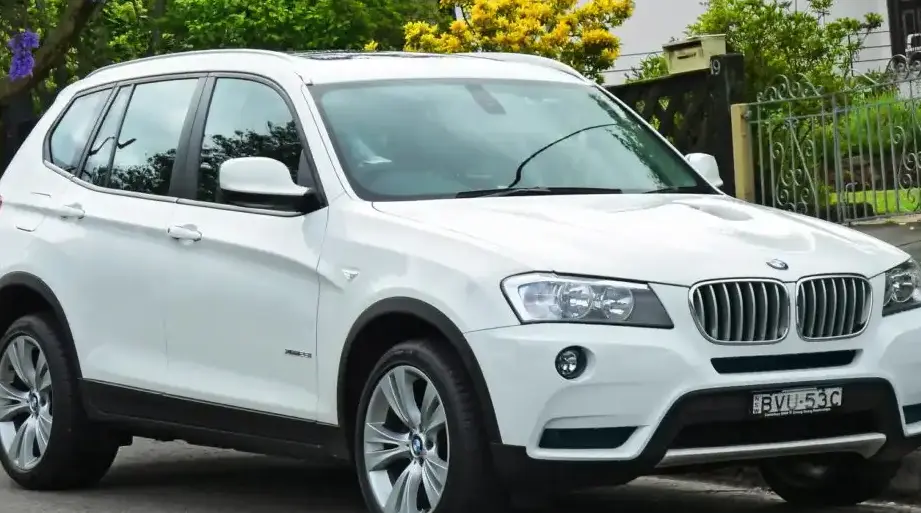
The BMW X3 (F25) 18d sDrive, produced from 2012 to 2014, represented the entry point into the second-generation X3 lineup. Positioned as a rear-wheel-drive variant, it offered a more accessible price point compared to the xDrive all-wheel-drive models. This version catered to European markets prioritizing fuel efficiency and lower running costs, while still delivering the X3’s core attributes of practicality and a premium driving experience. It sat below the more powerful 20d and 30d models in terms of performance, and was primarily aimed at buyers who didn’t require all-weather capability.
Technical Specifications
| Brand | BMW |
| Model | X3 |
| Generation | X3 (F25) |
| Type (Engine) | 18d (143 Hp) sDrive |
| Start of production | 2012 |
| End of production | 2014 |
| Powertrain Architecture | Internal Combustion engine |
| Body type | SUV |
| Seats | 5 |
| Doors | 5 |
| Fuel consumption (urban) | 5.8 l/100 km (40.6 US mpg, 48.7 UK mpg, 17.2 km/l) |
| Fuel consumption (extra urban) | 4.7 l/100 km (50 US mpg, 60.1 UK mpg, 21.3 km/l) |
| Fuel consumption (combined) | 5.1 l/100 km (46.1 US mpg, 55.4 UK mpg, 19.6 km/l) |
| CO2 emissions | 135 g/km |
| Fuel Type | Diesel |
| Acceleration 0 – 100 km/h | 9.9 sec |
| Acceleration 0 – 62 mph | 9.9 sec |
| Acceleration 0 – 60 mph | 9.4 sec |
| Maximum speed | 195 km/h (121.17 mph) |
| Emission standard | Euro 5 |
| Weight-to-power ratio | 11.6 kg/Hp, 86.1 Hp/tonne |
| Weight-to-torque ratio | 4.6 kg/Nm, 216.9 Nm/tonne |
| Power | 143 Hp @ 4000 rpm |
| Torque | 360 Nm @ 1750-2500 rpm (265.52 lb.-ft. @ 1750-2500 rpm) |
| Engine layout | Front, Longitudinal |
| Engine Model/Code | N47D20C |
| Engine displacement | 1995 cm3 (121.74 cu. in.) |
| Number of cylinders | 4 |
| Engine configuration | Inline |
| Cylinder Bore | 84 mm (3.31 in.) |
| Piston Stroke | 90 mm (3.54 in.) |
| Compression ratio | 16.5:1 |
| Number of valves per cylinder | 4 |
| Fuel injection system | Diesel Commonrail |
| Engine aspiration | Twin-power turbo, Intercooler |
| Engine oil capacity | 5.2 l (5.49 US qt | 4.58 UK qt) |
| Coolant | 8.7 l (9.19 US qt | 7.65 UK qt) |
| Kerb Weight | 1660 kg (3659.67 lbs.) |
| Max. weight | 2250 kg (4960.4 lbs.) |
| Max load | 590 kg (1300.73 lbs.) |
| Trunk (boot) space – minimum | 550 l (19.42 cu. ft.) |
| Trunk (boot) space – maximum | 1600 l (56.5 cu. ft.) |
| Fuel tank capacity | 67 l (17.7 US gal | 14.74 UK gal) |
| Max. roof load | 100 kg (220.46 lbs.) |
| Permitted trailer load with brakes (12%) | 2000 kg (4409.25 lbs.) |
| Permitted trailer load without brakes | 750 kg (1653.47 lbs.) |
| Permitted towbar download | 100 kg (220.46 lbs.) |
| Length | 4648 mm (182.99 in.) |
| Width | 1881 mm (74.06 in.) |
| Height | 1661 mm (65.39 in.) |
| Wheelbase | 2810 mm (110.63 in.) |
| Front track | 1616 mm (63.62 in.) |
| Rear (Back) track | 1632 mm (64.25 in.) |
| Ride height (ground clearance) | 212 mm (8.35 in.) |
| Drag coefficient (Cd) | 0.33 |
| Minimum turning circle (turning diameter) | 11.9 m (39.04 ft.) |
| Approach angle | 25.7° |
| Departure angle | 22.6° |
| Ramp-over (brakeover) angle | 19.4° |
| Wading depth | 500 mm (19.69 in.) |
| Drivetrain Architecture | The Internal combustion engine (ICE) drives the rear wheels of the vehicle. |
| Drive wheel | Rear wheel drive |
| Number of gears and type of gearbox | 6 gears, manual transmission |
| Rear suspension | Independent multi-link suspension |
| Front brakes | Ventilated discs |
| Rear brakes | Ventilated discs |
| Assisting systems | ABS (Anti-lock braking system) |
| Steering type | Steering rack and pinion |
| Power steering | Electric Steering |
| Tires size | 225/60 R17 V |
| Wheel rims size | 7.5 J x 17 |
INTRODUCTION
The F25 BMW X3, launched in 2010, represented a significant step forward for BMW’s compact SUV. The 18d sDrive, introduced in 2012, was a key variant aimed at maximizing fuel economy and offering a lower entry price. Built on the BMW’s scalable vehicle architecture, the F25 X3 shared its platform with the F30 3 Series. The ‘sDrive’ designation indicated a rear-wheel-drive configuration, differentiating it from the more common xDrive all-wheel-drive models. This model was primarily sold in Europe, where diesel engines and rear-wheel drive were more popular, and where fuel costs were higher.
Powertrain & Engine Architecture
The heart of the X3 18d sDrive is the N47D20C 2.0-liter four-cylinder diesel engine. This engine is a member of BMW’s highly regarded N47 family, known for its efficiency and refinement. The N47D20C utilizes a common rail direct injection system, delivering fuel at extremely high pressure for optimized combustion. It’s equipped with a single twin-scroll turbocharger with an intercooler, boosting power and torque. The engine also features four valves per cylinder and a timing chain. The 18d was exclusively offered with a six-speed manual transmission, optimized for fuel efficiency and smooth operation. The transmission’s gear ratios were tuned to maximize the engine’s torque output, providing adequate acceleration while maintaining low engine speeds for improved fuel economy.
Driving Characteristics
The X3 18d sDrive, with its 143 horsepower and 265 lb-ft of torque, offered a respectable, though not exhilarating, driving experience. Acceleration from 0-60 mph took around 9.4 seconds, and top speed was limited to 121 mph. The rear-wheel-drive configuration provided a balanced feel, although it lacked the all-weather grip of the xDrive models. The six-speed manual transmission was precise and easy to use, allowing drivers to make the most of the engine’s torque. Compared to the more powerful 20d and 30d variants, the 18d felt less responsive, particularly during overtaking maneuvers. However, its lighter weight and efficient engine contributed to better fuel economy and a more comfortable ride.
Equipment & Trim Levels
The X3 18d sDrive typically came with a reasonable level of standard equipment. This included automatic climate control, a multi-function steering wheel, power windows and mirrors, and a basic audio system. Upholstery was typically cloth, although leather options were available. Common optional extras included a sunroof, navigation system, upgraded audio, parking sensors, and heated seats. Trim levels varied slightly depending on the market, but generally followed a progression from base to higher-spec versions with more luxurious appointments and additional features. The interior design was typical BMW, with a driver-focused layout and high-quality materials.
Chassis & Braking
The F25 X3 featured a robust chassis with a MacPherson strut front suspension and a multi-link rear suspension. The suspension was tuned to provide a balance between comfort and handling. The 18d sDrive typically used ventilated disc brakes on all four wheels, providing adequate stopping power. Anti-lock braking system (ABS) was standard, along with electronic brake-force distribution (EBD). The rear-wheel-drive configuration meant that the 18d sDrive had a slightly different suspension setup compared to the xDrive models, optimized for its weight distribution. Stabilizer bars were fitted front and rear to reduce body roll during cornering.
Market Reception & Comparison
The X3 18d sDrive was generally well-received by automotive critics, particularly for its fuel efficiency and comfortable ride. However, some reviewers noted that its performance was somewhat underwhelming compared to the more powerful X3 variants. Compared to the 20d, the 18d offered significantly lower running costs but sacrificed acceleration and overall refinement. Against competitors like the Audi Q5 and Mercedes-Benz GLK, the X3 18d sDrive offered a compelling combination of practicality, luxury, and fuel economy. Its rear-wheel-drive configuration was a key differentiator, appealing to drivers who preferred a more traditional driving experience.
Legacy
The N47 engine family, including the N47D20C found in the X3 18d, has proven to be generally reliable, although some early versions were prone to timing chain issues. Regular maintenance, including oil changes and timing chain inspections, is crucial for long-term reliability. Today, used X3 18d sDrive models represent a relatively affordable entry point into BMW ownership. They are often sought after by buyers looking for a practical, fuel-efficient SUV with a premium badge. While not the fastest or most luxurious X3 variant, the 18d sDrive remains a capable and well-rounded vehicle that continues to offer a comfortable and enjoyable driving experience.