Technical Specifications
| Brand | BMW |
| Model | X3 |
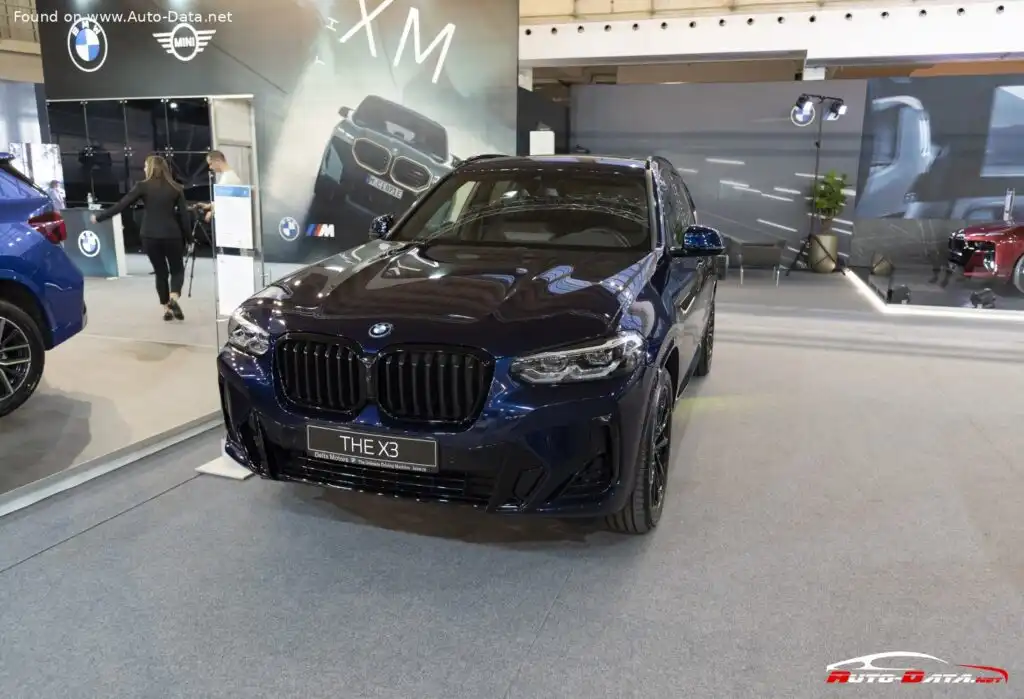
| Generation | X3 (G01 LCI, facelift 2021) |
| Type | 30e (292 Hp) Plug-in Hybrid xDrive Steptronic |
| Start of production | June, 2021 |
| End of production | 2024 |
| Powertrain Architecture | PHEV (Plug-in Hybrid Electric Vehicle) |
| Body type | SAV |
| Seats | 5 |
| Doors | 5 |
| Combined fuel consumption (WLTP) | 2-2.6 l/100 km (117.6 – 90.5 US mpg, 141.2 – 108.6 UK mpg, 50 – 38.5 km/l) |
| CO2 emissions (WLTP) | 45-59 g/km |
| Fuel Type | Petrol / electricity |
| Acceleration 0 – 100 km/h | 6.1 sec |
| Acceleration 0 – 62 mph | 6.1 sec |
| Acceleration 0 – 60 mph | 5.8 sec |
| Maximum speed | 210 km/h (130.49 mph) |
| Emission standard | Euro 6d |
| Weight-to-power ratio | 6.8 kg/Hp, 146.7 Hp/tonne |
| Weight-to-torque ratio | 4.7 kg/Nm, 211.1 Nm/tonne |
| Gross battery capacity | 12 kWh |
| Net (usable) battery capacity | 11.2 kWh |
| Battery voltage | 354 V |
| Battery technology | Lithium-ion (Li-Ion) |
| Battery location | Under the rear seats |
| Recuperation output | 20 kW |
| All-electric range (WLTP) | 42-50 km (26.1 – 31.07 mi) |
| Average Energy consumption (WLTP) | 18.9-20.5 kWh/100 km (30.42 – 32.99 kWh/100 mi, 111 – 102 MPGe, 5.3 – 4.9 km/kWh, 3.3 – 3 mi/kWh) |
| Max speed (electric) | 135 km/h (83.89 mph) |
| Electric motor power | 109 Hp @ 3140 rpm (195.45 lb.-ft. @ 100-2500 rpm) |
| Electric motor Torque | 265 Nm @ 100-2500 rpm |
| Electric motor location | Between the combustion engine and the transmission |
| System power | 292 Hp |
| System torque | 420 Nm (309.78 lb.-ft.) |
| Power | 184 Hp @ 5000-6500 rpm (92.1 Hp/l) |
| Torque | 300 Nm @ 1350-4000 rpm (221.27 lb.-ft. @ 1350-4000 rpm) |
| Engine layout | Front, Longitudinal |
| Engine Model/Code | B48B20A |
| Engine displacement | 1998 cm3 (121.93 cu. in.) |
| Number of cylinders | 4 |
| Engine configuration | Inline |
| Cylinder Bore | 82 mm (3.23 in.) |
| Piston Stroke | 94.6 mm (3.72 in.) |
| Compression ratio | 11:1 |
| Number of valves per cylinder | 4 |
| Fuel injection system | Direct injection |
| Engine aspiration | Twin-power turbo, Intercooler |
| Valvetrain | VALVETRONIC, Double VANOS |
| Engine oil capacity | 5.25 l (5.55 US qt | 4.62 UK qt) |
| Coolant | 11.2 l (11.83 US qt | 9.85 UK qt) |
| Kerb Weight | 1990 kg (4387.2 lbs.) |
| Max. weight | 2600 kg (5732.02 lbs.) |
| Max load | 610 kg (1344.82 lbs.) |
| Trunk (boot) space – minimum | 450 l (15.89 cu. ft.) |
| Trunk (boot) space – maximum | 1500 l (52.97 cu. ft.) |
| Fuel tank capacity | 50 l (13.21 US gal | 11 UK gal) |
| Max. roof load | 100 kg (220.46 lbs.) |
| Permitted trailer load with brakes (12%) | 2000 kg (4409.25 lbs.) |
| Permitted trailer load without brakes | 750 kg (1653.47 lbs.) |
| Permitted towbar download | 100 kg (220.46 lbs.) |
| Length | 4708 mm (185.35 in.) |
| Width | 1891 mm (74.45 in.) |
| Height | 1676 mm (65.98 in.) |
| Wheelbase | 2864 mm (112.76 in.) |
| Front track | 1620 mm (63.78 in.) |
| Rear (Back) track | 1636 mm (64.41 in.) |
| Ride height (ground clearance) | 204 mm (8.03 in.) |
| Drag coefficient (Cd) | 0.29 |
| Minimum turning circle (turning diameter) | 12 m (39.37 ft.) |
| Approach angle | 25° |
| Departure angle | 23.3° |
| Ramp-over (brakeover) angle | 20° |
| Wading depth | 500 mm (19.69 in.) |
| Drivetrain Architecture | The Internal combustion engine (ICE) and the electric motor permanently drive the four wheels of the car with the ability to work in full electric or mixed mode. |
| Drive wheel | All wheel drive (4×4) |
| Number of gears and type of gearbox | 8 gears, automatic transmission Steptronic |
| Front suspension | Spring Strut, Transverse stabilizer |
| Rear suspension | Independent multi-link spring suspension with stabilizer |
| Front brakes | Ventilated discs |
| Rear brakes | Ventilated discs |
The BMW X3 xDrive30e, launched in 2021, is a plug-in hybrid variant of the third-generation (G01) X3. It represents BMW’s commitment to electrification and offers a compelling alternative to traditional internal combustion engine (ICE) X3 models. The “30e” designation signifies its powertrain configuration – a 2.0-liter engine combined with an electric motor, delivering a combined output of 292 horsepower. This model aimed to appeal to environmentally conscious buyers seeking a premium SUV experience with the flexibility of electric-only driving for shorter commutes.
Powertrain & Engine Architecture
At the heart of the X3 xDrive30e lies BMW’s B48B20A 2.0-liter turbocharged four-cylinder gasoline engine. This engine utilizes direct fuel injection and BMW’s VALVETRONIC variable valve timing and Double VANOS variable camshaft timing systems for optimized efficiency and performance. The engine produces 184 horsepower and 300 Nm (221 lb-ft) of torque. Integrated with the engine is a 109 horsepower electric motor, drawing power from a 12 kWh (11.2 kWh usable) lithium-ion battery pack located under the rear seats. The electric motor delivers 265 Nm (195 lb-ft) of torque. The combined system output is 292 horsepower and 420 Nm (309.78 lb-ft) of torque. Power is transmitted to all four wheels via BMW’s eight-speed Steptronic automatic transmission. The transmission is specifically tuned to work seamlessly with both the gasoline engine and the electric motor, providing smooth and efficient gear changes.
Driving Characteristics
The X3 xDrive30e offers a distinct driving experience compared to its gasoline-only counterparts. In electric-only mode, the vehicle provides near-silent operation and instant torque, resulting in brisk acceleration for city driving. The all-electric range, rated at 42-50 km (26-31 miles) under WLTP testing, is sufficient for many daily commutes. Switching to hybrid mode allows the gasoline engine to kick in when more power is needed or when the battery is depleted. The integration between the engine and motor is generally seamless, providing a combined power output that delivers a 0-60 mph time of around 5.8 seconds. The eight-speed automatic transmission is well-matched to the powertrain, offering smooth shifts and responsive performance. Compared to the X3 xDrive30i (gasoline-only), the 30e feels slightly heavier due to the added weight of the battery pack, but the instant torque from the electric motor compensates for this in many driving situations.
Equipment & Trim Levels
The X3 xDrive30e typically came well-equipped, reflecting its position as a premium offering. Standard features included BMW’s iDrive infotainment system with a touchscreen display, navigation, Apple CarPlay and Android Auto compatibility, automatic climate control, and a suite of advanced driver-assistance systems such as lane departure warning and forward collision warning. Interior upholstery was typically leatherette or leather, with options for premium leather upgrades. Optional extras included a panoramic sunroof, Harman Kardon premium sound system, head-up display, and adaptive cruise control. Trim levels varied slightly by market, but generally offered packages that bundled popular options together.
Chassis & Braking
The X3 xDrive30e utilizes a robust chassis designed to handle the added weight of the hybrid powertrain. The front suspension features spring struts with a transverse stabilizer, while the rear suspension employs an independent multi-link setup, also with a stabilizer bar. Braking duties are handled by ventilated discs on all four wheels. The regenerative braking system captures energy during deceleration, helping to recharge the battery and improve overall efficiency. The xDrive all-wheel-drive system provides excellent traction and stability in various driving conditions.
Market Reception & Comparison
The X3 xDrive30e was generally well-received by automotive critics, who praised its blend of performance, efficiency, and practicality. Its ability to operate in electric-only mode for shorter distances was a significant selling point, appealing to environmentally conscious buyers. Compared to the X3 xDrive30i, the 30e offered improved fuel economy and lower emissions, but at a higher price point. Against competitors such as the Volvo XC60 Recharge and the Mercedes-Benz GLC 300e, the X3 xDrive30e held its own, offering a compelling combination of driving dynamics and technology.
Legacy
The BMW X3 xDrive30e represents an important step in BMW’s electrification strategy. The powertrain, while not without its complexities, has proven to be relatively reliable in real-world use. On the used car market, the xDrive30e commands a premium over comparable gasoline-only X3 models, reflecting its fuel efficiency and environmental benefits. The battery pack’s longevity is a key consideration for potential buyers, but BMW’s warranty coverage and the availability of battery health checks provide some reassurance. The X3 xDrive30e paved the way for BMW’s expanded range of plug-in hybrid and fully electric vehicles.