Technical Specifications
| Brand | BMW |
| Model | X5 |
| Generation | X5 (E53 LCI, facelift 2003) |
| Type (Engine) | 3.0d (218 Hp) Steptronic |
| Start of production | 2003 |
| End of production | 2006 |
| Powertrain Architecture | Internal Combustion engine |
| Body type | SUV |
| Seats | 5 |
| Doors | 5 |
| Fuel consumption (economy) – urban | 12 l/100 km (19.6 US mpg, 23.5 UK mpg, 8.3 km/l) |
| Fuel consumption (economy) – extra urban | 8 l/100 km (29.4 US mpg, 35.3 UK mpg, 12.5 km/l) |
| Fuel consumption (economy) – combined | 9.4 l/100 km (25 US mpg, 30.1 UK mpg, 10.6 km/l) |
| CO2 emissions | 250 g/km |
| Fuel Type | Diesel |
| Acceleration 0 – 100 km/h | 8.3 sec |
| Acceleration 0 – 62 mph | 8.3 sec |
| Acceleration 0 – 60 mph | 7.9 sec |
| Maximum speed | 210 km/h (130.49 mph) |
| Weight-to-power ratio | 10 kg/Hp, 100.5 Hp/tonne |
| Weight-to-torque ratio | 4.3 kg/Nm, 230.4 Nm/tonne |
| Power | 218 Hp @ 4000 rpm |
| Power per litre | 72.8 Hp/l |
| Torque | 500 Nm @ 2000 rpm (368.78 lb.-ft. @ 2000 rpm) |
| Engine layout | Front, Longitudinal |
| Engine Model/Code | M57D30 |
| Engine displacement | 2993 cm3 (182.64 cu. in.) |
| Number of cylinders | 6 |
| Engine configuration | Inline |
| Cylinder Bore | 84 mm (3.31 in.) |
| Piston Stroke | 90 mm (3.54 in.) |
| Compression ratio | 18:1 |
| Number of valves per cylinder | 4 |
| Fuel injection system | Diesel Commonrail |
| Engine aspiration | Turbocharger, Intercooler |
| Valvetrain | DOHC |
| Engine oil capacity | 8.25 l (8.72 US qt, 7.26 UK qt) |
| Coolant | 10.5 l (11.1 US qt, 9.24 UK qt) |
| Kerb Weight | 2170 kg (4784.03 lbs.) |
| Max. weight | 2685 kg (5919.41 lbs.) |
| Max load | 515 kg (1135.38 lbs.) |
| Trunk (boot) space – minimum | 465 l (16.42 cu. ft.) |
| Trunk (boot) space – maximum | 1550 l (54.74 cu. ft.) |
| Fuel tank capacity | 93 l (24.57 US gal, 20.46 UK gal) |
| Max. roof load | 100 kg (220.46 lbs.) |
| Permitted trailer load with brakes (8%) | 2700 kg (5952.48 lbs.) |
| Permitted trailer load with brakes (12%) | 2300 kg (5070.63 lbs.) |
| Permitted trailer load without brakes | 750 kg (1653.47 lbs.) |
| Permitted towbar download | 120 kg (264.55 lbs.) |
| Length | 4667 mm (183.74 in.) |
| Width | 1872 mm (73.7 in.) |
| Width including mirrors | 2180 mm (85.83 in.) |
| Height | 1715 mm (67.52 in.) |
| Wheelbase | 2820 mm (111.02 in.) |
| Front track | 1576 mm (62.05 in.) |
| Rear (Back) track | 1576 mm (62.05 in.) |
| Ride height (ground clearance) | 180 mm (7.09 in.) |
| Drive wheel | All wheel drive (4×4) |
| Number of gears and type of gearbox | 6 gears, automatic transmission |
| Front suspension | Double wishbone |
| Rear suspension | Independent multi-link suspension |
| Front brakes | Ventilated discs |
| Rear brakes | Disc |
| Assisting systems | ABS (Anti-lock braking system) |
| Steering type | Steering rack and pinion |
| Power steering | Hydraulic Steering |
| Tires size | 235/65 R17 |
| Wheel rims size | 7.5J X 17 |
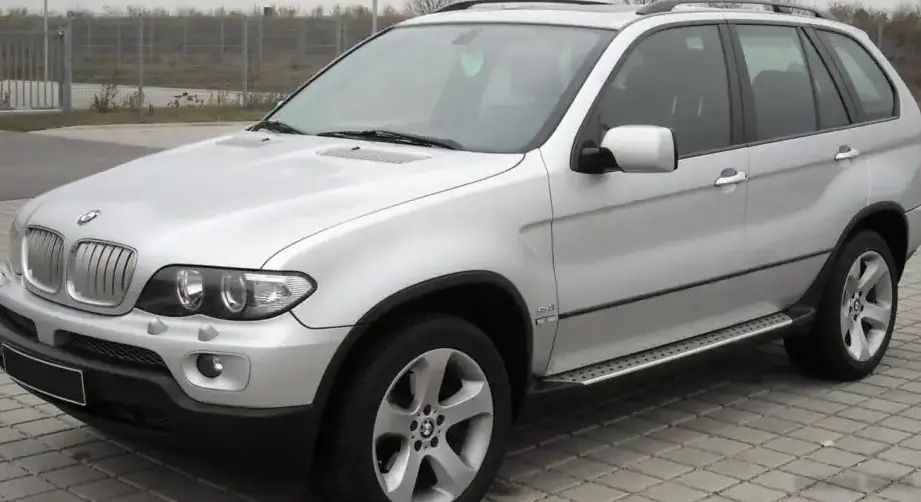
The BMW X5 (E53 LCI) 3.0d with the Steptronic automatic transmission, introduced in 2003 and produced through 2006, represents a significant refinement of the original X5. This mid-cycle update, known as the Life Cycle Impulse (LCI), aimed to address initial criticisms and enhance the model’s appeal in the growing luxury SUV segment. The 3.0d variant specifically offered a diesel engine option paired with a six-speed automatic, positioning itself as a practical and efficient alternative to the gasoline-powered X5s. It was a key offering in the European market, where diesel engines were – and continue to be – highly favored, but also gained traction in North America as buyers sought improved fuel economy.
Powertrain & Engine Architecture
The X5 3.0d Steptronic is powered by the M57D30, a 3.0-liter inline-six diesel engine. This engine was a mainstay of BMW’s diesel lineup during the early 2000s. It employs common rail direct injection, a technology that dramatically improved fuel atomization and combustion efficiency compared to earlier diesel systems. The M57D30 utilizes a variable geometry turbocharger (VGT) and an intercooler to produce 218 horsepower at 4000 rpm and a robust 500 Nm (368 lb-ft) of torque at a low 2000 rpm. The engine’s durable construction, featuring a robust bottom end and a Double Overhead Camshaft (DOHC) valvetrain with four valves per cylinder, contributed to its longevity. The “Steptronic” transmission is a six-speed automatic gearbox designed to handle the engine’s substantial torque output and provide a smooth, comfortable driving experience. It incorporates adaptive learning, adjusting shift points based on driving style.
Driving Characteristics
The X5 3.0d Steptronic delivered a distinct driving experience compared to its petrol-powered counterparts. While it didn’t offer the same level of outright acceleration as the 4.4i or 4.8is models, the 3.0d excelled in providing strong, readily available torque across a broad rev range. This made it well-suited for towing and effortless highway cruising. The automatic transmission, while not as engaging as a manual, offered smooth and predictable gear changes. The gear ratios were optimized for a balance of fuel economy and performance, prioritizing torque delivery in typical driving scenarios. Acceleration from 0-60 mph took approximately 7.9 seconds, a respectable figure for a large SUV of that era. The xDrive all-wheel-drive system provided excellent traction in various weather conditions, enhancing stability and control.
Equipment & Trim Levels
The X5 3.0d Steptronic came standard with a comprehensive list of features befitting a luxury SUV. These typically included leather upholstery, automatic climate control, power-adjustable front seats, a premium sound system, and alloy wheels. A wide range of optional extras were available, such as a navigation system, sunroof, upgraded leather trim, parking sensors, and active suspension. The LCI facelift brought improvements to interior materials and design, elevating the overall sense of quality. Trim levels were relatively simple, with options primarily focused on adding packages of convenience and luxury features.
Chassis & Braking
The X5 E53 featured a robust chassis with a double wishbone front suspension and an independent multi-link rear suspension. This configuration provided a comfortable ride while maintaining good handling characteristics. The 3.0d variant, being slightly lighter than the larger-engined models, benefited from a slightly more agile feel. Braking was handled by ventilated discs at the front and solid discs at the rear, complemented by an Anti-lock Braking System (ABS). The suspension was tuned to strike a balance between comfort and handling, delivering a stable and predictable driving experience.
Market Reception & Comparison
The X5 3.0d Steptronic was generally well-received by automotive critics. It was praised for its fuel efficiency, strong torque output, and comfortable ride quality. Compared to the petrol-powered X5s, the 3.0d offered significantly better fuel economy, making it a more practical choice for drivers covering long distances. Some critics noted that the diesel engine lacked the refinement and responsiveness of its gasoline counterparts, but the benefits in fuel economy and torque often outweighed this concern. When compared to competitors like the Mercedes-Benz ML-Class and the Porsche Cayenne, the X5 3.0d offered a compelling combination of luxury, performance, and practicality.
Legacy
The M57D30 engine has proven to be remarkably durable and reliable when properly maintained. The X5 3.0d Steptronic remains a popular choice in the used car market, appealing to buyers seeking a capable and comfortable luxury SUV with good fuel economy. While age and mileage inevitably lead to wear and tear, these vehicles can still provide years of reliable service with regular maintenance. Common issues include wear on suspension components, potential turbocharger problems (though generally robust), and occasional issues with the automatic transmission’s mechatronic unit. Overall, the X5 3.0d Steptronic represents a well-engineered and capable SUV that continues to hold its own in the modern automotive landscape, offering a blend of luxury, performance, and efficiency that remains attractive to many buyers.