
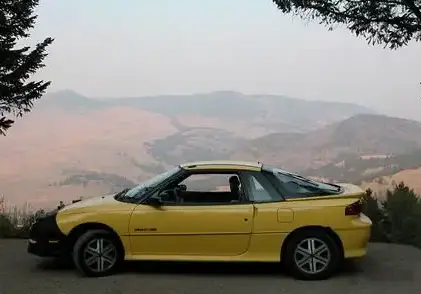
The Chevrolet Geo Storm 1.6 GSi, produced for the 1990 and 1991 model years, represented a sporty offering within the Geo sub-brand of General Motors. Positioned as the performance variant of the Geo Storm hatchback, the GSi aimed to attract buyers seeking a more engaging driving experience than the base models. It was built on GM’s front-wheel-drive platform, sharing components with other vehicles of the era like the Opel Kadett and Vauxhall Astra. The GSi was intended to be a relatively affordable and accessible sports compact car in the American market, competing with vehicles like the Honda Civic Si and Toyota Corolla GT-S.
Technical Specifications
| Brand | Chevrolet |
| Model | Geo Storm |
| Generation | Geo Storm |
| Type (Engine) | 1.6 GSi (130 Hp) |
| Start of production | 1990 |
| End of production | 1991 |
| Powertrain Architecture | Internal Combustion engine |
| Body type | Hatchback |
| Seats | 4 |
| Doors | 2 |
| Fuel Type | Petrol (Gasoline) |
| Acceleration 0 – 100 km/h | 8 sec |
| Acceleration 0 – 62 mph | 8 sec |
| Acceleration 0 – 60 mph | 7.6 sec |
| Maximum speed | 201 km/h (124.9 mph) |
| Power | 130 Hp @ 7000 rpm |
| Power per litre | 81.9 Hp/l |
| Torque | 138 Nm @ 5800 rpm (101.78 lb.-ft. @ 5800 rpm) |
| Engine layout | Front, Transverse |
| Engine displacement | 1588 cm3 (96.91 cu. in.) |
| Number of cylinders | 4 |
| Engine configuration | Inline |
| Cylinder Bore | 80 mm (3.15 in.) |
| Piston Stroke | 79 mm (3.11 in.) |
| Compression ratio | 9.8:1 |
| Fuel injection system | Multi-port manifold injection |
| Engine aspiration | Naturally aspirated engine |
| Valvetrain | DOHC |
| Trunk (boot) space – minimum | 310 l (10.95 cu. ft.) |
| Trunk (boot) space – maximum | 620 l (21.9 cu. ft.) |
| Length | 4150 mm (163.39 in.) |
| Width | 1695 mm (66.73 in.) |
| Height | 1300 mm (51.18 in.) |
| Wheelbase | 2450 mm (96.46 in.) |
| Front track | 1430 mm (56.3 in.) |
| Rear (Back) track | 1450 mm (57.09 in.) |
| Drivetrain Architecture | The Internal combustion engine (ICE) drives the front wheels of the vehicle. |
| Drive wheel | Front wheel drive |
| Number of gears and type of gearbox | 5 gears, manual transmission |
| Front suspension | Coil spring |
| Rear suspension | Coil spring |
| Front brakes | Ventilated discs |
| Rear brakes | Drum |
| Assisting systems | ABS (Anti-lock braking system) |
| Steering type | Steering rack and pinion |
Powertrain & Engine Architecture
The heart of the Geo Storm GSi was its 1.6-liter inline four-cylinder engine, designated as the X16S. This engine featured a double overhead camshaft (DOHC) valvetrain, a relatively advanced feature for its time, contributing to its higher power output. The engine utilized multi-port fuel injection, improving fuel atomization and combustion efficiency. The 1588cc engine produced 130 horsepower at 7000 rpm and 138 Nm (101.78 lb-ft) of torque at 5800 rpm. The GSi was exclusively offered with a five-speed manual transmission, providing drivers with full control over the engine’s power band. The transmission was designed to handle the engine’s output and deliver a responsive driving experience.
Driving Characteristics
The Geo Storm GSi offered a noticeably more spirited driving experience compared to the standard Storm models. The 130 hp engine, while not exceptionally powerful by modern standards, provided adequate acceleration for its class. The 0-60 mph time of around 7.6 seconds was competitive for the early 1990s. The five-speed manual transmission allowed drivers to keep the engine in its optimal power range, enhancing acceleration and responsiveness. The GSi’s suspension was tuned for a firmer ride, reducing body roll during cornering and improving handling. However, this firmer suspension also meant a slightly less comfortable ride on rough road surfaces. The steering was precise and provided good feedback, contributing to the car’s overall engaging driving dynamics.
Equipment & Trim Levels
The GSi trim level included several features designed to enhance both the sporty appearance and driving experience. Standard equipment typically included sport seats with more aggressive bolstering, a leather-wrapped steering wheel, and a unique instrument cluster. Exterior features included a rear spoiler, alloy wheels, and a more aggressive front fascia. Optional extras could include air conditioning, a premium sound system, and power windows and locks. The interior materials were generally of good quality for a car in this price range, although they were not as luxurious as those found in more expensive vehicles.
Chassis & Braking
The Geo Storm GSi utilized a MacPherson strut front suspension and a coil spring rear suspension. This setup provided a good balance between handling and ride comfort. The front brakes were ventilated discs, offering improved stopping power and heat dissipation compared to solid discs. The rear brakes were drum brakes, a cost-saving measure common in vehicles of this era. The GSi was equipped with an anti-lock braking system (ABS), enhancing safety by preventing wheel lockup during hard braking. The steering system was a rack-and-pinion setup, providing precise and responsive steering feel.
Market Reception & Comparison
The Geo Storm GSi was generally well-received by automotive critics, who praised its sporty handling, responsive engine, and affordable price. However, some critics noted that the interior was somewhat basic and that the ride could be firm. Compared to other vehicles in its class, the GSi offered a good balance of performance and value. The Honda Civic Si and Toyota Corolla GT-S were often considered its primary competitors, offering similar levels of performance and features. The GSi’s fuel economy was respectable for a sporty compact car, typically achieving around 26 mpg in the city and 34 mpg on the highway. Reliability was generally good, although some owners reported minor issues with the electrical system.
Legacy
The Geo Storm GSi, while a relatively short-lived model, has gained a following among enthusiasts of 1990s sports compact cars. The 1.6-liter X16S engine is known for its durability and relatively simple maintenance requirements. Parts availability is generally good, although some specific GSi-specific components can be difficult to find. Today, well-maintained examples of the Geo Storm GSi are becoming increasingly collectible, appealing to those seeking a nostalgic and affordable sports car from the early 1990s. The GSi represents a unique chapter in Chevrolet’s history, showcasing a period when the brand attempted to cater to a younger, more performance-oriented audience.
