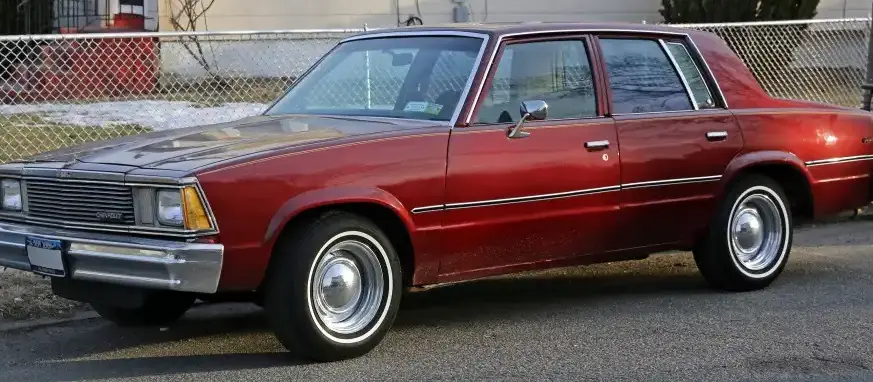
The Chevrolet Malibu IV Sedan, specifically the facelifted version produced from 1981 to 1983, represented a unique chapter in the Malibu lineage. Offered during a period of significant shifts in the automotive landscape, this iteration featured a diesel V8 engine option, a relatively uncommon choice for the American market at the time. The 5.7d V8 (105 hp) paired with an automatic transmission was positioned as a fuel-efficient alternative within the Malibu range, appealing to buyers seeking a full-size sedan with improved mileage compared to gasoline counterparts. It was built on the rear-wheel drive A-body platform, a design that had been a mainstay of General Motors’ mid-size offerings for many years.
Technical Specifications
| Brand | Chevrolet |
| Model | Malibu |
| Generation | Malibu IV Sedan (facelift 1981) |
| Type (Engine) | 5.7 d V8 (105 Hp) Automatic |
| Start of production | 1981 |
| End of production | 1983 |
| Powertrain Architecture | Internal Combustion engine |
| Body type | Sedan |
| Seats | 6 |
| Doors | 4 |
| Fuel Type | Diesel |
| Weight-to-power ratio | 15.2 kg/Hp, 65.6 Hp/tonne |
| Weight-to-torque ratio | 5.9 kg/Nm, 169.4 Nm/tonne |
| Power | 105 Hp @ 3200 rpm |
| Power per litre | 18.3 Hp/l |
| Torque | 271 Nm @ 1600 rpm (199.88 lb.-ft. @ 1600 rpm) |
| Engine layout | Front, Longitudinal |
| Engine Model/Code | LF9 |
| Engine displacement | 5735 cm3 (349.97 cu. in.) |
| Number of cylinders | 8 |
| Engine configuration | V-engine |
| Cylinder Bore | 103.05 mm (4.06 in.) |
| Piston Stroke | 85.98 mm (3.39 in.) |
| Compression ratio | 22.5:1 |
| Number of valves per cylinder | 2 |
| Fuel injection system | Precombustion chamber injection |
| Engine aspiration | Naturally aspirated engine |
| Valvetrain | OHV |
| Engine oil capacity | 6.6 l (6.97 US qt | 5.81 UK qt) |
| Coolant | 16.5 l (17.44 US qt | 14.52 UK qt) |
| Kerb Weight | 1600 kg (3527.4 lbs) |
| Trunk (boot) space – maximum | 469 l (16.56 cu. ft.) |
| Fuel tank capacity | 69 l (18.23 US gal | 15.18 UK gal) |
| Length | 4895 mm (192.72 in.) |
| Width | 1837 mm (72.32 in.) |
| Height | 1414 mm (55.67 in.) |
| Wheelbase | 2745 mm (108.07 in.) |
| Front track | 1486 mm (58.5 in.) |
| Rear (Back) track | 1467 mm (57.76 in.) |
| Front overhang | 915 mm (36.02 in.) |
| Rear overhang | 1235 mm (48.62 in.) |
| Ride height (ground clearance) | 153 mm (6.02 in.) |
| Minimum turning circle (turning diameter) | 12.2 m (40.03 ft.) |
| Approach angle | 23.3° |
| Departure angle | 16.5° |
| Ramp-over (brakeover) angle | 15.4° |
| Drivetrain Architecture | The Internal combustion engine (ICE) drives the rear wheels of the vehicle. |
| Drive wheel | Rear wheel drive |
| Number of gears and type of gearbox | 3 gears, automatic transmission |
| Front suspension | Independent, type McPherson with coil spring and anti-roll bar |
| Rear suspension | dependent spring suspension, Transverse stabilizer, Trailing arm |
| Front brakes | Ventilated discs |
| Rear brakes | Drum |
| Steering type | Steering rack and pinion |
| Tires size | 185/75 R14 |
| Wheel rims size | 6.0J x 14 |
Powertrain & Engine Architecture
The heart of this Malibu variant was the 5.7-liter (349.97 cubic inch) LF9 diesel V8 engine. This engine utilized a precombustion chamber injection system, a common design for diesel engines of the era. This system involved injecting fuel into a small pre-chamber within the cylinder head, where it would partially combust before igniting the main charge. This aided in smoother combustion and reduced engine noise. The engine featured a two-valve per cylinder OHV (Overhead Valve) valvetrain. The automatic transmission was a three-speed unit, designed to provide relatively smooth shifts, but not optimized for performance. The engine’s longitudinal front-mount configuration was typical for rear-wheel-drive vehicles of the time.
Driving Characteristics
The 105 horsepower and 271 Nm (199.88 lb-ft) of torque delivered by the diesel V8 resulted in a driving experience focused on fuel economy rather than outright acceleration. Compared to gasoline-powered Malibu models, the diesel offered significantly better mileage, but at the cost of performance. The three-speed automatic transmission further tempered performance, with relatively wide gear ratios. Acceleration was adequate for highway cruising and city driving, but passing maneuvers required careful planning. The diesel engine’s torque peak at 1600 rpm provided reasonable low-end grunt, making it suitable for everyday driving conditions. It wasn’t a sporty car, but a practical one.
Equipment & Trim Levels
The 1981-1983 Malibu with the 5.7d V8 and automatic transmission typically came with a fairly standard equipment list for the time. This included cloth upholstery, a basic AM/FM radio, and manual windows and locks. Air conditioning was often an optional extra. Interior trim was generally functional and durable, reflecting the car’s focus on practicality. Higher trim levels, if selected, might have included features like upgraded sound systems, power windows, and cruise control. The dashboard layout was typical of American cars of the era, with a straightforward instrument cluster and easily accessible controls.
Chassis & Braking
The Malibu IV Sedan utilized a traditional body-on-frame construction. The front suspension was independent, employing a McPherson strut design with coil springs and an anti-roll bar. The rear suspension was a dependent spring setup with trailing arms and a transverse stabilizer. This configuration provided a comfortable ride, but wasn’t particularly sporty. Braking duties were handled by ventilated discs at the front and drum brakes at the rear. The braking system was adequate for the car’s weight and performance, but lacked the stopping power of more modern systems. Steering was via a rack and pinion system, providing reasonable precision.
Market Reception & Comparison
The diesel-powered Malibu received mixed reviews. While praised for its fuel economy, critics noted its lack of power compared to gasoline-powered rivals. The diesel engine was also known to be somewhat noisy and rough compared to gasoline engines. Compared to the gasoline V6 and V8 options available in the Malibu lineup, the 5.7d V8 was positioned as the economy-minded choice. It appealed to buyers who prioritized fuel savings over performance. The 1.9 TDI versions of European cars like the Volkswagen Golf and Jetta, which arrived later, would eventually offer a more refined and powerful diesel experience.
Legacy
The Chevrolet Malibu IV Sedan with the 5.7d V8 engine represents a unique and somewhat forgotten chapter in the Malibu’s history. While not a high-performance model, it offered a fuel-efficient alternative during a time of rising gasoline prices. The LF9 diesel engine, while generally reliable, could be prone to issues with the injection pump and precombustion chambers over time. Today, these cars are relatively rare and sought after by collectors and enthusiasts interested in vintage American automobiles and alternative fuel vehicles. Parts availability can be a challenge, but a dedicated community of owners and restorers exists to support these classic Malibus.