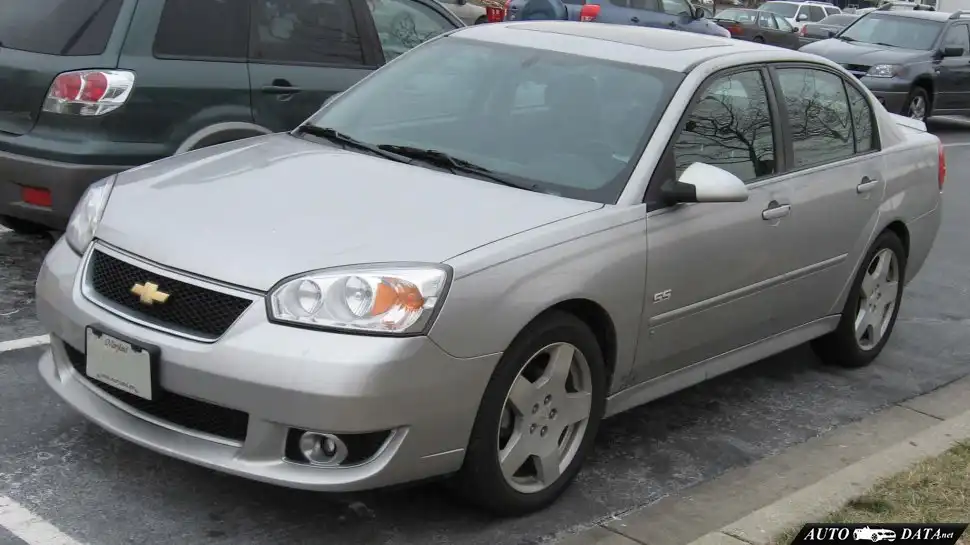
The Chevrolet Malibu VI, specifically the facelifted version introduced for the 2007 and 2008 model years, represented a significant step forward for Chevrolet’s mid-size sedan. Among the engine options available, the 3.5i V6 12V (217 Hp) paired with an automatic transmission was positioned as the premium offering, bridging the gap between the more economical four-cylinder variants and a potential (though never realized in the US market) turbocharged option. This configuration aimed to deliver a balance of performance and comfort for buyers seeking a more refined driving experience. The Malibu VI, built on the Epsilon platform, was Chevrolet’s attempt to compete directly with established players like the Toyota Camry and Honda Accord in the highly competitive American family sedan segment.
Technical Specifications
| Brand | Chevrolet |
| Model | Malibu |
| Generation | Malibu VI (facelift 2006) |
| Type (Engine) | 3.5i V6 12V (217 Hp) Automatic |
| Start of production | 2007 |
| End of production | 2008 |
| Powertrain Architecture | Internal Combustion engine |
| Body type | Sedan |
| Seats | 5 |
| Doors | 4 |
| Fuel consumption (urban) | 9.8 l/100 km (24 US mpg) |
| Fuel consumption (extra urban) | 7.3 l/100 km (32.2 US mpg) |
| Fuel Type | Petrol (Gasoline) |
| Weight-to-power ratio | 6.9 kg/Hp |
| Weight-to-torque ratio | 5.1 kg/Nm |
| Power | 217 Hp @ 5800 rpm |
| Torque | 294 Nm @ 4000 rpm (216.84 lb.-ft. @ 4000 rpm) |
| Maximum engine speed | 6400 rpm |
| Engine layout | Front, Transverse |
| Engine Model/Code | LZ4 |
| Engine displacement | 3510 cm3 (214.19 cu. in.) |
| Number of cylinders | 6 |
| Engine configuration | V-engine |
| Cylinder Bore | 99 mm (3.9 in.) |
| Piston Stroke | 76 mm (2.99 in.) |
| Compression ratio | 9.8:1 |
| Number of valves per cylinder | 2 |
| Fuel injection system | Multi-port manifold injection |
| Engine aspiration | Naturally aspirated engine |
| Valvetrain | OHV, VVT |
| Engine oil capacity | 4.7 l (4.97 US qt | 4.14 UK qt) |
| Coolant | 9.4 l (9.93 US qt | 8.27 UK qt) |
| Kerb Weight | 1504 kg (3315.75 lbs.) |
| Trunk (boot) space – maximum | 436 l (15.4 cu. ft.) |
| Fuel tank capacity | 61 l (16.11 US gal | 13.42 UK gal) |
| Length | 4783 mm (188.31 in.) |
| Width | 1776 mm (69.92 in.) |
| Height | 1461 mm (57.52 in.) |
| Wheelbase | 2700 mm (106.3 in.) |
| Front track | 1524 mm (60 in.) |
| Rear (Back) track | 1506 mm (59.29 in.) |
| Ride height (ground clearance) | 154 mm (6.06 in.) |
| Minimum turning circle (turning diameter) | 10.9 m (35.76 ft.) |
| Drivetrain Architecture | Front wheel drive |
| Number of gears and type of gearbox | 4 gears, automatic transmission Hydra-Matic |
| Front suspension | Independent, type McPherson with coil spring and anti-roll bar |
| Rear suspension | Independent multi-link suspension |
| Front brakes | Ventilated discs |
| Rear brakes | Drum |
| Assisting systems | ABS (Anti-lock braking system) |
| Steering type | Steering rack and pinion |
| Power steering | Electric Steering |
| Tires size | 225/50 R17 |
| Wheel rims size | 17 |
Powertrain & Engine Architecture
The heart of this Malibu variant was the 3.5-liter LZ4 V6 engine. This engine, part of GM’s L67 family, featured a 60-degree V-angle and utilized an overhead valve (OHV) valvetrain with variable valve timing (VVT) on the intake camshafts. The multi-port fuel injection system delivered fuel directly to each cylinder, optimizing combustion. The 12-valve configuration (two valves per cylinder) was a cost-effective design choice, prioritizing reliability and ease of maintenance over ultimate performance. The engine produced 217 horsepower at 5800 rpm and 294 Nm (216.84 lb-ft) of torque at 4000 rpm. This power was channeled through a four-speed Hydra-Matic automatic transmission, a common and generally dependable unit for its time. The transmission was tuned for smooth shifts and comfortable cruising, rather than aggressive acceleration.
Driving Characteristics
The 3.5L V6 automatic Malibu offered a noticeable improvement in acceleration and overall responsiveness compared to the base 2.4L four-cylinder models. While not a sports sedan, it provided ample power for highway merging, passing maneuvers, and everyday driving. The four-speed automatic, while adequate, lacked the efficiency and responsiveness of more modern transmissions with greater gear counts. Gear ratios were optimized for cruising comfort, meaning the engine could feel slightly strained during hard acceleration. Compared to a hypothetical manual transmission version (which wasn’t offered in the US market for this engine), the automatic traded some performance for ease of use. The weight of the vehicle (approximately 3315 lbs) did impact the overall feeling of agility, but the suspension did a reasonable job of managing body roll.
Equipment & Trim Levels
The 3.5L V6 Malibu typically came equipped as the LT or LTZ trim level, representing the higher end of the Malibu range. Standard features included air conditioning, power windows and locks, a CD player with MP3 compatibility, and cruise control. The LTZ trim added features like leather upholstery, heated front seats, a power driver’s seat, and upgraded audio systems. Optional extras included a sunroof, remote start, and a navigation system. Interior materials were generally of good quality for the price point, though not quite matching the refinement of some Japanese competitors.
Chassis & Braking
The Malibu VI utilized an independent McPherson strut suspension in the front and an independent multi-link suspension in the rear. This setup provided a comfortable ride quality, absorbing bumps and imperfections in the road effectively. The front brakes were ventilated discs, offering good stopping power, while the rear brakes were drums, a cost-saving measure. Anti-lock brakes (ABS) were standard, enhancing safety. The steering was rack-and-pinion with electric power steering, providing a reasonably responsive feel. Stabilizer bars were included at both the front and rear to reduce body roll during cornering.
Market Reception & Comparison
Critics generally praised the Malibu VI for its improved styling, spacious interior, and comfortable ride. However, the 3.5L V6 automatic combination received mixed reviews. While the engine was considered powerful enough, the four-speed automatic transmission was often criticized for being outdated and less efficient than the transmissions offered by competitors. Fuel economy was rated at 24 mpg city and 32 mpg highway, which was competitive for the time but not class-leading. Compared to the 2.4L four-cylinder models, the V6 offered a significant performance boost but at the cost of increased fuel consumption. The V6 also commanded a higher price, making it a less attractive option for budget-conscious buyers.
Legacy
The 3.5L V6 engine in the Malibu VI proved to be a relatively reliable powertrain. While not without its quirks (such as potential intake manifold gasket leaks), it generally held up well over time with proper maintenance. Today, these Malibus are relatively affordable on the used car market. The LZ4 engine is known for its durability, and parts availability remains good. However, potential buyers should be aware of the age of the vehicle and the potential for wear and tear on components like the transmission and suspension. The Malibu VI, particularly the 3.5L V6 variant, represents a transitional period for Chevrolet, showcasing the brand’s efforts to improve its offerings in the competitive mid-size sedan segment.