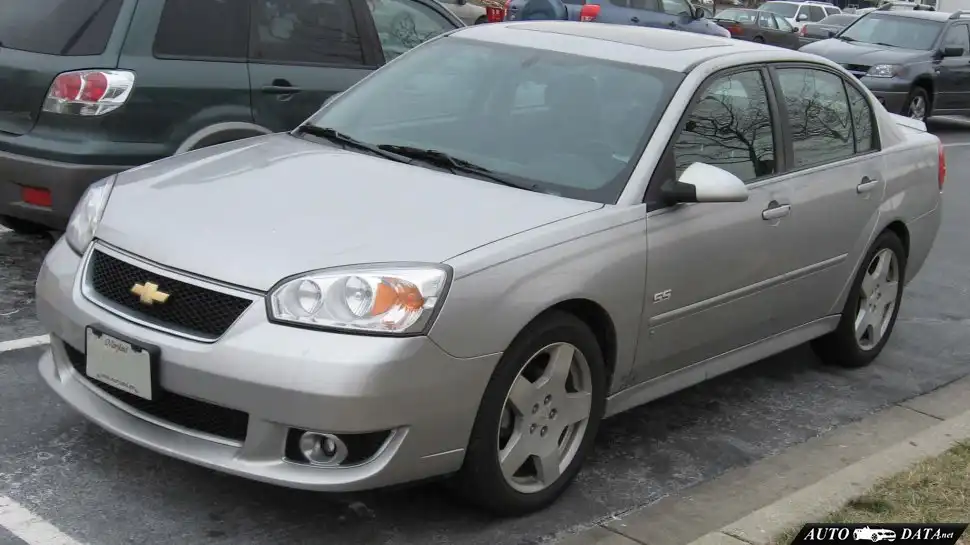
The Chevrolet Malibu VI (facelift, 2006) SS 3.9i V6 12V (240 Hp) Automatic represents the performance-oriented variant of the sixth-generation Malibu, produced for the 2006 and 2007 model years. Positioned as the top-tier trim level, the SS offered a significant power upgrade over the base models, targeting buyers seeking a more engaging driving experience within the mid-size sedan segment. This facelift brought revised styling cues and refinements to the already established Malibu platform (based on the GM Epsilon platform), solidifying its position as a competitive offering in the American family sedan market.
Technical Specifications
| Brand | Chevrolet |
| Model | Malibu |
| Generation | Malibu VI (facelift 2006) |
| Type (Engine) | SS 3.9i V6 12V (240 Hp) Automatic |
| Start of production | 2006 |
| End of production | 2007 |
| Powertrain Architecture | Internal Combustion engine |
| Body type | Sedan |
| Seats | 5 |
| Doors | 4 |
| Fuel consumption (urban) | 12.3 l/100 km (19.1 US mpg) |
| Fuel consumption (extra urban) | 9 l/100 km (26.1 US mpg) |
| Fuel Type | Petrol (Gasoline) |
| Weight-to-power ratio | 6.5 kg/Hp, 154.9 Hp/tonne |
| Weight-to-torque ratio | 4.8 kg/Nm, 209.8 Nm/tonne |
| Power | 240 Hp @ 5800 rpm |
| Power per litre | 61.9 Hp/l |
| Torque | 325 Nm @ 2800 rpm (239.71 lb.-ft. @ 2800 rpm) |
| Maximum engine speed | 6400 rpm |
| Engine layout | Front, Transverse |
| Engine Model/Code | LZ9 |
| Engine displacement | 3880 cm3 (236.77 cu. in.) |
| Number of cylinders | 6 |
| Engine configuration | V-engine |
| Cylinder Bore | 99 mm (3.9 in.) |
| Piston Stroke | 84 mm (3.31 in.) |
| Compression ratio | 9.8:1 |
| Number of valves per cylinder | 2 |
| Fuel injection system | Multi-port manifold injection |
| Engine aspiration | Naturally aspirated engine |
| Valvetrain | OHV, CVVT |
| Engine oil capacity | 4.7 l (4.97 US qt | 4.14 UK qt) |
| Coolant | 9.4 l (9.93 US qt | 8.27 UK qt) |
| Kerb Weight | 1549 kg (3414.96 lbs.) |
| Trunk (boot) space – maximum | 436 l (15.4 cu. ft.) |
| Fuel tank capacity | 61 l (16.11 US gal | 13.42 UK gal) |
| Length | 4783 mm (188.31 in.) |
| Width | 1776 mm (69.92 in.) |
| Height | 1461 mm (57.52 in.) |
| Wheelbase | 2700 mm (106.3 in.) |
| Front track | 1524 mm (60 in.) |
| Rear (Back) track | 1506 mm (59.29 in.) |
| Ride height (ground clearance) | 154 mm (6.06 in.) |
| Minimum turning circle (turning diameter) | 11.4 m (37.4 ft.) |
| Drivetrain Architecture | The Internal combustion engine (ICE) drives the front wheels of the vehicle. |
| Drive wheel | Front wheel drive |
| Number of gears and type of gearbox | 4 gears, automatic transmission Hydra-Matic |
| Front suspension | Independent, type McPherson with coil spring and anti-roll bar |
| Rear suspension | Independent multi-link suspension |
| Front brakes | Ventilated discs |
| Rear brakes | Disc |
| Assisting systems | ABS (Anti-lock braking system) |
| Steering type | Steering rack and pinion |
| Power steering | Electric Steering |
| Tires size | 225/50 R18 |
| Wheel rims size | 18 |
Powertrain & Engine Architecture
The heart of the Malibu SS was the 3.9-liter (3880 cc) LZ9 V6 engine. This naturally aspirated engine featured a 60-degree V-angle and utilized an overhead valve (OHV) valvetrain with Continuously Variable Valve Timing (CVVT) on the intake camshafts. The LZ9 employed multi-port fuel injection to deliver fuel to the cylinders, and boasted a compression ratio of 9.8:1. The engine produced 240 horsepower at 5800 rpm and 325 Nm (239.71 lb-ft) of torque at 2800 rpm. This engine was a significant upgrade from the base 2.4-liter four-cylinder offered in other Malibu trims.
Power was transmitted to the front wheels through a four-speed Hydra-Matic automatic transmission. This transmission was a common unit used in various GM vehicles of the era. While not offering the efficiency of more modern transmissions, the Hydra-Matic provided smooth shifts and adequate performance for the intended application. The automatic transmission was a key factor in the SS’s appeal to buyers prioritizing comfort and ease of driving over outright performance.
Driving Characteristics
The 240 hp and 325 Nm of torque provided by the LZ9 V6 delivered noticeably quicker acceleration compared to the base Malibu models. While not a sports car, the SS offered respectable performance for a mid-size family sedan. The four-speed automatic transmission, while smooth, did have relatively wide gear ratios, which could sometimes result in the engine feeling slightly strained during aggressive acceleration. Compared to a manual transmission equipped Malibu (not offered with the SS engine), the automatic traded some responsiveness for convenience. The power delivery was linear, making it easy to modulate the throttle for everyday driving. The front-wheel-drive configuration provided adequate traction under normal conditions, but could exhibit some torque steer under hard acceleration.
Equipment & Trim Levels
The Malibu SS came standard with a number of features designed to enhance both comfort and style. These included alloy wheels (typically 18-inch), a sport-tuned suspension, and unique exterior styling cues such as a rear spoiler and body-colored side moldings. Inside, the SS featured upgraded upholstery, often leather, and a premium audio system. Optional extras included a sunroof, upgraded sound system, and remote start. The interior generally featured a dark color scheme with metallic accents, aiming for a more sophisticated look than the lower trims.
Chassis & Braking
The Malibu SS utilized an independent McPherson strut front suspension and an independent multi-link rear suspension. This suspension setup provided a good balance between ride comfort and handling. The SS also featured a thicker front stabilizer bar compared to the base models, further enhancing its cornering ability. Braking duties were handled by ventilated discs at the front and solid discs at the rear. The inclusion of ABS (Anti-lock Braking System) was standard, providing enhanced stopping power and control in emergency situations. The suspension tuning was geared towards a more comfortable ride than outright sportiness, reflecting the car’s intended role as a family sedan with a performance edge.
Market Reception & Comparison
The Malibu SS was generally well-received by automotive critics, who praised its powerful engine and comfortable ride. However, some reviewers noted that the four-speed automatic transmission felt dated compared to the five- or six-speed automatics offered by some competitors. Fuel economy was also a point of concern, with the SS consuming significantly more fuel than the base Malibu models. Compared to other V6-powered mid-size sedans of the time, such as the Ford Fusion and Toyota Camry, the Malibu SS offered a competitive level of performance and features at a reasonable price point. The SS aimed to bridge the gap between mainstream family sedans and more performance-focused offerings.
Legacy
The Chevrolet Malibu VI SS 3.9i V6 Automatic, while not a high-volume seller, holds a place as a capable and relatively affordable performance sedan from the mid-2000s. The LZ9 V6 engine, while not known for exceptional longevity, proved to be reasonably reliable with proper maintenance. Today, these vehicles can be found on the used car market at relatively low prices. Common issues include oil leaks and sensor failures, typical for vehicles of this age. The SS remains a popular choice for those seeking a comfortable and reasonably powerful American sedan with a touch of style. Its relative simplicity and readily available parts make it a viable option for enthusiasts and budget-minded buyers alike.