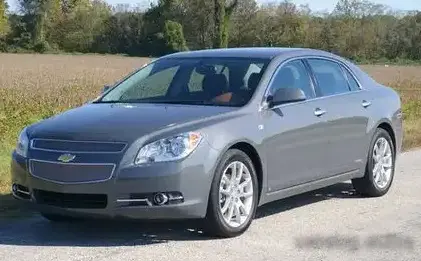
The Chevrolet Malibu VII 2.4i, produced for the 2009 and 2010 model years, represented the seventh generation of Chevrolet’s mid-size sedan. This variant, equipped with a 2.4-liter inline-four engine producing 169 horsepower (and 175 hp on E85 ethanol), paired with a four-speed automatic transmission, occupied a central position within the Malibu VII lineup. It aimed to provide a balance of fuel efficiency, comfortable driving dynamics, and affordability, appealing to a broad segment of family car buyers in the North American market. The seventh-generation Malibu was a significant departure from its predecessor, focusing on a more refined interior and improved ride quality, attempting to compete more effectively with established rivals like the Toyota Camry and Honda Accord.
Technical Specifications
| Brand | Chevrolet |
| Model | Malibu |
| Generation | Malibu VII |
| Type (Engine) | 2.4i (169/175 Hp) Ethanol Automatic |
| Start of production | 2009 |
| End of production | 2010 |
| Powertrain Architecture | Internal Combustion engine |
| Body type | Sedan |
| Seats | 5 |
| Doors | 4 |
| Fuel consumption (economy) – urban | 10.7 l/100 km (22 US mpg, 26.4 UK mpg, 9.3 km/l) |
| Fuel consumption (economy) – urban (Ethanol – E85) | 15.7 l/100 km |
| Fuel consumption (economy) – extra urban | 7.1 l/100 km (33.1 US mpg, 39.8 UK mpg, 14.1 km/l) |
| Fuel consumption (economy) – extra urban (Ethanol – E85) | 10.2 l/100 km |
| Fuel consumption (economy) – combined | 9 l/100 km (26.1 US mpg, 31.4 UK mpg, 11.1 km/l) |
| Fuel consumption (economy) – combined (Ethanol – E85) | 13.1 l/100 km |
| Fuel Type | Petrol / Ethanol – E85 |
| Weight-to-power ratio | 9.2 kg/Hp, 109.1 Hp/tonne |
| Weight-to-torque ratio | 7.1 kg/Nm, 140.1 Nm/tonne |
| Power | 169 Hp @ 6200 rpm |
| Power per litre | 70.9 Hp/l |
| Power (Ethanol – E85) | 175 Hp @ 6300 rpm |
| Power per litre (Ethanol – E85) | 73.4 Hp/l |
| Torque | 217 Nm @ 4500 rpm (160.05 lb.-ft. @ 4500 rpm) |
| Torque (Ethanol – E85) | 230 Nm @ 4700 rpm |
| Maximum engine speed | 6600/6750 rpm |
| Engine layout | Front, Transverse |
| Engine Model/Code | LE5 |
| Engine displacement | 2384 cm3 (145.48 cu. in.) |
| Number of cylinders | 4 |
| Engine configuration | Inline |
| Cylinder Bore | 88 mm (3.46 in.) |
| Piston Stroke | 98 mm (3.86 in.) |
| Compression ratio | 10.4:1 |
| Number of valves per cylinder | 4 |
| Fuel injection system | Multi-port manifold injection |
| Engine aspiration | Naturally aspirated engine |
| Valvetrain | DOHC, VVT |
| Engine oil capacity | 4.7 l (4.97 US qt | 4.14 UK qt) |
| Coolant | 7.1 l (7.5 US qt | 6.25 UK qt) |
| Kerb Weight | 1549 kg (3414.96 lbs.) |
| Trunk (boot) space – maximum | 427 l (15.08 cu. ft.) |
| Fuel tank capacity | 62 l (16.38 US gal | 13.64 UK gal) |
| Length | 4872 mm (191.81 in.) |
| Width | 1785 mm (70.28 in.) |
| Height | 1451 mm (57.13 in.) |
| Wheelbase | 2852 mm (112.28 in.) |
| Front track | 1514 mm (59.61 in.) |
| Rear (Back) track | 1524 mm (60 in.) |
| Minimum turning circle (turning diameter) | 12.3 m (40.35 ft.) |
| Drivetrain Architecture | The Internal combustion engine (ICE) drives the front wheels of the vehicle. |
| Drive wheel | Front wheel drive |
| Number of gears and type of gearbox | 4 gears, automatic transmission |
| Front suspension | Independent, type McPherson with coil spring and anti-roll bar |
| Rear suspension | Independent multi-link suspension |
| Front brakes | Ventilated discs |
| Rear brakes | Disc |
| Assisting systems | ABS (Anti-lock braking system) |
| Steering type | Steering rack and pinion |
| Power steering | Electric Steering |
| Tires size | 225/50 R17 |
| Wheel rims size | 17 |
Powertrain & Engine Architecture
The heart of the Malibu VII 2.4i was the LE5 2.4-liter inline-four cylinder engine. This engine featured a cast iron block with an aluminum cylinder head, incorporating dual overhead camshafts (DOHC) and variable valve timing (VVT) on both intake and exhaust valves. The LE5 utilized multi-port fuel injection, delivering fuel directly to each cylinder. The engine was designed to offer a balance between power and fuel economy, and its ability to run on E85 ethanol provided a slight power boost (to 175 hp) but at the cost of reduced fuel efficiency. The four-speed automatic transmission (4T45-E) was a conventional hydraulic automatic, known for its reliability but lacking the efficiency of more modern transmissions with additional gears. The transmission’s gear ratios were tuned for comfortable cruising and adequate acceleration, prioritizing smooth shifts over sporty performance.
Driving Characteristics
The 2.4i automatic Malibu offered a comfortable, if not particularly exciting, driving experience. Acceleration was adequate for everyday driving, with 0-60 mph times typically around 9-10 seconds. The four-speed automatic transmission, while smooth, lacked the responsiveness of manual transmissions or transmissions with more gears. The engine delivered its peak torque at 4500 rpm, meaning drivers often needed to depress the accelerator firmly to initiate quicker overtaking maneuvers. Compared to the available 2.0L turbocharged engine, the 2.4i offered less outright performance, but it provided a more linear power delivery and better fuel economy. The suspension was tuned for comfort, absorbing bumps and road imperfections well, but this came at the expense of sharp handling.
Equipment & Trim Levels
The 2.4i trim typically included standard features such as air conditioning, power windows and locks, a CD player with auxiliary input, and keyless entry. Higher trim levels, such as the LT and LTZ, added features like leather upholstery, a sunroof, upgraded audio systems, and alloy wheels. Interior upholstery was typically cloth on the base model, with leather options available on higher trims. The dashboard layout was straightforward and functional, with easy-to-read gauges and logically placed controls. Optional extras included a navigation system, remote start, and a premium sound system.
Chassis & Braking
The Malibu VII utilized a front-wheel-drive layout with an independent McPherson strut suspension in the front and an independent multi-link suspension in the rear. This suspension setup provided a comfortable ride and decent handling characteristics. Braking duties were handled by ventilated discs in the front and solid discs in the rear. Anti-lock brakes (ABS) were standard equipment. The steering was rack-and-pinion with electric power assist, offering light and easy steering feel. The standard tire size was 225/50R17, providing a good balance of grip and ride comfort.
Market Reception & Comparison
The 2009-2010 Chevrolet Malibu 2.4i was generally well-received by critics as a competent and comfortable family sedan. However, it often fell short of matching the refinement and driving dynamics of its key competitors, the Toyota Camry and Honda Accord. Fuel economy was considered average for its class, and the four-speed automatic transmission was seen as outdated compared to the five- and six-speed automatics offered by rivals. The E85 compatibility was a plus for some buyers, but the reduced fuel economy on E85 limited its appeal. Compared to the turbocharged 2.0L Malibu, the 2.4i offered lower performance but better reliability and lower maintenance costs.
Legacy
The LE5 2.4-liter engine and 4T45-E transmission proved to be relatively reliable powertrains. While not without their share of common issues (such as oil leaks and occasional transmission slippage), they generally held up well over time with proper maintenance. Today, the Malibu VII 2.4i can be found as an affordable used car option. Its simplicity and relatively low maintenance costs make it an attractive choice for budget-conscious buyers. However, potential buyers should be aware of the age-related issues common to older vehicles, such as worn suspension components and potential electrical problems. The Malibu VII, while not a standout performer, represents a solid and dependable mid-size sedan from Chevrolet.