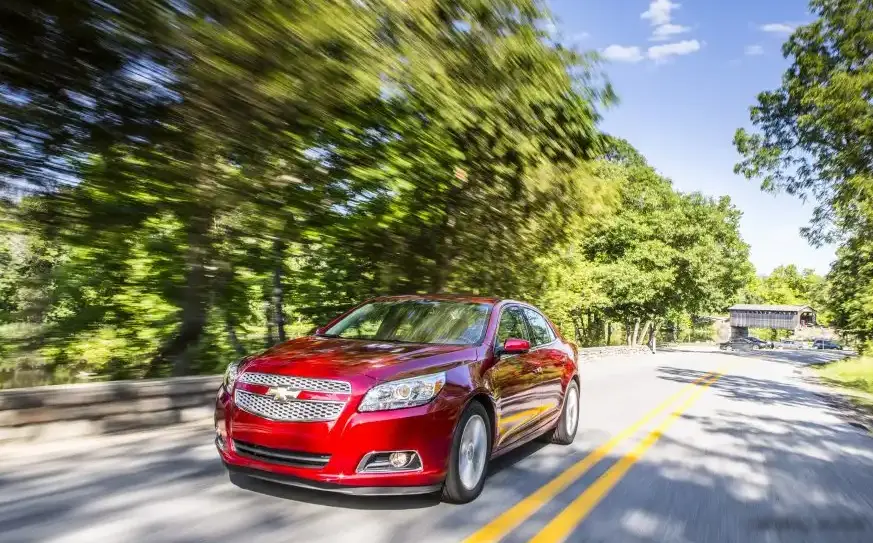
The Chevrolet Malibu VIII 2.0L (160 hp) was a mid-cycle offering within the eighth generation of Chevrolet’s popular Malibu sedan, produced from 2012 to 2014. Positioned as a fuel-efficient alternative to the gasoline-powered 2.4L and 2.8L turbocharged engines available in the North American market, this diesel variant aimed to appeal to buyers prioritizing economy and torque. It represented Chevrolet’s attempt to broaden the Malibu’s appeal with a European-sourced powertrain, though it was not a significant seller in the US. The Malibu VIII, built on the GM Epsilon II platform, sought to modernize the Malibu’s image with improved interior quality and a more refined driving experience compared to its predecessor.
Technical Specifications
| Brand | Chevrolet |
| Model | Malibu |
| Generation | Malibu VIII |
| Type (Engine) | 2.0 (160 Hp) |
| Start of production | 2012 |
| End of production | 2014 |
| Powertrain Architecture | Internal Combustion engine |
| Body type | Sedan |
| Seats | 5 |
| Doors | 4 |
| Fuel consumption (urban) | 6.6 l/100 km (35.6 US mpg) |
| Fuel consumption (extra urban) | 4.2 l/100 km (56 US mpg) |
| Fuel consumption (combined) | 5.1 l/100 km (46.1 US mpg) |
| CO2 emissions | 134 g/km |
| Fuel Type | Diesel |
| Acceleration 0 – 100 km/h | 9.7 sec |
| Acceleration 0 – 62 mph | 9.7 sec |
| Acceleration 0 – 60 mph | 9.2 sec |
| Maximum speed | 204 km/h (126.76 mph) |
| Emission standard | Euro 5 |
| Weight-to-power ratio | 10 kg/Hp |
| Weight-to-torque ratio | 4.6 kg/Nm |
| Power | 160 Hp @ 4000 rpm |
| Torque | 350 Nm @ 1750 rpm (258.15 lb.-ft. @ 1750 rpm) |
| Engine layout | Front, Transverse |
| Engine Model/Code | LBS |
| Engine displacement | 1956 cm3 (119.36 cu. in.) |
| Number of cylinders | 4 |
| Engine configuration | Inline |
| Cylinder Bore | 83 mm (3.27 in.) |
| Piston Stroke | 90.4 mm (3.56 in.) |
| Compression ratio | 16.5:1 |
| Number of valves per cylinder | 4 |
| Fuel injection system | Diesel Commonrail |
| Engine aspiration | Turbocharger, Intercooler |
| Valvetrain | DOHC |
| Engine oil capacity | 4.5 l (4.76 US qt | 3.96 UK qt) |
| Coolant | 9 l (9.51 US qt | 7.92 UK qt) |
| Kerb Weight | 1595 kg (3516.37 lbs.) |
| Max. weight | 2260 kg (4982.45 lbs.) |
| Max load | 665 kg (1466.07 lbs.) |
| Trunk (boot) space – minimum | 545 l (19.25 cu. ft.) |
| Fuel tank capacity | 73 l (19.28 US gal | 16.06 UK gal) |
| Max. roof load | 100 kg (220.46 lbs.) |
| Permitted trailer load with brakes (12%) | 1800 kg (3968.32 lbs.) |
| Permitted trailer load without brakes | 750 kg (1653.47 lbs.) |
| Length | 4865 mm (191.54 in.) |
| Width | 1854 mm (72.99 in.) |
| Height | 1462 mm (57.56 in.) |
| Wheelbase | 2738 mm (107.8 in.) |
| Front track | 1579 mm (62.17 in.) |
| Rear (Back) track | 1575 mm (62.01 in.) |
| Drag coefficient (Cd) | 0.30 |
| Minimum turning circle | 11.4 m (37.4 ft.) |
| Drivetrain Architecture | Front wheel drive |
| Number of gears | 6 |
| Type of gearbox | Manual transmission |
| Front suspension | Independent type McPherson |
| Rear suspension | Independent multi-link suspension |
| Front brakes | Disc |
| Assisting systems | ABS (Anti-lock braking system) |
| Steering type | Steering rack and pinion |
| Tires size | 225/55 R17 |
| Wheel rims size | 17 |
Powertrain & Engine Architecture
The Malibu VIII 2.0L diesel utilized a 1.956-liter, inline-four cylinder engine designated the LBS. This engine was sourced from a European supplier, specifically designed to meet stringent Euro 5 emissions standards. The LBS engine featured a common-rail direct injection system, delivering fuel at extremely high pressure for optimized combustion. A turbocharger with an intercooler was employed to boost power output and improve torque across a wider RPM range. The engine boasted a relatively high compression ratio of 16.5:1, contributing to its efficiency. The engine was paired with a six-speed manual transmission, prioritizing fuel economy over outright performance. The engine’s DOHC (Double Overhead Camshaft) valvetrain further enhanced its breathing and efficiency.
Driving Characteristics
The 160 hp and 350 Nm (258 lb-ft) of torque provided by the 2.0L diesel engine delivered a noticeably different driving experience compared to the gasoline-powered Malibu variants. While lacking the immediate responsiveness of the turbocharged gasoline engines, the diesel offered a broader, more usable torque curve. This translated to strong low-end and mid-range acceleration, making it well-suited for everyday driving and highway cruising. The six-speed manual transmission allowed drivers to maintain optimal engine RPMs for efficiency or power. However, the diesel engine was noticeably louder and exhibited more vibration than its gasoline counterparts. Acceleration from 0-60 mph took approximately 9.2 seconds, making it slower than the 2.4L and 2.8T models. The focus was clearly on fuel efficiency rather than sporty performance.
Equipment & Trim Levels
The 2.0L diesel Malibu typically came with a fairly standard equipment level, positioned as a value-oriented option. Standard features generally included air conditioning, power windows and locks, a basic audio system with auxiliary input, and steel wheels with wheel covers. Higher trim levels, such as the LT and LTZ, offered upgrades like alloy wheels, a more advanced audio system, Bluetooth connectivity, and a sunroof. Interior upholstery was typically cloth, with leather options available on higher trims. The diesel variant did not typically offer the same level of luxury features as the higher-end gasoline models.
Chassis & Braking
The Malibu VIII utilized an independent McPherson strut suspension in the front and an independent multi-link suspension in the rear, providing a comfortable and controlled ride. The front brakes were disc brakes, while the rear brakes were typically drum brakes on the base models, with disc brakes available on higher trims. ABS (Anti-lock Braking System) was standard. The chassis was tuned to prioritize ride comfort over sporty handling. The relatively modest power output of the 2.0L diesel engine meant that the braking system was generally adequate for the vehicle’s performance capabilities.
Market Reception & Comparison
The Chevrolet Malibu VIII 2.0L diesel received mixed reviews. Critics praised its fuel economy and torque, but noted its lack of refinement compared to gasoline engines and its relatively slow acceleration. Compared to the 2.4L gasoline engine, the diesel offered significantly better fuel economy but less overall performance. The 2.8L turbocharged engine provided substantially more power but at the expense of fuel efficiency. The diesel variant was primarily targeted at buyers who prioritized fuel economy and torque over outright performance and refinement. Its limited availability and relatively high price compared to the gasoline models contributed to its modest sales figures.
Legacy
The Chevrolet Malibu VIII 2.0L diesel represents a relatively uncommon variant of the eighth-generation Malibu. While not a commercial success in the US market, it demonstrated Chevrolet’s willingness to explore alternative powertrains to improve fuel efficiency. The LBS engine itself has a generally good reputation for reliability, although diesel engines typically require more diligent maintenance than gasoline engines. On the used car market, these models are relatively rare and often command a slightly higher price due to their fuel efficiency and unique powertrain. However, potential buyers should be aware of the higher maintenance costs associated with diesel engines and the potential for issues with the diesel particulate filter.