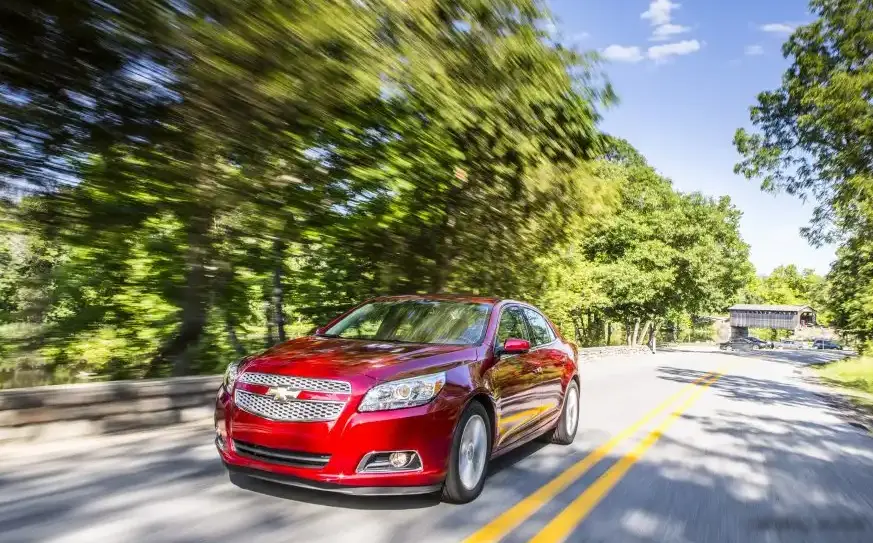
The Chevrolet Malibu VIII 2.0 (160 hp) Automatic, produced between 2012 and 2014, represented a significant step forward for Chevrolet’s mid-size sedan offering. Part of the eighth generation of the Malibu (introduced for the 2013 model year), this variant aimed to balance fuel efficiency with acceptable performance for the average commuter. It occupied a mid-range position within the Malibu VIII lineup, slotting below the more powerful 2.5-liter four-cylinder and above the base 1.6-liter EcoTec engine. This model was primarily targeted at the North American market, where fuel economy and comfortable cruising were key considerations for family sedan buyers.
Technical Specifications
| Brand | Chevrolet |
| Model | Malibu |
| Generation | Malibu VIII |
| Type (Engine) | 2.0 (160 Hp) Automatic |
| Start of production | 2012 |
| End of production | 2014 |
| Powertrain Architecture | Internal Combustion engine |
| Body type | Sedan |
| Seats | 5 |
| Doors | 4 |
| Fuel consumption (urban) | 6.8 l/100 km (34.6 US mpg) |
| Fuel consumption (extra urban) | 4.5 l/100 km (52.3 US mpg) |
| Fuel consumption (combined) | 5.3 l/100 km (44.4 US mpg) |
| CO2 emissions | 147 g/km |
| Fuel Type | Diesel |
| Acceleration 0 – 100 km/h | 9.9 sec |
| Acceleration 0 – 62 mph | 9.9 sec |
| Acceleration 0 – 60 mph | 9.4 sec |
| Maximum speed | 204 km/h (126.76 mph) |
| Emission standard | Euro 5 |
| Weight-to-power ratio | 10.2 kg/Hp |
| Weight-to-torque ratio | 4.7 kg/Nm |
| Power | 160 Hp @ 4000 rpm |
| Torque | 350 Nm @ 1750 rpm (258.15 lb.-ft. @ 1750 rpm) |
| Engine layout | Front, Transverse |
| Engine Model/Code | LBS |
| Engine displacement | 1956 cm3 (119.36 cu. in.) |
| Number of cylinders | 4 |
| Engine configuration | Inline |
| Cylinder Bore | 83 mm (3.27 in.) |
| Piston Stroke | 90.4 mm (3.56 in.) |
| Compression ratio | 16.5:1 |
| Number of valves per cylinder | 4 |
| Fuel injection system | Diesel Commonrail |
| Engine aspiration | Turbocharger, Intercooler |
| Valvetrain | DOHC |
| Engine oil capacity | 4.5 l (4.76 US qt | 3.96 UK qt) |
| Coolant | 9 l (9.51 US qt | 7.92 UK qt) |
| Kerb Weight | 1635 kg (3604.56 lbs.) |
| Max. weight | 2260 kg (4982.45 lbs.) |
| Max load | 625 kg (1377.89 lbs.) |
| Trunk (boot) space – minimum | 545 l (19.25 cu. ft.) |
| Fuel tank capacity | 73 l (19.28 US gal | 16.06 UK gal) |
| Max. roof load | 100 kg (220.46 lbs.) |
| Permitted trailer load with brakes (12%) | 1800 kg (3968.32 lbs.) |
| Permitted trailer load without brakes | 750 kg (1653.47 lbs.) |
| Length | 4865 mm (191.54 in.) |
| Width | 1854 mm (72.99 in.) |
| Height | 1462 mm (57.56 in.) |
| Wheelbase | 2738 mm (107.8 in.) |
| Front track | 1579 mm (62.17 in.) |
| Rear (Back) track | 1575 mm (62.01 in.) |
| Drag coefficient (Cd) | 0.30 |
| Minimum turning circle | 11.4 m (37.4 ft.) |
| Drivetrain Architecture | Front wheel drive |
| Number of gears | 6 |
| Gearbox type | Automatic transmission |
| Front suspension | Independent type McPherson |
| Rear suspension | Independent multi-link suspension |
| Front brakes | Ventilated discs |
| Rear brakes | Disc |
| Assisting systems | ABS (Anti-lock braking system) |
| Steering type | Steering rack and pinion |
| Tires size | 245/45 R18 |
| Wheel rims size | 18 |
Powertrain & Engine Architecture
The heart of the Malibu VIII 2.0 Automatic is the LBS engine, a 1.956-liter (119.36 cubic inches) turbocharged four-cylinder diesel engine. This engine utilizes a common rail direct injection system, delivering fuel directly into the combustion chamber at extremely high pressure for improved efficiency and reduced emissions. The engine features a double overhead camshaft (DOHC) valvetrain with four valves per cylinder, optimizing airflow for enhanced power output. The turbocharger, coupled with an intercooler, forces more air into the engine, boosting horsepower and torque. The engine’s 16.5:1 compression ratio is typical for a diesel engine, contributing to its thermal efficiency. This engine was sourced from a European supplier, reflecting GM’s strategy of leveraging global platforms and components.
The engine is paired with a six-speed automatic transmission. This transmission was chosen for its smooth shifting characteristics and its ability to optimize fuel economy. The automatic transmission features electronically controlled shifting, adapting to driving conditions and driver input. While not a performance-oriented transmission, it provided adequate responsiveness for everyday driving.
Driving Characteristics
The 2.0-liter diesel engine, producing 160 horsepower and 350 Nm (258 lb-ft) of torque, provided adequate, though not exhilarating, performance. Acceleration from 0 to 60 mph took approximately 9.4 seconds, making it competitive with other mid-size sedans in its class. The turbocharger provided a noticeable boost in power at lower RPMs, offering good low-end torque for merging onto highways and passing maneuvers. However, compared to the 2.5-liter gasoline engine option, the 2.0-liter diesel felt less responsive at higher speeds. The six-speed automatic transmission generally shifted smoothly, but could sometimes feel hesitant during quick acceleration. The focus was clearly on fuel efficiency and comfortable cruising rather than sporty handling.
Equipment & Trim Levels
The Malibu VIII 2.0 Automatic typically came standard with features such as air conditioning, power windows and locks, a basic audio system with USB connectivity, and stability control. Higher trim levels added features like leather upholstery, a premium audio system, a sunroof, and advanced safety features like blind-spot monitoring and rear cross-traffic alert. Interior upholstery was typically cloth on the base models, with leather options available on higher trims. The dashboard layout was straightforward and functional, prioritizing ease of use. Optional extras included a navigation system and a rear-seat entertainment system.
Chassis & Braking
The Malibu VIII utilized an independent McPherson strut suspension in the front and an independent multi-link suspension in the rear. This suspension setup provided a comfortable ride quality, absorbing bumps and imperfections in the road effectively. The front brakes were ventilated discs, providing good stopping power, while the rear brakes were solid discs. Anti-lock braking system (ABS) was standard, enhancing safety during emergency braking situations. The chassis was designed to provide a balance between ride comfort and handling stability.
Market Reception & Comparison
The Malibu VIII 2.0 Automatic received mixed reviews. Critics praised its fuel economy and comfortable ride, but some found the engine to be underpowered compared to its gasoline counterparts. The diesel engine offered significantly better fuel economy – around 44.4 US mpg combined – than the 2.5-liter gasoline engine, making it an attractive option for drivers who prioritized fuel savings. However, the diesel engine also came with a higher initial cost and potentially higher maintenance expenses. Compared to competitors like the Toyota Camry and Honda Accord, the Malibu VIII offered a more stylish design but lacked the same level of refinement and reliability.
Legacy
The LBS diesel engine, while not without its complexities, proved to be reasonably reliable when properly maintained. However, diesel engines generally require more diligent maintenance than gasoline engines, including regular oil changes and fuel filter replacements. In the used car market, the Malibu VIII 2.0 Automatic remains a relatively affordable option, appealing to buyers seeking a fuel-efficient and comfortable mid-size sedan. Its longevity and continued availability are a testament to its overall build quality and the enduring appeal of the Malibu nameplate. While not a collector’s item, it represents a significant chapter in Chevrolet’s history of offering fuel-efficient and practical transportation to the American public.