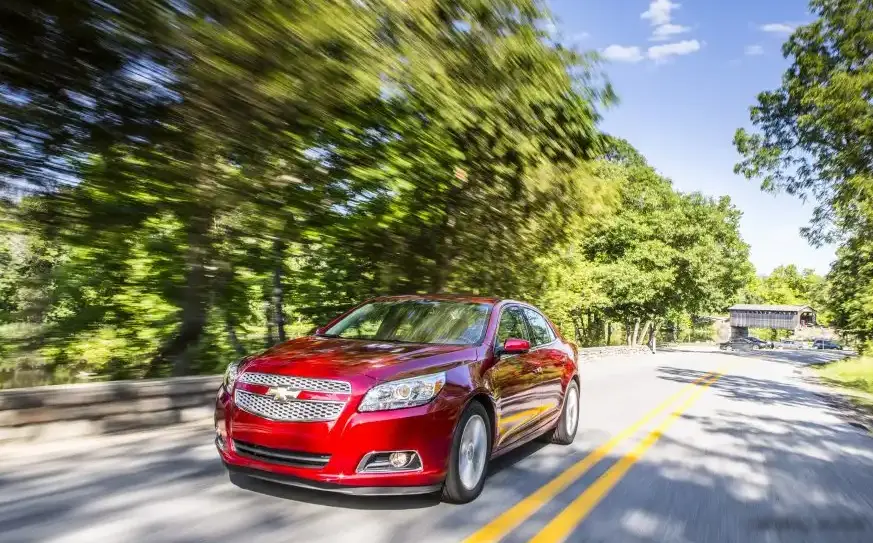
The Chevrolet Malibu VIII, produced from 2012 to 2014, represented a significant redesign for Chevrolet’s mid-size sedan. This generation, built on the GM Epsilon II platform, aimed to offer a more refined and fuel-efficient package compared to its predecessor. Within the Malibu VIII lineup, the 2.4-liter (167 horsepower) variant with a 6-speed automatic transmission occupied a central position, offering a balance between performance, fuel economy, and affordability. It served as the volume seller, appealing to a broad range of family car buyers.
Technical Specifications
| Brand | Chevrolet |
| Model | Malibu |
| Generation | Malibu VIII |
| Type (Engine) | 2.4 (167 Hp) |
| Start of production | 2012 |
| End of production | 2014 |
| Powertrain Architecture | Internal Combustion engine |
| Body type | Sedan |
| Seats | 5 |
| Doors | 4 |
| Fuel consumption (urban) | 10.8 l/100 km (21.8 US mpg) |
| Fuel consumption (extra urban) | 6 l/100 km (39.2 US mpg) |
| Fuel consumption (combined) | 7.8 l/100 km (30.2 US mpg) |
| CO2 emissions | 184 g/km |
| Fuel Type | Petrol (Gasoline) |
| Acceleration 0 – 100 km/h | 9.5 sec |
| Acceleration 0 – 62 mph | 9.5 sec |
| Acceleration 0 – 60 mph | 9 sec |
| Maximum speed | 204 km/h (126.76 mph) |
| Emission standard | Euro 5 |
| Weight-to-power ratio | 9.1 kg/Hp |
| Weight-to-torque ratio | 6.8 kg/Nm |
| Power | 167 Hp @ 5800 rpm |
| Torque | 225 Nm @ 4600 rpm (165.95 lb.-ft. @ 4600 rpm) |
| Engine layout | Front, Transverse |
| Engine Model/Code | LE9 |
| Engine displacement | 2384 cm3 (145.48 cu. in.) |
| Number of cylinders | 4 |
| Engine configuration | Inline |
| Cylinder Bore | 88 mm (3.46 in.) |
| Piston Stroke | 98 mm (3.86 in.) |
| Compression ratio | 10.4:1 |
| Number of valves per cylinder | 4 |
| Fuel injection system | Direct injection |
| Engine aspiration | Naturally aspirated engine |
| Valvetrain | DOHC |
| Engine oil capacity | 4.7 l (4.97 US qt | 4.14 UK qt) |
| Coolant | 9.6 l (10.14 US qt | 8.45 UK qt) |
| Kerb Weight | 1520 kg (3351.03 lbs.) |
| Max. weight | 2100 kg (4629.71 lbs.) |
| Max load | 580 kg (1278.68 lbs.) |
| Trunk (boot) space – minimum | 545 l (19.25 cu. ft.) |
| Fuel tank capacity | 73 l (19.28 US gal | 16.06 UK gal) |
| Max. roof load | 100 kg (220.46 lbs.) |
| Permitted trailer load with brakes (12%) | 1200 kg (2645.55 lbs.) |
| Permitted trailer load without brakes | 750 kg (1653.47 lbs.) |
| Length | 4865 mm (191.54 in.) |
| Width | 1854 mm (72.99 in.) |
| Height | 1462 mm (57.56 in.) |
| Wheelbase | 2738 mm (107.8 in.) |
| Front track | 1579 mm (62.17 in.) |
| Rear (Back) track | 1575 mm (62.01 in.) |
| Drag coefficient (Cd) | 0.30 |
| Minimum turning circle (turning diameter) | 11.4 m (37.4 ft.) |
| Drivetrain Architecture | The Internal combustion engine (ICE) drives the front wheels of the vehicle. |
| Drive wheel | Front wheel drive |
| Number of gears and type of gearbox | 6 gears, automatic transmission |
| Front suspension | Independent type McPherson |
| Rear suspension | Independent multi-link suspension |
| Front brakes | Ventilated discs |
| Rear brakes | Disc |
| Assisting systems | ABS (Anti-lock braking system) |
| Steering type | Steering rack and pinion |
| Tires size | 245/45 R18 |
| Wheel rims size | 18 |
Powertrain & Engine Architecture
The heart of this Malibu variant is the LE9 2.4-liter inline-four cylinder engine. This engine is a naturally aspirated powerplant featuring direct fuel injection, a dual overhead camshaft (DOHC) valvetrain with four valves per cylinder, and a compression ratio of 10.4:1. The direct injection system, a key feature, allowed for more precise fuel delivery, improving both power and fuel efficiency. The LE9 engine was a common sight in various GM vehicles of the era, known for its relative reliability and straightforward maintenance. Paired with the engine was a six-speed automatic transmission (6T40), offering smooth shifts and contributing to the car’s overall refinement. This transmission was designed to balance fuel economy with acceptable performance.
Driving Characteristics
The 2.4-liter Malibu with the automatic transmission delivered a comfortable and predictable driving experience. Acceleration from 0-60 mph took around 9 seconds, which was adequate for everyday driving but didn’t offer particularly sporty performance. The automatic transmission was tuned for fuel efficiency, meaning it would upshift quickly to maintain lower engine speeds. While this contributed to good gas mileage, it could sometimes feel hesitant during quick acceleration maneuvers. Compared to the available turbocharged 2.0-liter engine, the 2.4-liter lacked the same punch, but it offered a smoother, more linear power delivery. The 6-speed automatic’s gear ratios were optimized for cruising, making it a pleasant highway companion.
Equipment & Trim Levels
The 2.4-liter Malibu typically came standard with features like air conditioning, power windows and locks, a basic audio system with USB connectivity, and stability control. Higher trim levels, such as the LT and LTZ, added features like leather upholstery, a premium audio system, a sunroof, and advanced safety features like blind-spot monitoring. The interior design was generally considered modern for its time, with a focus on ergonomics and user-friendliness. Optional extras included a navigation system and remote start. The base trim focused on value, while the higher trims aimed for a more luxurious experience.
Chassis & Braking
The Malibu VIII utilized an independent McPherson strut suspension in the front and an independent multi-link suspension in the rear. This setup provided a comfortable ride quality, absorbing bumps and irregularities in the road effectively. The front brakes were ventilated discs, while the rear brakes were solid discs, providing adequate stopping power for the vehicle’s weight. Anti-lock brakes (ABS) were standard, enhancing safety during emergency braking situations. The steering was a rack-and-pinion system, offering precise and responsive handling. The suspension tuning was geared towards comfort rather than sporty handling, making it a suitable choice for daily commuting and family trips.
Market Reception & Comparison
The 2.4-liter Malibu was generally well-received by critics as a competent and practical mid-size sedan. It was praised for its comfortable ride, spacious interior, and good fuel economy. However, some reviewers noted that the engine lacked the excitement of some of its competitors, and the interior materials weren’t quite as premium as those found in some other vehicles in the segment. Compared to the turbocharged 2.0-liter Malibu, the 2.4-liter offered better fuel economy in real-world driving, but at the expense of performance. The 2.4-liter also proved to be more reliable than the 2.0-liter turbo, with fewer reported issues related to the turbocharger and associated components.
Legacy
The Chevrolet Malibu VIII 2.4-liter automatic has proven to be a relatively reliable vehicle in the used car market. The LE9 engine is known for its durability, and the 6T40 transmission, while not without its potential issues, is generally considered robust when properly maintained. Common maintenance items include regular oil changes, coolant flushes, and transmission fluid services. Today, these Malibus represent an affordable and practical option for buyers seeking a dependable mid-size sedan. While not a performance standout, its blend of comfort, fuel efficiency, and reliability has ensured its continued presence on roads across the United States.