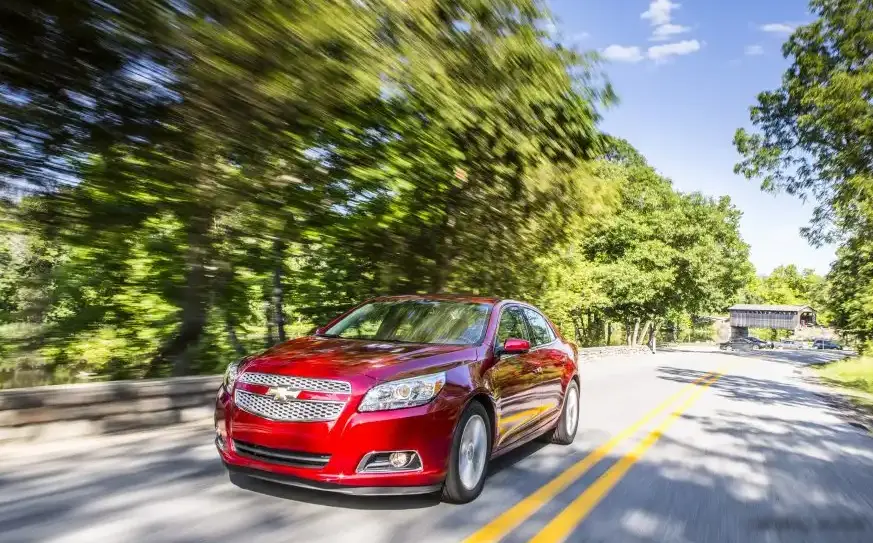
The Chevrolet Malibu VIII, produced from 2012 to 2014, represented a significant redesign for Chevrolet’s mid-size sedan. This generation, built on the GM Epsilon II platform, aimed to offer a more refined and fuel-efficient package compared to its predecessor. Among the engine options available, the 2.4-liter Ecotec engine paired with a six-speed automatic transmission was a popular choice, positioned as a balanced offering between affordability and performance. This variant served as the mainstay of the Malibu VIII lineup in the North American market, appealing to a broad range of buyers seeking a comfortable and practical family sedan.
Technical Specifications
| Brand | Chevrolet |
| Model | Malibu |
| Generation | Malibu VIII |
| Type (Engine) | 2.4 (182 Hp) Ecotec Automatic |
| Start of production | 2012 |
| End of production | 2014 |
| Powertrain Architecture | Internal Combustion engine |
| Body type | Sedan |
| Seats | 5 |
| Doors | 4 |
| Fuel consumption (urban) | 9.4 l/100 km (25 US mpg) |
| Fuel consumption (extra urban) | 6.3 l/100 km (37.3 US mpg) |
| Fuel Type | Petrol (Gasoline) |
| Weight-to-power ratio | 8.5 kg/Hp |
| Weight-to-torque ratio | 6.6 kg/Nm |
| Power | 182 Hp @ 6200 rpm |
| Power per litre | 76.3 Hp/l |
| Torque | 233 Nm @ 4900 rpm (171.85 lb.-ft. @ 4900 rpm) |
| Maximum engine speed | 7000 rpm |
| Engine layout | Front, Transverse |
| Engine Model/Code | LUK |
| Engine displacement | 2384 cm3 (145.48 cu. in.) |
| Number of cylinders | 4 |
| Engine configuration | Inline |
| Cylinder Bore | 88 mm (3.46 in.) |
| Piston Stroke | 98 mm (3.86 in.) |
| Compression ratio | 10.4:1 |
| Number of valves per cylinder | 4 |
| Fuel injection system | Direct injection |
| Engine aspiration | Naturally aspirated engine |
| Valvetrain | DOHC |
| Engine oil capacity | 4.7 l (4.97 US qt | 4.14 UK qt) |
| Coolant | 9.6 l (10.14 US qt | 8.45 UK qt) |
| Kerb Weight | 1539 kg (3392.91 lbs.) |
| Trunk (boot) space – minimum | 462 l (16.32 cu. ft.) |
| Fuel tank capacity | 70 l (18.49 US gal | 15.4 UK gal) |
| Length | 4865 mm (191.54 in.) |
| Width | 1854 mm (72.99 in.) |
| Height | 1462 mm (57.56 in.) |
| Wheelbase | 2738 mm (107.8 in.) |
| Front track | 1579 mm (62.17 in.) |
| Rear (Back) track | 1575 mm (62.01 in.) |
| Drag coefficient (Cd) | 0.29 |
| Minimum turning circle (turning diameter) | 11.4 m (37.4 ft.) |
| Drivetrain Architecture | The Internal combustion engine (ICE) drives the front wheels of the vehicle. |
| Drive wheel | Front wheel drive |
| Number of gears and type of gearbox | 6 gears, automatic transmission Hydra-Matic |
| Front suspension | Independent type McPherson |
| Rear suspension | Independent multi-link suspension |
| Front brakes | Ventilated discs |
| Rear brakes | Disc |
| Assisting systems | ABS (Anti-lock braking system) |
| Steering type | Steering rack and pinion |
| Tires size | 215/60 R16; 225/55 R17; 235/50 R18; 245/45 R19 |
| Wheel rims size | 7.5J x 16; 8.0J x 17; 8.0J x 18; 19J x 19 |
Powertrain & Engine Architecture
The heart of this Malibu variant was the 2.4-liter LE9 Ecotec inline-four cylinder engine. This engine, designated with the code LUK in some applications, featured direct fuel injection, a dual overhead camshaft (DOHC) valvetrain with four valves per cylinder, and variable valve timing (VVT). The direct injection system allowed for precise fuel delivery, contributing to improved fuel efficiency and reduced emissions. The Hydra-Matic 6T40 six-speed automatic transmission was the sole transmission option for this engine. This transmission was known for its smooth shifting and relatively quick response, although it wasn’t as sporty as some dual-clutch transmissions available in competing models. The engine’s design prioritized refinement and fuel economy over outright performance.
Driving Characteristics
The 182 horsepower and 233 lb-ft of torque provided by the 2.4-liter Ecotec and six-speed automatic combination resulted in adequate, but not exhilarating, performance. Acceleration from 0 to 60 mph typically took around 9-10 seconds. The automatic transmission was tuned for comfort, with gear changes being largely imperceptible during normal driving. Compared to the available turbocharged 2.0-liter engine, the 2.4-liter offered less peak power but a broader, more accessible torque curve. The 2.0L turbo was quicker, but the 2.4L felt more relaxed and predictable in everyday driving situations. The gear ratios were optimized for fuel efficiency, meaning the engine sometimes felt strained during aggressive acceleration or when climbing hills.
Equipment & Trim Levels
The 2.4-liter Malibu typically came standard with features like air conditioning, power windows and locks, a basic audio system, and steel wheels with wheel covers. Higher trim levels, such as the LS, LT, and LTZ, added features like alloy wheels, upgraded audio systems, a sunroof, leather upholstery, and advanced safety features like blind-spot monitoring and rear cross-traffic alert. The interior design was generally considered modern and comfortable, with a focus on ergonomics. Optional extras included a navigation system, a premium Bose audio system, and heated front seats.
Chassis & Braking
The Malibu VIII utilized an independent McPherson strut front suspension and an independent multi-link rear suspension. This setup provided a comfortable ride quality, absorbing bumps and imperfections in the road effectively. The front brakes were ventilated discs, while the rear brakes were solid discs. Anti-lock braking system (ABS) was standard. The steering was a rack-and-pinion system, providing reasonably precise steering feel. Stabilizer bars were included at both the front and rear to reduce body roll during cornering. The suspension tuning was geared towards comfort rather than sporty handling.
Market Reception & Comparison
The 2.4-liter Malibu received generally positive reviews from automotive critics. It was praised for its comfortable ride, spacious interior, and good fuel economy. However, some critics noted that the engine lacked the punch of some competitors, and the interior materials weren’t as premium as those found in some other mid-size sedans. Compared to the turbocharged 2.0-liter Malibu, the 2.4-liter offered better fuel economy in real-world driving conditions, but less overall performance. The 2.4L was often seen as the more sensible choice for families and commuters prioritizing practicality and affordability.
Legacy
The 2.4-liter Ecotec engine proved to be a reliable powertrain, with relatively few reported issues. The Hydra-Matic 6T40 transmission also demonstrated good durability. In the used car market, the Malibu VIII 2.4L Automatic remains a popular choice for buyers seeking an affordable and dependable mid-size sedan. Maintenance costs are generally reasonable, and parts availability is good. While it may not offer the same level of performance or luxury as some of its competitors, the Malibu VIII 2.4L provides a solid value proposition for those seeking a practical and reliable family car.