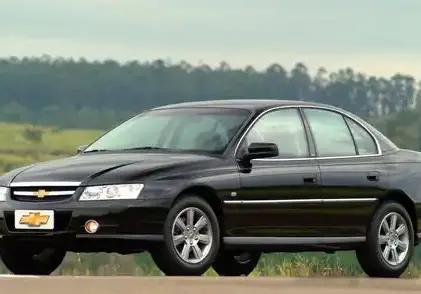
The Chevrolet Omega 4.1 i CD, produced between 1995 and 1998, represented a significant offering in the Brazilian executive car market. Positioned as a premium trim within the second-generation Omega (launched in 1994), the 4.1 i CD featured a larger displacement engine and more refined appointments than the base models. It was a direct competitor to the Ford Versailles and Volkswagen Passat, aiming to provide a comfortable and powerful rear-wheel-drive experience. The Omega, in general, was a crucial model for Chevrolet in South America, offering a domestically produced alternative to imported luxury sedans.
Technical Specifications
| Brand | Chevrolet |
| Model | Omega |
| Generation | Omega |
| Type (Engine) | 4.1 i CD (168 Hp) |
| Start of production | 1995 year |
| End of production | 1998 year |
| Powertrain Architecture | Internal Combustion engine |
| Body type | Sedan |
| Seats | 5 |
| Doors | 4 |
| Fuel consumption (economy) – combined | 11 l/100 km |
| Fuel consumption (economy) – combined (US mpg) | 21.4 US mpg |
| Fuel consumption (economy) – combined (UK mpg) | 25.7 UK mpg |
| Fuel consumption (economy) – combined (km/l) | 9.1 km/l |
| Fuel Type | Petrol (Gasoline) |
| Acceleration 0 – 100 km/h | 9.5 sec |
| Acceleration 0 – 62 mph | 9.5 sec |
| Acceleration 0 – 60 mph | 9 sec |
| Maximum speed | 215 km/h (133.59 mph) |
| Weight-to-power ratio | 9 kg/Hp, 111.6 Hp/tonne |
| Weight-to-torque ratio | 5.3 kg/Nm, 189.4 Nm/tonne |
| Power | 168 Hp @ 4500 rpm |
| Power per litre | 41 Hp/l |
| Torque | 285 Nm @ 3500 rpm (210.21 lb.-ft. @ 3500 rpm) |
| Engine layout | Front, Longitudinal |
| Engine Model/Code | Turbo-Thrift 250 |
| Engine displacement | 4093 cm3 (249.77 cu. in.) |
| Number of cylinders | 6 |
| Engine configuration | Inline |
| Cylinder Bore | 98.4 mm (3.87 in.) |
| Piston Stroke | 89.7 mm (3.53 in.) |
| Compression ratio | 8.5:1 |
| Number of valves per cylinder | 2 |
| Fuel injection system | Multi-port manifold injection |
| Engine aspiration | Naturally aspirated engine |
| Kerb Weight | 1505 kg (3317.96 lbs.) |
| Trunk (boot) space – minimum | 520 l (18.36 cu. ft.) |
| Trunk (boot) space – maximum | 870 l (30.72 cu. ft.) |
| Fuel tank capacity | 75 l (19.81 US gal | 16.5 UK gal) |
| Length | 4738 mm (186.54 in.) |
| Width | 1760 mm (69.29 in.) |
| Height | 1418 mm (55.83 in.) |
| Wheelbase | 2730 mm (107.48 in.) |
| Front track | 1460 mm (57.48 in.) |
| Rear (Back) track | 1478 mm (58.19 in.) |
| Drivetrain Architecture | The Internal combustion engine (ICE) drives the rear wheels of the vehicle. |
| Drive wheel | Rear wheel drive |
| Number of gears and type of gearbox | 5 gears, manual transmission |
| Front suspension | Coil spring |
| Rear suspension | Coil spring |
| Front brakes | Ventilated discs |
| Rear brakes | Disc |
| Assisting systems | ABS (Anti-lock braking system) |
| Steering type | Steering rack and pinion |
| Power steering | Hydraulic Steering |
| Tires size | 195/65 R15 V |
Powertrain & Engine Architecture
The heart of the Omega 4.1 i CD was the Chevrolet Turbo-Thrift 250 inline-six engine. Displacing 4.1 liters (4093 cc), this engine was a descendant of designs dating back to the 1960s, but had undergone significant revisions over the years. It featured a cast iron block and cylinder head, with a two-valve-per-cylinder configuration. Fuel delivery was handled by a multi-port fuel injection system, providing improved efficiency and responsiveness compared to earlier carbureted versions. The engine produced 168 horsepower at 4500 rpm and 285 Nm (210 lb-ft) of torque at 3500 rpm. The engine’s longitudinal mounting and rear-wheel-drive configuration were a deliberate choice, providing a more traditional driving experience favored by many in the executive car segment. The 5-speed manual transmission was the only transmission option available with this engine.
Driving Characteristics
The 4.1-liter engine provided a noticeable performance advantage over the smaller 2.0 and 2.2-liter engines offered in other Omega trims. Acceleration to 100 km/h (62 mph) took approximately 9.5 seconds, and the car could reach a top speed of 215 km/h (133.59 mph). While not a sports car, the Omega 4.1 i CD offered ample power for comfortable highway cruising and confident overtaking. The rear-wheel-drive layout contributed to balanced handling, although the car’s weight (1505 kg / 3317.96 lbs) was noticeable in corners. The 5-speed manual transmission allowed for precise control over the engine’s power band, and the gear ratios were well-suited for both city driving and high-speed travel.
Equipment & Trim Levels
The “CD” designation indicated a higher level of equipment. Standard features included power windows, power locks, air conditioning, and a basic audio system. The interior typically featured cloth upholstery, although leather was available as an option. The dashboard layout was functional and straightforward, with clearly marked gauges and controls. Optional extras included a sunroof, upgraded audio system, and alloy wheels. The Omega 4.1 i CD was positioned as a comfortable and well-equipped vehicle, appealing to buyers who prioritized luxury and refinement.
Chassis & Braking
The Omega’s chassis utilized a coil spring suspension system at both the front and rear. The front suspension employed independent coil springs, while the rear used a solid axle with coil springs. This setup provided a comfortable ride, although it wasn’t particularly sporty. Braking duties were handled by ventilated discs at the front and solid discs at the rear. An anti-lock braking system (ABS) was standard, enhancing safety and control during hard braking. The steering was a rack-and-pinion system with hydraulic power assistance, providing precise and responsive steering feel.
Market Reception & Comparison
The Omega 4.1 i CD was generally well-received by Brazilian automotive critics. It was praised for its powerful engine, comfortable ride, and spacious interior. However, some critics noted its relatively high fuel consumption (11 l/100 km / 21.4 US mpg) compared to smaller-engined rivals. Compared to the 2.0 and 2.2-liter Omega models, the 4.1 i CD offered significantly more performance but came at a higher price point. The Ford Versailles and Volkswagen Passat were its main competitors, offering similar levels of luxury and performance. The Omega’s rear-wheel-drive layout and robust engine were seen as advantages by some buyers, while others preferred the front-wheel-drive configuration of its rivals.
Legacy
The Chevrolet Omega 4.1 i CD remains a sought-after classic car in Brazil. The Turbo-Thrift 250 engine, while not known for being particularly fuel-efficient, is considered to be durable and reliable when properly maintained. Parts availability can be a challenge, but a dedicated community of Omega enthusiasts helps to keep these cars on the road. The 4.1 i CD represents a high point in Chevrolet’s Brazilian automotive history, offering a unique blend of American engineering and Brazilian manufacturing. Well-maintained examples command a premium in the used car market, appealing to collectors and enthusiasts who appreciate its classic styling and powerful engine.