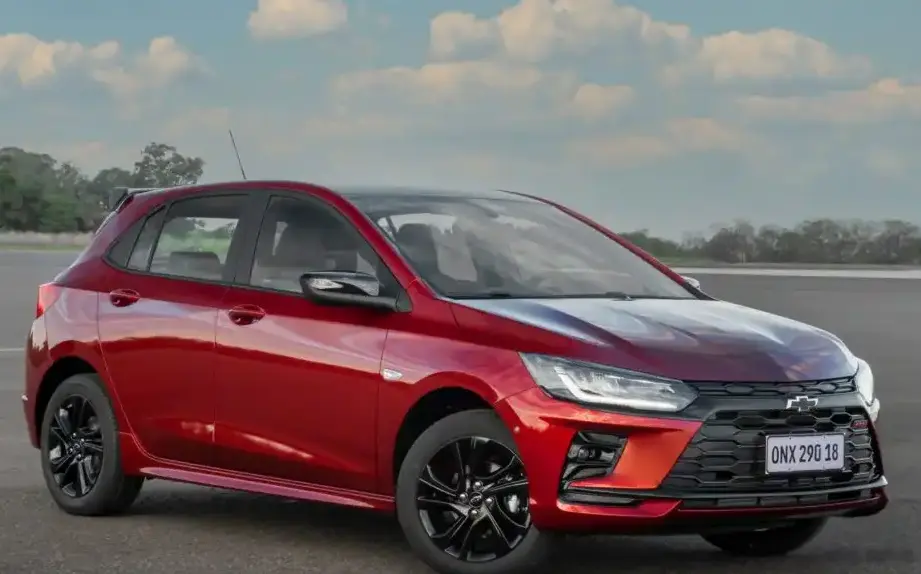
The Chevrolet Onix II, specifically the 1.0-liter (80/82 horsepower) Ethanol variant introduced with the 2025 facelift, represents an entry-level offering within the broader Onix lineup in the Brazilian market and other South American countries. Launched in July 2025, this model is designed to provide affordable and fuel-efficient transportation, capitalizing on Brazil’s widespread use of ethanol as a fuel source. Positioned as the base trim, it caters to buyers prioritizing economy and practicality over outright performance. The Onix II is built on General Motors’ GEM platform, a versatile architecture used for several small vehicles in emerging markets.
Technical Specifications
| Brand | Chevrolet |
| Model | Onix |
| Generation | Onix II (facelift 2025) |
| Type (Engine) | 1.0 (80/82 Hp) Ethanol |
| Start of production | July, 2025 |
| Powertrain Architecture | Internal Combustion engine |
| Body type | Hatchback |
| Seats | 5 |
| Doors | 5 |
| Fuel consumption (economy) – urban | 7.4 l/100 km (31.8 US mpg, 38.2 UK mpg, 13.5 km/l) |
| Fuel consumption (economy) – urban (Ethanol – E100) | 10.5 l/100 km |
| Fuel consumption (economy) – extra urban | 6.1 l/100 km (38.6 US mpg, 46.3 UK mpg, 16.4 km/l) |
| Fuel consumption (economy) – extra urban (Ethanol – E100) | 8.8 l/100 km |
| CO2 emissions | 109 g/km |
| CO2 emissions (Ethanol – E100) | 104 g/km |
| Fuel Type | Petrol / Ethanol – E100 |
| Acceleration 0 – 100 km/h | 12.9 sec |
| Acceleration 0 – 62 mph | 12.9 sec |
| Acceleration 0 – 60 mph | 12.3 sec |
| Maximum speed | 176 km/h (109.36 mph) |
| Weight-to-power ratio | 12.9 kg/Hp, 77.4 Hp/tonne |
| Weight-to-torque ratio | 10.3 kg/Nm, 96.7 Nm/tonne |
| Power | 80 Hp @ 6400 rpm |
| Power per litre | 80.1 Hp/l |
| Power (Ethanol – E100) | 82 Hp @ 6400 rpm |
| Power per litre (Ethanol – E100) | 82.1 Hp/l |
| Torque | 100 Nm @ 4000 rpm (73.76 lb.-ft. @ 4000 rpm) |
| Torque (Ethanol – E100) | 104 Nm @ 4000 rpm |
| Maximum engine speed | 6500 rpm |
| Engine layout | Front, Transverse |
| Engine displacement | 999 cm3 (60.96 cu. in.) |
| Number of cylinders | 3 |
| Engine configuration | Inline |
| Cylinder Bore | 74 mm (2.91 in.) |
| Piston Stroke | 77.49 mm (3.05 in.) |
| Compression ratio | 12.5:1 |
| Number of valves per cylinder | 4 |
| Fuel injection system | Multi-port manifold injection |
| Engine aspiration | Naturally aspirated engine |
| Valvetrain | DOHC |
| Engine oil capacity | 3.75 l (3.96 US qt, 3.3 UK qt) |
| Coolant | 5.4 l (5.71 US qt, 4.75 UK qt) |
| Kerb Weight | 1034-1049 kg (2279.58 – 2312.65 lbs.) |
| Max. weight | 1409-1424 kg (3106.31 – 3139.38 lbs.) |
| Max load | 375 kg (826.73 lbs.) |
| Trunk (boot) space – minimum | 303 l (10.7 cu. ft.) |
| Trunk (boot) space – maximum | 1151 l (40.65 cu. ft.) |
| Fuel tank capacity | 44 l (11.62 US gal, 9.68 UK gal) |
| Length | 4169 mm (164.13 in.) |
| Width | 1746 mm (68.74 in.) |
| Width including mirrors | 2044 mm (80.47 in.) |
| Height | 1473-1474 mm (57.99 – 58.03 in.) |
| Wheelbase | 2551 mm (100.43 in.) |
| Front track | 1500 mm (59.06 in.) |
| Rear (Back) track | 1504 mm (59.21 in.) |
| Front overhang | 888 mm (34.96 in.) |
| Rear overhang | 730 mm (28.74 in.) |
| Ride height (ground clearance) | 157 mm (6.18 in.) |
| Drag coefficient (Cd) | 0.346 |
| Minimum turning circle (turning diameter) | 10.4 m (34.12 ft.) |
| Approach angle | 14° |
| Drivetrain Architecture | The Internal combustion engine (ICE) drives the front wheels of the vehicle. |
| Drive wheel | Front wheel drive |
| Number of gears and type of gearbox | 6 gears, manual transmission |
| Front suspension | Independent, type McPherson with coil spring and anti-roll bar |
| Rear suspension | Semi-independent, coil spring, Torsion |
| Front brakes | Ventilated discs |
| Rear brakes | Drum |
| Assisting systems | ABS (Anti-lock braking system) |
| Steering type | Steering rack and pinion |
| Power steering | Electric Steering |
| Tires size | 185/65 R15 |
| Wheel rims size | 6J x 15 |
Powertrain & Engine Architecture
The heart of this Onix variant is the 1.0-liter inline-three cylinder engine, designated as a naturally aspirated unit. This engine is designed to run efficiently on both gasoline and ethanol (E100), a key feature for the Brazilian market. The engine utilizes a multi-port fuel injection system and a double overhead camshaft (DOHC) valvetrain, contributing to improved combustion efficiency. The 12.5:1 compression ratio is optimized for ethanol’s higher octane rating. When running on ethanol, the engine produces 82 horsepower, a slight increase over the 80 horsepower achieved with gasoline. The engine’s relatively small displacement and three-cylinder configuration contribute to its fuel efficiency, but also limit its overall power output. The engine is transversely mounted, driving the front wheels.
Driving Characteristics
The 1.0-liter engine paired with a manual transmission delivers modest performance. Acceleration from 0 to 100 km/h (0-62 mph) takes approximately 12.9 seconds. The power delivery is relatively linear, but the engine feels strained at higher RPMs. Compared to higher-trim Onix models equipped with 1.2-liter engines or turbocharged options, this variant offers significantly less power and acceleration. The gear ratios are tuned for fuel economy rather than performance, meaning the engine needs to be revved to maintain speed, especially when carrying passengers or cargo. The driving experience is best described as adequate for urban commuting and light highway driving.
Equipment & Trim Levels
As the entry-level trim, the 1.0-liter Onix typically comes with a basic set of features. Standard equipment generally includes air conditioning, power steering, electric front windows, and a basic audio system with Bluetooth connectivity. Safety features typically include dual front airbags and ABS brakes. Optional extras, depending on the specific package, could include power rear windows, a more advanced infotainment system with a touchscreen display, and alloy wheels. Interior upholstery is typically cloth, and the dashboard features a functional but basic design.
Chassis & Braking
The Onix II utilizes a McPherson strut suspension setup at the front and a semi-independent torsion beam suspension at the rear. This configuration provides a reasonable balance between ride comfort and handling. The front brakes are ventilated discs, offering adequate stopping power, while the rear brakes are drums, a cost-saving measure common in entry-level vehicles. The electric power steering provides light and easy steering, making it well-suited for city driving. The relatively lightweight construction of the Onix helps to offset the limited power output of the 1.0-liter engine.
Market Reception & Comparison
The 1.0-liter Onix has been well-received in the Brazilian market as an affordable and fuel-efficient option. Critics generally acknowledge its practicality and low running costs, but also point out its limited performance. Compared to other trims in the Onix lineup, such as the 1.2-liter versions, the 1.0-liter model offers lower fuel economy and slower acceleration. However, it also comes with a lower price tag, making it an attractive option for budget-conscious buyers. Its fuel economy is competitive with other small hatchbacks in the segment.
Legacy
The 1.0-liter engine in the Onix II has proven to be a relatively reliable powertrain. While not known for its longevity or high-performance capabilities, it is generally considered a durable and dependable engine when properly maintained. In the used car market, this variant represents a good value proposition for buyers seeking an affordable and economical vehicle. Its simplicity and relatively low maintenance costs contribute to its appeal. However, potential buyers should be aware of its limited power output and the potential for higher fuel consumption when running on ethanol compared to gasoline.